The clatter of dishes and the hum of conversation filled Bella’s. The upscale Italian restaurant where I’d been waiting tables for the past 8 months. My feet achd in the mandatory black heels that pinched my toes, and the starched collar of my uniform shirt scratched against my neck as I balanced three plates of linguini along my forearm.
The scent of garlic and basil clung to my skin and hair. A perfume I couldn’t wash away no matter how long I showered. Table 7 needs their check, Maya. Tina hissed as she brushed past me, her eyes darting nervously toward the entrance. “And whatever you do, don’t mess up table 12.
” I nodded, sliding the steaming plates in front of a group of businessmen who barely acknowledged my existence. That was fine by me. The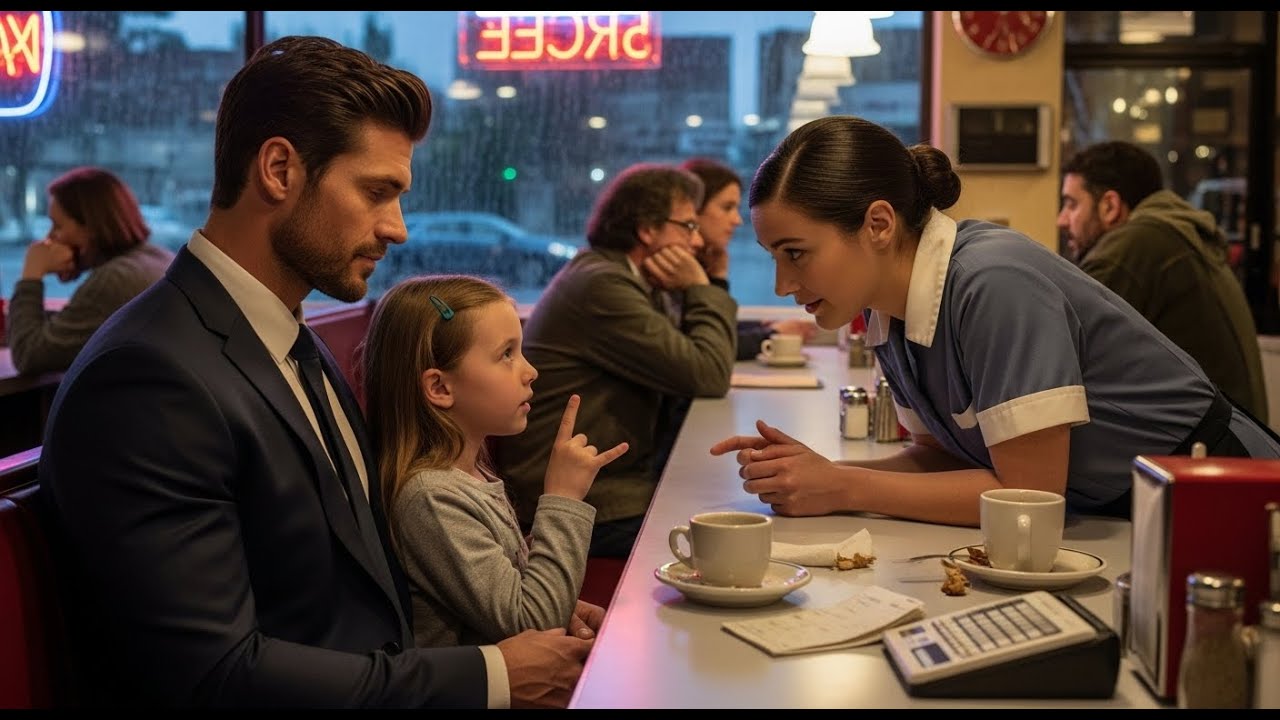 invisible ones survived in this world. I’d learned that lesson early. As I turned to grab table 7’s check, I felt it, the shift in atmosphere, like the air pressure dropping before a violent storm. The restaurant felt eerily quiet.
Conversations stuttering to a halt as the heavy oak doors swung open. Two men in impeccable black suits entered first, their eyes scanning the room with mechanical precision. I’d seen enough movies to recognize security personnel, but these weren’t the bumbling mall cops I’d grown up mocking with my friends.
These men moved with the calculated awareness of predators. And then he entered. Vincent Moretti didn’t look like what I’d expected from the whispered rumors that circulated among the staff. No flashy gold chains or goddy rings, just a tall, broad- shouldered man in his early 40s, wearing a charcoal gray suit that probably cost more than my yearly rent.
His dark hair was threaded with silver at the temples, and his olives skinned face bore the subtle marks of someone who had seen and caused violence. But it was his eyes that made my breath catch, dark as midnight and utterly unreadable, like looking into an abyss that might swallow you whole if you stared too long.
The matraee rushed forward, practically trembling as he greeted Moretti, who responded with a slight nod. They spoke in hushed tones before the staff began a flurried reconfiguration of table 12, the best table in the house, secluded in the corner with a view of both the restaurant and the street outside.
No one had told me who Moretti was when I started working at Bella’s, but I’d pieced it together from fragments of whispered conversations and the way even the owner cowered in his presence. Vincent Moretti controlled half the city’s underground operations, from gambling to protection rackets. The kind of man whose name was spoken in whispers, if at all.
But it wasn’t Moretti who caught and held my attention. It was the small figure partially hidden behind his imposing frame. A little girl, no more than 7 years old, with glossy dark hair falling in neat waves around a heart-shaped face. She wore a pressed navy blue dress with patent leather shoes, looking like she belonged on a private school brochure rather than trailing behind one of the most dangerous men in the city. “Sophia, come.
” Moretti said, his voice surprisingly soft as he guided the child to the table with a gentle hand on her shoulder. I watched as one of the guards pulled out her chair first, then Morettes. The little girl, Sophia, climbed into her seat with practiced grace, her back straight, chin up, a perfect miniature adult, but her eyes, so like her father’s in shape, but warmer in color, darted around the room with barely concealed apprehension. Maya.
My manager, Marco’s urgent whisper broke my trance. He appeared beside me, face pale with panic. You’re taking table 12. What? I nearly dropped the checkbook I was holding. Why me? That’s Roberto’s section. Roberto called in sick. Marco’s right eye twitched. A tell that he was lying. Just don’t screw this up. Okay. Mr. Moretti is a very important customer. Important.
The euphemism hung between us, heavy with unspoken meaning. Important meant dangerous. Important meant that if I spilled water on his designer suit, I might not live to regret it. Fine,” I muttered, smoothing down my apron with trembling hands. As I approached table 12, I forced my face into the practice smile that had earned me decent tips from businessmen who confused professional politeness for flirtation. “Good evening, and welcome to Bella’s,” I recited, my voice steadier than I felt.
“My name is Maya, and I’ll be your server tonight. May I start you with some drinks?” Mett’s gaze flicked up to my face, assessing me in one swift, comprehensive look that felt like being stripped bare. I resisted the urge to fidget under his scrutiny. Sparkling water for myself, he said, his voice a low, measured rumble.
And he glanced at his daughter, who stared down at her perfectly folded napkin. For the first time, I noticed how the other servers gave their table a wide birth, how the nearby diners kept their eyes deliberately averted. Even Marco was hovering near the kitchen door, watching our interaction like someone might watch a ticking bomb.
“Does your daughter want something special to drink?” I asked, surprising myself with my boldness. “We have Italian sodas in different flavors.” “The raspberry is my favorite.” “Mett’s expression remained impassive,” but something flickered in his eyes. “Surprise, perhaps.” “Sophia doesn’t speak,” he stated flatly.
The little girl’s shoulders hunched slightly at her father’s words, and I saw her small fingers clutched the edge of the tablecloth. “That’s okay,” I said, addressing Sophia directly, bending slightly to meet her downturned gaze. “You don’t need to speak to have preferences. I didn’t expect what happened next.” Without thinking, my hands moved in the familiar patterns I hadn’t used in years. Not since my cousin Ellie moved away.
Would you like raspberry, strawberry, or orange? I signed, the movements coming back to me with surprising ease. Sophia’s head snapped up, her dark eyes widening in shock. For a heartbeat, the restaurant seemed to fade away, and it was just us, a little girl and a waitress, connected by unexpected understanding. Then her small hands lifted, fingers moving tentatively. “Strawberry, please.
” The smile that bloomed across her face was like watching the sun break through storm clouds. I smiled back. warmth spreading through my chest. “She’d like the strawberry,” I told Moretti, straightening up. He stared at me with an intensity that made my skin prickle, his expression unreadable.
One of his bodyguards shifted position, hand drifting toward his jacket in a motion that made my stomach clench. “You know sign language,” Moretti said. “A statement rather than a question.” I nodded, suddenly aware that I might have overstepped. My cousin was deaf. We grew up together. For several excruciating seconds, he continued to stare at me.
Then, just as I was considering the quickest route to the exit, his expression softened fractionally. Sparkling water and a strawberry Italian soda, he confirmed. And we’ll need a few minutes with the menu. Of course. I backed away from the table, exhaling the breath I hadn’t realized I was holding. As I headed toward the drink station, I felt Morett’s gaze following me, heavy as a physical touch between my shoulder blades. I returned with their drinks, setting Sophia’s soda down with an extra flourish that made her eyes light up.
Thank you, she signed discreetly. You’re welcome, I replied, aware of Moretti watching our exchange with hawkish intensity. Throughout dinner, I found myself drawn back to their table more often than necessary.
Each time I would sign something small to Sophia, a question about her food, a comment about the dessert options and watch her face illuminate with the joy of being understood. It was clear that few people bothered to communicate with her directly. Most addressed her father, speaking about her as if she weren’t present.
By the time dessert arrived, tiramisu foretti and gelato for Sophia, I had learned that she loved dolphins, hated broccoli, and was learning to play the piano. simple things, childhood things that seemed in congruous with the daughter of a man who made people tremble with a glance. As they prepared to leave, I brought their check, placing it discreetly beside Moretti’s empty espresso cup.
He withdrew a sleek leather wallet, sliding a black credit card into the folder without even glancing at the total. “Daddy, can Ma be my friend?” Sophia signed, her movement so quick and excited that I almost missed them. My heart stuttered as Moretti’s eyes snapped to mine, his expression suddenly guarded. “I think Maya is busy with her job, Sophia,” he replied, his voice gentle but firm. “Thank her for the nice service.” Sophia’s face fell and my heart squeezed painfully in my chest.
“Before I could stop myself, I signed to her. I’m here every Tuesday through Saturday. Come visit anytime.” Her answering smile was radiant, but it was Moretti’s reaction that sent a chill down my spine. A calculating look that lingered too long, assessing something I couldn’t name.
As they left, Moretti paused beside me close enough that I could smell his expensive cologne, notes of cedar and something darker, more primal. Tuesday through Saturday, he repeated, his voice so low only I could hear it, not a question, but a confirmation. Then he was gone. Sophia’s small hand in his bodyguards flanking them as they moved through the restaurant like royalty through a crowd of commoners.
I exhaled slowly, my hands trembling as I collected their dishes. It wasn’t until I was clearing the table that I saw it. The tip. Five crisp $100 bills folded neatly under the salt shaker. “Holy shit,” Tina whispered, appearing beside me like a ghost. “What did you do to earn that?” I stared at the money. a strange unease settling over me. I just talked to his daughter.
You must be the only person in this city crazy enough to talk to Moretti’s kid. She shook her head. Everyone knows to stay away from them. Why? I asked, pocketing the bills before Marco could see and try to make me share. Tina’s eyes widened.
Because anyone who gets close to Vincent Moretti either ends up working for him, owing him, or six feet under. There’s no in between. I should have heeded her warning. I should have called in sick the next evening, asked for different tables, done anything to avoid being pulled into their orbit. But when I arrived at work the following day, “Marco was waiting by the time card machine, his face a mask of nervous tension.” “Mr.
Moretti has requested you personally,” he said, fingers worrying at his tie. “He’s bringing his daughter for dinner again. Table 12, 7:00.” I felt a fluttering in my stomach. Part excitement at seeing Sophia again, part dread at being singled out by her father. “Okay,” I said, trying to sound casual. “No problem.” But as I tied my apron and prepared for my shift, I couldn’t shake the feeling that I had inadvertently stepped into something much larger and more dangerous than I could comprehend.
All because I’d made the fatal mistake of noticing a little girl that everyone else tried their best to ignore. 7:00 arrived with the inevitability of an incoming tide. I found myself hovering near the entrance, adjusting and readjusting table settings that were already perfect. When the heavy oak doors swung open at precisely 7:02, my heart leaped into my throat. This time, Moretti brought three guards instead of two.
They entered in the same formation, scanning the restaurant with practiced efficiency before Moretti himself appeared. Sophia trailed behind him, wearing a burgundy dress with a matching headband, her small hand clutching a worn stuffed dolphin, a detail that made something twist in my chest.
Despite being the daughter of one of the most feared men in the city, she was still just a child clinging to a beloved toy, our eyes met across the restaurant, and her face lit up. She tugged on her father’s sleeve, signing rapidly. Even from a distance, I could read her excitement. Maya is here. Moretti’s gaze found me and a slight smile curved his lips, the kind that didn’t reach his eyes.
He nodded in acknowledgement as Marco led them to their table. I took a deep breath, smoothed my apron, and approached. Good evening, Mr. Moretti. I turned to Sophia with a genuine smile. Hello again. I like your dolphin. Her answering grin was dazzling. His name is Blue. Daddy got him for me at the aquarium.
Sophia has been looking forward to seeing you again,” Moretti said, his voice a controlled rumble that sent involuntary shivers down my spine. “It seems you made quite an impression.” “I shifted under his scrutiny, acutely aware that his guards were watching me with the cold calculation of men assessing a potential threat.” “She’s easy to talk to,” I replied, trying to keep my voice steady.
“What can I get you both to drink tonight?” “The same as yesterday for Sophia. I’ll have a glass of the bo. As I turned to fetch their drinks, I heard Sophia’s hands moving in rapid signs. I glanced back to see Moretti shaking his head. Not tonight, Piccola, he said gently. Maybe another time. Sophia’s face fell and she clutched her dolphin tighter. When I returned with their drinks, curiosity got the better of me.
“What did you ask your father?” I signed to Sophia while setting down her strawberry soda. She glanced hesitantly at Moretti, who gave an almost imperceptible nod of permission. “I wanted to know if you could sit with us for a little while,” she signed, her small fingers moving shyly. “I don’t have many friends who know how to talk to me.
” My heart constricted at her admission. “Before I could respond,” Moretti spoke. “Perhaps Miz,” he paused, eyes flicking to my name tag, though I was certain he already knew my name. Maya could join us for a few minutes after her shift ends. It wasn’t a question or even a suggestion. It was a statement of fact, the kind that brokered no argument. My mouth went dry as I realized the implied command. Refusing didn’t feel like an option.
“I finish at 9,” I said, the words tumbling out before I could consider their implications. Moretti nodded, satisfied. “Well be here until 9:30. Sophia usually has dessert around 9:00.” He lifted his wine glass in a gesture that was somehow both a dismissal and a promise. The next two hours passed in a blur of orders, plates, and forced smiles.
I was hyper aware of Moretti watching me as I worked, his dark eyes tracking my movements whenever I passed near their table. By the time my shift ended, my nerves were stretched taut as piano wire. I changed out of my server uniform in the employee bathroom, splashing cold water on my face and staring at my reflection in the spotty mirror.
Dark circles shadowed my eyes, a testament to too many late nights picking up extra shifts to make rent. I’d pulled my chestnut hair into a neat ponytail for work, but now I let it fall loose around my shoulders. A small act of reclaiming myself from my waitress persona. You don’t have to do this, I whispered to my reflection. You could just leave. But even as the thought formed, I knew I wouldn’t.
Something about Sophia’s loneliness called to me, resonating with memories of my own isolated childhood. When I emerged from the back room, Marco intercepted me. His face creased with worry. Maya, what are you doing? Going to their table out of uniform. Are you crazy? He asked me to join them, I said, keeping my voice low.
What was I supposed to say? No thanks. I’m busy. Marco ran a hand through his thinning hair. Listen to me. Vincent Moretti doesn’t make casual invitations. If he’s interested in you, there’s a reason. A chill skittered down my spine. He’s not interested in me. He just wants someone who can talk to his daughter.
And you don’t find that strange? That of all the people in this city who know sign language, you’re the one serving his table twice in a row? Marco’s eyes darted nervously toward Moretti’s table. Just be careful. Men like him don’t believe in coincidences. His words followed me like a shadow. As I made my way across the now quieter restaurant, Moretti saw me coming, his conversation with one of his guards cutting off abruptly.
He stood as I approached, a gesture of oldworld courtesy that seemed inongruous with what I knew of him. “Maya,” he said, as though testing the sound of my name on his tongue. “Please join us. Sophia has been counting the minutes.” The little girl was practically bouncing in her seat, her eyes bright with excitement.
“You came,” she signed as though she had half expected me to disappear. “Of course I did,” I signed back, sliding into the chair one of the guards had pulled out for me. “I promised, didn’t I?” Sophia beamed, then launched into rapid signing, telling me about her dolphin, her piano lessons, and a book she was reading about sea creatures.
I nodded, responding when appropriate, acutely aware of Moretti observing our exchange with unwavering attention. “You sign very well,” he remarked during a pause in Sophia’s animated storytelling. “You mentioned a cousin?” “Yes, Ellie. We grew up together until I was 12. She was deaf from birth.” I hesitated, then added, “She moved away when her parents divorced.
” I kept practicing because, well, it felt like keeping a part of her with me. Something flickered in Morett’s eyes, a momentary softening that transformed his face, making him look almost approachable. Loyalty, an admirable quality, a server, not one I recognized from my shift, appeared with three desserts.
Tiramisu for Moretti, gelato for Sophia, and a slice of chocolate cake that was placed in front of me. I took the liberty of ordering for you, Moretti said, noting my surprise. Sophia mentioned you told her chocolate was your favorite. I glanced at Sophia, who nodded enthusiastically. You said it yesterday when you showed me the dessert menu, she signed.
Thank you, I murmured, unsettled by the realization that they had discussed me. Remembered details about me I barely recalled sharing. As we ate our desserts, Moretti asked questions, casual inquiries about my life that felt anything but casual under his intense scrutiny.
Where I lived, a cramped studio apartment in a neighborhood that made his jaw tighten almost imperceptibly. How long I’d worked at Bella’s, where I’d grown up? I answered truthfully but vaguely, instinct telling me to reveal as little as possible. “And your family?” he asked, his tone conversational but his eyes sharp. It’s just me, I said, the familiar ache of aloneeness twisting in my chest. My parents died in a car accident when I was 17. I’ve been on my own since then.
Something shifted in Moretti’s expression. A look I couldn’t decipher. Before he could respond, Sophia tugged on his sleeve. Can Ma come to my piano recital next week? She signed. Her movements eager and hopeful. Please, Daddy. Moretti’s gaze moved between his daughter’s pleading face and my startled one. A slow smile spread across his features, the first genuine one I’d seen from him.
“Would you like to come, Maya?” he asked, his voice soft, but laden with unspoken implications. “It would mean the world to Sophia.” I looked at the little girl, her dark eyes wide with hope, and found myself nodding before I could consider the consequences. I’d love to. When is it? Thursday evening at 7, the Westridge Academy of Music. Moretti reached into his jacket pocket and withdrew a business card.
He flipped it over and wrote something on the back before sliding it across the table to me. My personal number in case you have any questions. The card was heavy cream colored card stock with just his name and a phone number embossed in elegant black script.
The handwritten number on the back, I suspected, was one few people possessed. My driver will collect you at 6:30,” he continued as though my acceptance was a foregone conclusion. “Text your address to that number. I can get there on my own,” I said, a feeble attempt to maintain some control over the situation. Morett’s smile didn’t waver, but something hardened in his eyes. “The academy is in Westridge Heights.
It’s not easily accessible by public transportation, and the parking is complicated.” His tone made it clear this wasn’t a point for negotiation. I swallowed my objection, nodding instead. 6:30. Then Sophia clapped her hands together in delight, then launched into a detailed explanation of the pieces she would be playing as she signed animatedly. One of Morett’s guards bent down to whisper something in his ear.
His expression darkened momentarily before smoothing into impassivity. Unfortunately, we must cut this evening short, he announced, placing his napkin beside his halfeaten tiramisu. Sophia, it’s time to go. The little girl’s face crumpled in disappointment, but she didn’t protest, immediately, sliding from her chair and gathering her dolphin.
The swiftness of her compliance spoke of strict discipline. “I’ll see you on Thursday,” I assured her, signing the words as I spoke them, she brightened slightly, signing back. Promise. Promise, I replied, making the sign with deliberate emphasis. Moretti watched our exchange with an expression I couldn’t read.
Then he stood, buttoning his jacket with the fluid grace of a man accustomed to being observed until Thursday. Maya, as they left, flanked by their protective detail, I remained seated, staring at the business card between my fingers. The implications of what I’d agreed to washed over me in a cold wave of realization.
I was about to willingly enter Vincent Moretti’s world, a world I knew only through whispered rumors and news reports carefully worded to avoid liel suits. You okay? Tina appeared beside me, her eyes wide as she stared at the retreating figures of Moretti and his entourage. What did he want? I slipped the card into my pocket.
He invited me to his daughter’s piano recital. Tina’s face drained of color. Maya, do you have any idea what you’re getting yourself into? Men like Moretti don’t just invite random waitresses to family events. I’m not random, I said, the words sounding hollow even to my own ears. I can talk to Sophia.
That’s all this is. No, Tina said, shaking her head slowly. That’s not all this is. Nothing is ever that simple with people like him. She leaned closer, lowering her voice. There’s a reason he brought her here two nights in a row. A reason he requested you specifically. Don’t be naive.
I wanted to dismiss her concerns, but Marco’s earlier warning echoed in my mind. Men like him don’t believe in coincidences. I gathered my purse, suddenly eager to escape the restaurant, and the weight of decisions I wasn’t sure I fully understood. Outside, the night air was cool against my skin, carrying the promise of approaching autumn.
I wrapped my thin jacket tighter around myself and started the familiar walk to the bus stop, my mind whirling with conflicting thoughts. Part of me wanted to throw away Moretti’s card, to call in sick on Thursday and every day after, to retreat into the relative safety of anonymity.
But another part, a part I was almost afraid to acknowledge, was intrigued, drawn to the mystery of the silent little girl and her dangerous father. I was so absorbed in my thoughts that I didn’t notice the black SUV with tinted windows until it pulled alongside me, keeping pace with my steps. My heart lurched as the rear window rolled down, revealing one of Moretti’s guards, the older one with the scar bisecting his right eyebrow. “Miss Carter,” he said, his voice gruff, but not unkind. “Mr.
Moretti thought you might appreciate a ride home. The buses run infrequently at this hour. I stopped walking, my pulse pounding in my ears. How did they know my last name? I’d only ever introduced myself as Maya. And how did they know I took the bus? That’s not necessary, I said, trying to keep the tremor from my voice. I’m fine, really.
The guard’s expression remained neutral. It’s no trouble. Mr. Moretti insists on ensuring you arrive home safely. The emphasis he placed on insists made it clear this wasn’t a request. I hesitated, weighing my options. Making a scene seemed unwise, running even more so. All right, I conceded, moving toward the SUV as the door swung open.
As I settled into the leather seat, a chilling thought occurred to me. This was how it happened. the slow, inexurable process of being drawn into Vincent Morett’s orbit. Not with threats or violence, but with kindness that wasn’t really kindness. Offers that weren’t really offers.
The SUV pulled away from the curb, carrying me into a future that seemed suddenly, frighteningly uncertain. And somewhere in the back of my mind, I heard Tina’s voice again. Anyone who gets close to Vincent Moretti either ends up working for him, owing him, or 6 feet under. There’s no in between. The days until Thursday stretched and compressed like an accordion, sometimes crawling by with excruciating slowness. Other times rushing forward with alarming speed.
I found myself watching the door whenever I worked, half expecting to see Morett’s imposing figure. But he didn’t return to the restaurant. What he did do, however, was ensure his presence was felt in other ways. The morning after our dinner, a package arrived at my apartment.
A building with no door man and unreliable mail delivery. Yet somehow, a pristine white box tied with silver ribbon appeared outside my door before I left for my morning shift. Inside was a children’s book about a dolphin and a girl who could speak to animals with a small note card bearing only the words Sophia thought you might enjoy this VM.
How he knew my address when I hadn’t yet texted it to him sent a chill through me that no amount of coffee could dispel. The next day it was a delivery of groceries. Not random items, but precisely what I needed, including the brand of coffee I preferred and the type of bread I always bought.
The delivery person shrugged when I asked who had sent them, handing me a note that read simply, “You work too hard to waste time on errands. VM.” By Wednesday, I was jumping at shadows, convinced I was being watched. The rational part of my brain said I should be terrified. Should report this to the police. But what would I say? That a powerful man was sending me children’s books and groceries? That his driver had offered me a ride home? They would laugh me out of the station if they weren’t already on Morett’s payroll.
Besides, a small traitorous part of me was intrigued. No one had ever paid this much attention to me before. No one had ever noticed the little details of my life, the small struggles I navigated daily. It was unsettling, yes, but also strangely compelling. When Thursday evening arrived, I found myself standing before my closet, agonizing over what to wear to a children’s piano recital.
My wardrobe consisted primarily of practical, forgettable clothing, perfect for someone trying to blend into the background. Nothing appropriate for Westridge Heights, one of the wealthiest neighborhoods in the city. I finally settled on a simple navy blue dress, the one I’d worn to my final foster care hearing when I aged out of the system.
It was the most formal thing I owned, though the hem was fraying slightly and the fabric had faded from too many washes. At precisely 6:28 p.m., my phone buzzed with a text from an unknown number. Car waiting downstairs. Heart pounding, I grabbed my purse and made my way down the three flights of stairs to the street.
The same black SUV from Monday night idled at the curb, gleaming like a panther against the dingy backdrop of my neighborhood. The same guard with the scarred eyebrow stood beside it, opening the rear door as I approached. “Miss Carter,” he greeted me with a respectful nod. “Mr. Moretti sends his apologies. He’s meeting us at the academy traffic,” he added, as though that explained everything. The interior of the SUV smelled of leather and subtle cologne.
As we pulled away from my apartment building, I noticed a small gift bag on the seat beside me. Mr. Mr. Moretti thought you might want this for tonight, the guard explained, noticing my confusion. Inside the bag was a delicate silver bracelet with a small dolphin charm, elegant, but not ostentatious. My throat tightened at the gesture, thoughtful, but presumptuous.
Still, I slipped it onto my wrist, the cool metal a constant reminder of whose world I was entering. The Westridge Academy of Music was housed in a renovated historical mansion, all marble columns and manicured gardens. As we pulled through the rot iron gates, I felt increasingly out of place. Parents in designer clothing escorted children carrying instrument cases across the grand entrance.
Luxury vehicles lined the circular driveway, attended by valet in crisp uniforms. The driver parked in a reserved space near the entrance. Before I could reach for the door handle, it swung open, revealing Vincent Moretti in a charcoal suit that made him look both sophisticated and dangerous.
His dark eyes swept over me, taking in the navy dress, the worn purse, the bracelet now adorning my wrist. “Maya,” he said, offering his hand to help me from the car. “You look lovely.” “Thank you for the bracelet,” I said, accutely aware of the warmth of his palm against mine. “You didn’t have to do that. Sophia picked it out, he replied, though something in his expression suggested there was more to the story. She’ll be delighted you’re wearing it.
He didn’t release my hand as he led me up the marble steps, his bodyguards flanking us discreetly. I was intensely conscious of the stairs following our progress, curious, wary, some openly hostile. Clearly, Moretti was known here, his reputation preceding him, even in this rarified environment. “Where is Sophia?” I asked, trying to ignore the whispers that trailed in our wake. Backstage with the other performers. We’ll see her afterward.
He guided me through ornate double doors into a concert hall with soaring ceilings and gleaming wood paneling. I’ve reserved seats in the front row. As we moved down the center aisle, people shifted in their seats, gazes darting away when Moretti looked in their direction.
No one spoke to him directly, though several men nodded in acknowledgement. Their wives clutched designer purses closer, as though proximity to him might taint them somehow. We settled into plush velvet seats just as the lights dimmed. A distinguished looking woman in her 60s took the stage, welcoming parents and introducing the evening’s program.
I scanned the printed program Moretti handed me, finding Sophia’s name among the performers. Sophia Moretti, Claire DeLoon by Claude Deucey. She’s been practicing for months, Moretti murmured, his voice close to my ear. She was determined to master it, though her teacher suggested something simpler.
There was unmistakable pride in his tone, a father’s admiration for his child’s determination. It humanized him in a way that made my heart constrict painfully. The recital began with younger children playing simple pieces, their small faces serious with concentration. Parents applauded enthusiastically after each performance, no matter how halting or mistake riddled, I found myself relaxing slightly as the program progressed, swept up in the innocent atmosphere of children sharing their developing talents. Then Sophia took the stage, her burgundy dress from Monday night replaced with a pale pink one that
made her look even younger than her seven years. She walked to the grand piano with careful steps, her back straight, chin lifted in the same poised manner I’d noticed at the restaurant. She didn’t look toward the audience, didn’t scan the crowd for her father’s face as the other children had done.
When she began to play, I understood why. Sophia’s small hands moved across the keys with a confidence and sensitivity that belied her age. Notes flowed like water, the familiar melody of Clare DeLoon filling the hall with ethereal beauty. She played with her eyes closed, lost in the music, her expression serene.
In that moment, she wasn’t the mute daughter of a feared man. She was simply a child with an extraordinary gift. Beside me, Moretti sat absolutely still, his breathing shallow, eyes fixed on his daughter with naked adoration. I glanced sideways at him, struck by the transformation. Gone was the calculating coldness, replaced by something raw and vulnerable.
For the first time, I saw him not as Vincent Moretti, the crime boss, but as Sophia’s father, a man capable of profound love. When Sophia finished, there was a moment of stunned silence before the audience erupted in applause. She opened her eyes, gave a small practiced bow, and finally, for the first time, looked directly at the front row when she saw me sitting beside her father, her solemn face broke into a radiant smile.
I found myself on my feet, applauding with genuine enthusiasm, my eyes stinging with unexpected tears. Moretti stood beside me, his expression composed once more, but I’d seen the crack in his armor. After the final performer, parents streamed toward the reception area where the children would join them. Metti placed his hand at the small of my back, guiding me through the crowd.
People parted before him like water around a stone. Mr. Moretti, a woman’s voice called sharp with forced pleasantness. A moment, please. We turned to find an elegant woman in her 40s approaching, her blonde hair swept into a perfect shin, diamonds glittering at her throat and ears. Beside her stood a man I assumed was her husband, his smile strained. Mrs.
Blackwell, Moretti acknowledged with a slight nod. Mr. Blackwell. Sophia’s performance was quite impressive. Mrs. Blackwell said, her gaze sliding to me with poorly disguised curiosity. Far beyond what one would expect from a child her age. She works hard, Moretti replied, his tone courteous but cool. Talent means little without discipline.
Indeed. Mrs. Blackwell’s smile didn’t reach her eyes. I was hoping we might discuss the spring charity gala. As a board member, I’d be remiss not to at least ask for your contribution again this year. I felt Moretti stiffened beside me, though his expression remained pleasant. Why don’t you have your assistant call mine to discuss the details? I’m sure we can come to an arrangement that benefits the academy.
The emphasis he placed on benefits carried an undercurrent I couldn’t quite decipher. But Mrs. Blackwell’s smile faltered slightly. Of course, she murmured before turning her attention to me. And you are? Before I could answer, Morett’s hand pressed more firmly against my back. Maya Carter, a family friend.
The lie, or was it a lie, hung between us, laden with implications I wasn’t prepared to examine. Mrs. Blackwell’s eyebrows rose fractionally. How lovely. Well, we won’t keep you from Sophia. I’m sure she’s eager to hear your praise. With a brittle smile, she retreated. Husband and tow. What was that about? I asked once they were out of earshot.
Mett’s mouth quirked in a humorless smile. Mrs. Blackwell’s husband owes me a considerable sum. The academy benefits from my generosity, and in return, they overlook certain irregularities in Sophia’s enrollment. I frowned, confused. Irregularities? Most private institutions are reluctant to accept students with special needs. They cite lack of resources, inadequate staff training, his jaw tightened.
What they mean is that children like Sophia complicate their perfect image. The bitterness in his voice was palpable. A father’s anger at a world that saw his daughter as less than perfect. Before I could respond, a small figure in pink burst through the reception doors, darting through the crowd straight toward us.
Sophia launched herself at her father, who caught her easily, lifting her into a brief hug before setting her down. His hands moved in swift signs. You were magnificent, Piccolola. I am so proud. Her face glowed at his praise. Then she turned to me, signing rapidly. You came. Did you like it? Was I good? I knelt to her level, signing back. You were amazing. The best one by far.
I’ve never heard anyone play so beautifully. Her small hands clasped together in delight before she threw her arms around my neck in an impulsive hug. The scent of strawberry shampoo and piano polish enveloped me as I returned her embrace. Something warm and painful expanding in my chest.
When I straightened, I found Moretti watching us, his expression unreadable. Around us, other parents stared openly, whispering behind manicured hands. I realized how this must look. Vincent Moretti, his mute daughter, and a woman who clearly didn’t belong in their world, communicating in a language few others here understood. An island of outsiders in a sea of privilege.
“Sophia would like you to join us for dinner,” Moretti said, his tone making it clear this wasn’t just his daughter’s wish to celebrate her performance. I hesitated, glancing at my watch. “It was already 8 and I had an early shift tomorrow. I should probably please,” Sophia signed. her dark eyes pleading. I want to show you my house and my room and my piano. Looking into her hopeful face, I found my resistance crumbling. One dinner.
What harm could come from one more evening in their company? All right, I conceded. But I can’t stay too late. Sophia’s answering smile was worth the flutter of anxiety in my stomach. She slipped her small hand into mine, tugging me toward the exit with childish impatience. Moretti followed, a slight smile playing at the corners of his mouth as he watched his daughter leading me away.
Outside, the night air had cooled considerably. Sophia shivered in her thin recital dress. And without thinking, I slipped off my cardigan and draped it around her shoulders. The gesture felt natural, instinctive, the kind of thing my mother used to do for me before the accident that took her away forever.
Thank you, Moretti said quietly as we walked toward the waiting SUV. Most people don’t. They don’t see her. They see her condition or they see me and what I represent. But not her. His words spoken with rare vulnerability caught me off guard. She’s easy to see, I replied honestly. She shines. Something shifted in his gaze, a softening that transformed his entire face.
For a heartbeat, I glimpsed the man he might have been in another life, one not shaped by whatever darkness had led him to his current path. As we settled into the SUV, Sophia nestled between us, I felt the familiar sensation of crossing a threshold into unknown territory. Only this time, I wasn’t being pulled. I was walking forward with open eyes, drawn by the genuine connection with a silent child and the enigma of her dangerous father.
The car glided through the city streets, leaving behind the familiar neighborhoods of my ordinary life. We turned onto a private road winding up into the hills overlooking the city, where mansions sat back from the road, hidden behind security gates and dense foliage. Moretti’s home was not the ostentatious display of wealth I had expected, but a tasteful Mediterranean style villa, warm lights glowing from within. As we passed through the security gate, manned by guards who nodded respectfully to Moretti.
I caught a glimpse of extensive gardens and what looked like a separate guest house. “Welcome to our home,” Moretti said as the SUV pulled to a stop in the circular driveway. Sophia has been planning this evening since you agreed to attend her recital. Sophia bounced with excitement, tugging me from the car and up the stone steps to the heavy wooden front door.
It opened before we reached it, revealing an older woman with silver streaked dark hair in Moretti’s eyes. “Nana,” Sophia signed, releasing my hand to embrace the woman. “There’s my star,” the woman replied in Italian accented English, hugging Sophia before looking up at me with undisguised curiosity. And this must be Maya. I blinked in surprise. You know my name.
The woman’s smile was warm but assessing. Sophia has spoken of little else for days. I’m Elena Moretti, Vincent’s mother. Welcome to our home. Before I could respond, Sophia was pulling at my hand again, eager to show me her domain. I glanced back at Moretti, who nodded his permission. Go ahead. Dinner won’t be ready for another half hour.
My mother will call you when it’s time. Led by an enthusiastic seven-year-old, I was given a whirlwind tour of the Moretti home, or at least the parts of it deemed appropriate for visitors. The house was elegant but comfortable, filled with art and books rather than flashy displays of wealth.
Sophia’s room was a child’s paradise, with bookshelves filled with stories, a small piano in one corner, and an elaborate dollhouse that she proudly informed me her father had built himself. It was in this moment, watching Sophia arrange tiny furniture in her dollhouse with meticulous care, that the reality of my situation truly hit me.
I had somehow stepped into the intimate family life of a man who, according to every rumor and news report, was responsible for much of the city’s underground criminal activity. A man who had people disappeared, who controlled politicians and police officers alike. Yet, here was his daughter, just a little girl who wanted to show me her toys. Here was his mother preparing dinner in the kitchen.
Here was a home filled with music and books and photographs of Sophia at various ages. The contradiction made my head spin. Do you like it here? I signed to Sophia as she demonstrated how the dollhouse lights turned on with a tiny switch. She nodded emphatically. I love my home. Daddy makes it safe.
Something in her phrasing caught my attention. Safe from what? I asked. Sophia’s expression grew serious, her small brow furrowing. Bad people, the ones who hurt mommy. My breath caught. This was the first mention of Sophia’s mother I’d heard. Before I could ask more, Elena’s voice called from downstairs, announcing dinner was ready. Sophia closed the dollhouse carefully.
Her earlier excitement dimmed. She took my hand again, but her grip was tighter now, almost desperate. Don’t go away,” she signed quickly, her eyes wide and earnest. “Please stay with us.” The childish plea struck me like a physical blow, layered with meanings I couldn’t fully decipher.
As I followed her downstairs to where Moretti and his mother waited, I felt as though I was balancing on the edge of a precipice, with no clear view of what waited below, if I fell or jumped. The dining room was intimate despite its size, warmed by candles and the rich aroma of home-cooked Italian food. No staff served us. Instead, Elena brought out dishes herself. Lasagna, fresh bread, salad with vine ripened tomatoes. Moretti poured wine for the adults, sparkling water for Sophia.
The domesticity of the scene was jarring, at odds with everything I knew or thought I knew about the man at the head of the table. Sophia sat beside me, occasionally signing comments about the food or asking me questions. I noticed that both Moretti and Elena signed as they spoke, a family adaptation that allowed Sophia to follow all conversations. It was touching and telling.
“Maya,” Elena said as she served me a second helping of lasagna I hadn’t requested, but was too intimidated to refuse. “Vincent tells me you learned sign language for your cousin.” “Yes,” I replied, acutely aware of Moretti watching me from across the table. We grew up together until I was 12. And after that, Elena pressed, her direct gaze reminding me of her sons.
You kept practicing? I shifted uncomfortably. I didn’t have anyone to practice with, but I studied on my own. Books, online videos. It felt important not to lose it. As if you knew someday you would need it again, she observed, her tone suggesting layers of meaning I couldn’t quite grasp. Before I could respond, Moretti intervened.
Mother, he said, a gentle warning in his voice. Elena smiled, patting his hand. Forgive an old woman’s curiosity. She turned to Sophia. Tell Maya about your science project, Tessoro. The conversation shifted to safer ground as Sophia enthusiastically signed about her study of dolphin communication. I participated, asking questions and offering encouragement, but my mind kept returning to Elena’s strange comment and Sophia’s earlier revelation about her mother.
After dinner, Sophia begged to show me the garden before I left. Moretti nodded his permission, and soon I found myself following Sophia’s dancing figure through a landscaped paradise lit by subtle ground lighting. The scent of jasmine hung heavy in the night air, mingling with roses and the distant salt tang of the ocean far below the hillside property. Sophia led me to a stone bench beside a small fountain.
This was mommy’s favorite place, she signed, her expression solemn in the moonlight, my heart thumped painfully. Your mother, I signed carefully. Where is she now? Sophia’s small face grew still. In heaven. Bad men hurt her when I was three. Her hands faltered, then continued. “Daddy doesn’t like to talk about it.
I’m so sorry,” I whispered aloud, the inadequacy of the words burning in my throat. She nodded, accepting my sympathy with a child’s directness. After mommy died, I stopped talking. The words got stuck inside. Her hands formed each sign with deliberate care. The doctors say I can talk, but something in my head won’t let me. Selective mutism. I’d read about it once, a psychological condition often triggered by trauma.
My heart broke for the little girl sitting beside me who had witnessed something no child should ever see. It’s okay not to talk, I signed. Your hands speak beautifully. Her smile was small but genuine. Daddy learned signing for me. Nana, too. But nobody else tries. She looked down, fingers twisting in her lap. The other kids think I’m weird.
Kids can be mean when they don’t understand something, I replied, remembering my own childhood isolation after my parents’ death. The way foster siblings had either pied or resented me. Did they think you were weird, too? Sophia asked, her perception startling me. I hesitated, then nodded. Sometimes. After my parents died, I moved around a lot. It was hard to make friends.
But you’re not alone anymore, she signed with childish certainty. You have us now. The simple declaration left me speechless. Before I could formulate a response, a shadow fell across the bench. I looked up to find Moretti standing a few feet away, his expression unreadable in the dim light. “It’s getting late, Sophia,” he said gently. “Time for bed. You have school tomorrow.
” She pouted, but didn’t protest, sliding off the bench. “Good night, Maya,” she signed. “Will you come back soon?” The question hung between us, waited with hope. I glanced at Moretti, unsure how to answer. You are welcome anytime, he said, his voice low and even. Sophia would like that very much. It wasn’t just Sophia’s wishes he was conveying.
I realized there was an undercurrent in his tone that suggested my presence was something he also desired. “Good night, Sophia,” I signed. “Your playing was beautiful. I’m proud of you.” she beamed, throwing her arms around my waist in a fierce hug before darting over to her father. Moretti bent to kiss the top of her head, murmuring something in Italian that made her smile.
She signed something back that I couldn’t catch, then skipped toward the house where Elena waited at the terrace doors. When we were alone, Moretti sat beside me on the bench, leaving a respectful distance between us. For several moments, we listened to the gentle splash of the fountain. “She told you about her mother,” he finally said. Not a question, but a statement. I nodded. Not much. Just that.
Bad men hurt her. Morett’s jaw tightened, a muscle working in his cheek. Isabella was shopping with Sophia downtown middle of the afternoon. They were followed, leaving a toy store. His voice was flat, controlled, but I could hear the rage simmering beneath. Three men. A rival organization thought they could send me a message. My blood ran cold. They killed her in front of Sophia.
No. His hands curled into fists on his thighs. Isabella saw them coming. She hid Sophia in a display cabinet. Told her not to make a sound no matter what she heard. He drew a ragged breath. My daughter watched through the slats as they took her mother. She didn’t make a sound. Not then and not since. Horror washed through me.
Did you find them? The men who took her? Something terrible and cold moved across Moretti’s face, transforming his features into those of a stranger. Yes. The single word contained volumes. A promise fulfilled. A vengeance so complete it didn’t require elaboration. I shivered. Not from the night air, but from the reminder of exactly who sat beside me. I failed to protect them. he continued after a moment, his voice softer now.
I thought my name alone would be shield enough. I was wrong. The vulnerability in his admission caught me off guard. This was not the calculated display of a man trying to earn sympathy, but the raw confession of a husband and father still haunted by his greatest failure.
It’s why we live here now, he added, gesturing to the high walls surrounding the property. The security I’d noticed at every entrance. Why Sophia has guards at her school. Why she rarely goes to public places. A gilded cage, I murmured. His gaze snapped to mine, sharp with surprise at my insight. Yes, but a necessary one. And you? I asked, the question slipping out before I could reconsider.
Is it your cage, too? Something shifted in his expression. A softening, a recognition. Perceptive, he said quietly. Yes, Maya. In many ways, it is. The choices I’ve made, the path I’ve walked. There’s no turning back. There’s always a choice, I said, thinking of my own life. The crossroads I’d faced after my parents’ death. The harder path I’d chosen rather than following friends into drugs and petty crime.
Moretti studied me, his dark eyes reflecting the moonlight. Is that what you believe? That we always have a choice? I believe we have more choices than we sometimes let ourselves see. He smiled then, a genuine smile that transformed his face, erasing years of hardness. You are not what I expected, Maya Carter. What did you expect? Someone easily intimidated.
Someone who would see only what I wanted them to see. He leaned slightly closer, his voice dropping. Instead, I find myself sitting in my garden with a waitress who sees too much and fears too little. My pulse quickened at his proximity at the undercurrent in his words. I wouldn’t say I don’t feel fear, I admitted.
I just don’t always let it make my decisions for me. A rare quality. His gaze traveled over my face, lingering on my lips in a way that sent heat cascading through my veins and an attractive one. The moment stretched between us. taught with possibility. Part of me, the rational, self-preserving part, screamed to pull back, to maintain distance from this dangerous man.
But another part, a part I barely recognized, wanted to lean into that danger to discover what lay beneath the controlled exterior. Before either impulse could win, the terrace doors opened, spilling light onto the garden path. Elena stood silhouetted in the doorway. “Vincent,” she called. “Sophia is asking for you. She won’t sleep until you say good night.
The spell broken, Moretti straightened, putting distance between us. I should take you home, he said, his voice once again composed. It’s late. The drive back to my apartment was quiet. The silence between us charged with unspoken words. Moretti sat beside me in the back of the SUV, close enough that I could feel the heat of him, smell the subtle cologne that had become familiar over the past week.
His bodyguards occupied the front seats. Their presence a constant reminder of the world he inhabited. As we neared my neighborhood, the contrast between his life and mine grew stark. The clean, affluent streets gave way to graffiti marked buildings and shuttered storefronts. Moretti’s expression remained impassive, but I saw his gaze noting every detail, assessing potential threats with the instinct of a man accustomed to danger.
When the SUV pulled up in front of my building, I expected him to remain in the car to send one of his guards to escort me to the door. Instead, he stepped out himself, coming around to open my door before his security could move. I’ll see Miss Carter to her apartment, he told them, his tone brooking no argument.
The lead guard, the one with the scarred eyebrow, looked unhappy, but nodded. Well wait here, sir. My apartment building had no elevator, just three flights of narrow stairs that I climbed daily without thought. Now with Vincent Moretti following behind me, each step felt deliberate, the silence between us heavy with potential. At my door, I fumbled with my keys, suddenly nervous in a way I hadn’t been even in his intimidating home.
This was my space, my sanctuary, humble as it was. Having him here felt like worlds colliding. “Thank you for coming tonight,” he said as I finally got the door unlocked. “It meant everything to Sophia. I enjoyed it.” I replied honestly. “She’s an incredible child,” he nodded, pride evident in his expression. “She is.” I hesitated, one hand on the door knob.
Common courtesy dictated I should invite him in, but nothing about our interaction fell under the realm of common anything. Would you like to come in?” I asked finally, gesturing to my small apartment. “It’s not much, but I could make coffee.” Moretti’s eyes held mine for a long moment. “Another time, perhaps,” he said, his voice low. “Tonight, I need to get back to Sophia.
” I nodded, relieved and disappointed in equal measure. “Maya.” He stepped closer, entering my personal space with the confidence of a man unused to being denied. There are things you should know about me, about why you’re here. My heart stuttered. What do you mean why I’m here? His expression was serious intent.
Do you believe in coincidence? That of all the restaurants in this city, I would choose the one where you work. That of all the waitresses there, you would be the one to serve us? Cold spread through my chest. You knew I could sign before you came to Bella’s. It wasn’t a question, but he answered anyway. Yes. How? He hesitated, then seemed to come to a decision.
3 months ago, I began searching for someone who could communicate with Sophia, someone who might connect with her. The specialists, the tutors. They were qualified, but they didn’t see her. They saw a job, a paycheck. His jaw tightened. I have resources. I had people looking for candidates with the right skills, the right character.
You had me investigated. The realization was a cold stone in my stomach. Yes. He didn’t apologize. Didn’t try to soften the admission. I know about your parents’ accident when you were 17, your time in foster care, your cousin Ellie, your scholarship to community college that you had to abandon when your last foster family moved away.
Each revelation was like a physical blow. My privacy, my history laid bare for this man’s scrutiny without my knowledge or consent. So the restaurant, meeting me, it was all arranged. My voice sounded distant to my own ears. The opportunity was created, he acknowledged.
But what happened afterward? Sophia’s connection to you, your kindness to her, that was real. Unexpected even. I stepped back, needing distance. I don’t understand. Why go to such lengths? You could have hired an interpreter, a tutor. I did many. Sophia rejected them all. Frustration edged his voice. She needs more than someone who can sign Maya.
She needs someone who understands isolation. Someone who knows what it means to be alone in a crowded room. The accuracy of his assessment cut deep. I did understand that feeling, the invisible barrier that had separated me from others after my parents’ death. The sense of being perpetually on the outside looking in. So, I’m what? An employee? A project? The thought left a bitter taste in my mouth.
No. He moved closer, eliminating the distance I’d created. You were meant to be Sophia’s companion, perhaps her tutor, but you’ve become, he paused, seeming to search for the right word, “More.” My pulse quickened at the intensity in his gaze. “More,” I repeated softly.
His hand came up, fingers brushing my cheek with surprising gentleness. “I didn’t anticipate you, Maya Carter. The way you stand your ground, the way you see beyond surfaces.” His voice dropped lower. The way you make me want things I haven’t wanted in a very long time. The air between us seemed to crackle with electricity. I should have been angry at his manipulation, his orchestration of our meeting.
Instead, I found myself swaying toward him, drawn by something I couldn’t name. This is a bad idea, I whispered, even as my body betrayed me, leaning into his touch. Yes, he agreed, his thumb tracing my lower lip. a complication neither of us needs. And then he was kissing me, his mouth claiming mine with a hunger that stole my breath.
I gasped against his lips, my hands instinctively coming up to grip his shoulders, not to push him away, but to steady myself against the storm. His kiss was like nothing I’d experienced before, confident, consuming. Leaving no room for thought or doubt, one of his hands slid into my hair, cradling the back of my head while the other pressed against the small of my back, drawing me against the solid heat of him. I should have resisted.
I should have remembered who he was, what he’d done, the calculated way he’d entered my life. Instead, I found myself responding with equal fervor. Months of loneliness and years of guarded isolation crumbling under his touch. When we finally broke apart, both breathing heavily, I couldn’t meet his eyes. Confusion and desire wared within me, leaving me shaken.
“I should go,” he said, his voice rough. “My men are waiting.” I nodded, unable to form words. He stepped back, visibly composing himself. I’d like you to come to the house this weekend, Saturday afternoon. Sophia wants to show you her dolphins. The mundane request after such a charged moment was almost comical. I found myself laughing softly, the sound slightly hysterical even to my own ears.
“This is insane,” I said, finally looking up at him. “You know that, right? Whatever this is, it’s crazy.” A smile touched his lips, transforming his face. Most worthwhile things are in my experience. He reached for my hand, bringing it to his lips in an oldworld gesture that should have seemed affected, but instead sent shivers racing up my arm.
Saturday, he said, pressing a kiss to my palm. I’ll send a car at noon. Then he was gone. footsteps receding down the stairs, leaving me standing in my doorway with my lips still burning from his kiss and my mind reeling with questions I was afraid to answer. Inside my apartment, I leaned against the closed door, trying to process everything that had happened.
The revelation that our meeting had been orchestrated should have left me feeling violated, manipulated. Instead, I found myself dwelling on what he’d said about me understanding Sophia, about the kiss that had ignited something long dormant within me. My phone buzzed with a text message. Unknown number. Home safe. Sleep well, Maya. VM. I stared at the screen, wondering what I’d gotten myself into. Tina’s warning echoed in my mind.
Anyone who gets close to Vincent Moretti either ends up working for him, owing him, or 6 feet under. But as I got ready for bed, my fingers kept straying to my lips. Remembering the feel of his mouth on mine, the strength of his arms around me. For the first time in years, I felt truly seen.
Not as the orphaned girl, the struggling waitress, the invisible woman moving through life without leaving ripples. Vincent Moretti had orchestrated our meeting, had investigated my past without my knowledge or consent. I should have been outraged, should have deleted his number and refused to see him or Sophia again. Instead, I found myself setting an alarm for Saturday morning, already wondering what I would wear.
As I drifted toward sleep, one thought surfaced from the chaos of my mind. I was falling, had perhaps already fallen, into the orbit of a dangerous man and his wounded daughter. And despite every warning, every red flag, I wasn’t sure I wanted to find my way out again. Saturday arrived with golden autumn sunlight streaming through my thin curtains. I’d barely slept, my mind cycling between anticipation and anxiety about what the day might bring.
After trying on nearly every item in my limited wardrobe, I settled on a simple sundress I’d found at a thrift store, pale blue with tiny white flowers, modest yet feminine. At precisely noon, my phone buzzed with the now familiar text, “Car waiting.” The same black SUV idled by the curb, but this time when the door opened, Sophia burst out, running toward me with a joyful expression.
She wore denim overalls over a striped shirt, looking like any ordinary child rather than the polished miniature adult I’d seen at the restaurant and recital. “Maya,” she signed enthusiastically. “You came.” “Of course,” I signed back, smiling at her exuberance. “I promised, didn’t I?” She nodded, grabbing my hand and pulling me toward the car where Moretti stood, watching our interaction, his expression softer than I’d ever seen it.
“Good afternoon, Maya,” he said, his voice sending an involuntary shiver down my spine as memories of our kiss flooded back. “Hello,” I managed, acutely aware of his guard’s impassive observation and Sophia’s curious gaze darting between us. The drive to the Moretti estate was filled with Sophia’s animated signing about her dolphins. Not live ones, she clarified, but a collection she was eager to show me.
I responded to her enthusiasm, asking questions and admiring her knowledge while hyper aware of Moretti beside me, his thigh occasionally brushing mine with the car’s movement. When we arrived, Sophia immediately dragged me toward the back gardens beyond where we’d sat the previous visit. A pathway led through manicured grounds to a guest house I hadn’t noticed before. A charming cottage with wide windows overlooking the ocean in the distance.
This was Isabella’s studio, Moretti explained as Sophia unlocked the door with obvious familiarity. She was an artist. Now Sophia uses it for her projects. The interior was sundrenched and airy. Walls lined with built-in shelves containing hundreds of dolphin figures, glass, ceramic, wood, fabric, arranged by size and material with meticulous precision. Impressive, I said, genuinely aed by the collection.
How long have you been collecting them? Since mommy went to heaven, Sophia signed. Dolphins were her favorite, too. She proceeded to show me her most treasured pieces, explaining where each came from and who had given it to her. Many were gifts from her father, who apparently brought back a dolphin figurine from every business trip.
As Sophia sorted through a drawer, looking for her sketchbook, Moretti stepped closer to me, his voice low. About Thursday night. We don’t have to talk about it, I interrupted, suddenly afraid of what he might say. He studied me for a moment. Perhaps not, but I don’t regret it. Before I could respond, Sophia returned with her sketchbook, saving me from having to formulate a reply, she showed me drawings of dolphins. Surprisingly skilled for a child her age, explained that she wanted to be a marine biologist when she grew
- We spent the afternoon in the sunlit studio. Sophia teaching me the differences between dolphin species while Moretti watched from a comfortable chair in the corner, occasionally adding a comment or answering a question, but mostly content to observe our interaction. As the sun began its descent, Elena appeared at the doorway. Dinner will be ready in 20 minutes.
She announced, “Sophia, come wash up and help me set the table.” Sophia looked disappointed but didn’t protest, giving me a quick hug before following her grandmother. As they walked toward the main house, Moretti and I were left alone in the studio, the air suddenly thick with unspoken words. “She adores you,” he said, moving to stand beside me at the window. “She’s an amazing child,” I replied honestly.
“So resilient despite everything.” He nodded, pride evident in his expression. “Children adapt sometimes too well.” His gaze turned distant. I worry about what she’s lost. Not just her mother, but her voice. Her freedom to be a normal child. The vulnerability in his admission caught me off guard.
You’ve given her a beautiful home, education, security, I said gently. Most importantly, you’ve given her your time and love. Many children have far less. His eyes met mine. Something warming in their depths. You see the best in situations, don’t you? Despite everything life has thrown at you, I shrugged. uncomfortable with his assessment, not always, but I try to focus on what can be built rather than what’s been lost.
He stepped closer, one hand coming up to touch my cheek with surprising gentleness. That’s a rare quality. My heart hammered against my ribs as he leaned in, his intention clear. This time, there was no shock when our lips met, just a warm current of inevitability. The kiss was softer than our first. a question rather than a demand. When we parted, I kept my eyes closed for a moment, gathering my courage. This is complicated, I whispered.
Yes, he agreed, his thumb tracing my lower lip. More than you know. Then help me understand, I said, meeting his gaze directly. Who am I to you, Vincent? Sophia’s tutor. A curiosity, a distraction. Something shifted in his expression. surprised perhaps at my directness. You were meant to be just Sophia’s companion, he admitted.
Someone who could reach her in ways others couldn’t. But now, now. His hands framed my face, his eyes intense. Now you’re a complication I didn’t anticipate, but find I cannot walk away from before I could respond. His phone buzzed. He checked it, his expression hardening. We need to go to the house now.
The sudden shift in his demeanor sent alarm racing through me. What’s wrong? Security breach, he said tursly, already moving toward the door. Stay close to me. Fear clenched my stomach as I followed him across the garden. Two guards met us halfway, hands inside their jackets in a way that left little doubt they were armed.
“Where’s Sophia?” Moretti demanded, his voice carrying the sharp edge I remembered from our first meeting at Bella’s. With your mother in the safe room, sir,” one guard replied. The perimeter alert was triggered at the southeast corner. “Teams are sweeping the grounds now.” Moretti nodded, seemingly satisfied with this answer.
He placed a protective hand at the small of my back, guiding me toward the main house with swift, purposeful strides. The man I’d been kissing moments ago had vanished, replaced by someone harder, more dangerous. a reminder of exactly who Vincent Moretti was.
Inside the house, more guards moved with efficient precision, speaking into communications devices and checking security monitors. One broke away from the group, approaching Moretti with what looked like a tablet. “Sir, we’ve identified the breach,” he said, showing Moretti something on the screen. “Looks like an animal triggered the sensor. A deer. No human presence detected.” Morett’s posture relaxed slightly, though his expression remained vigilant. Maintain full sweep protocols.
I want confirmation. Yes, sir. He turned to me, his face softening fractionally. Everything’s fine. Just a false alarm, his hand found mine, squeezing gently. This happens occasionally. Better to overreact than underreact. I nodded, still shaken by the sudden transformation I’d witnessed. This was the reality of his world.
Constant vigilance, the everpresent threat of danger. Not just the trappings of paranoia, but necessary precautions for a man with enemies. “Where are Sophia and Elellanena?” I asked, trying to keep my voice steady. “The safe room.” “They’ll come out when we get the all clear,” he hesitated, then added.
“Would you like to see it?” “Might be good for you to know where it is, just in case.” The implication that I might need such knowledge in the future sent a chill through me, but I nodded. Yes, I think that would be wise. He led me through the house to what appeared to be a normal bookcase in his study.
At his touch, a hidden panel revealed a keypad where he entered a code. The bookcase slid aside, revealing a steel door with another keypad and what looked like a retinal scanner. State-of-the-art, he explained as he completed the security protocols. bulletproof, signal proof, with its own air supply and enough provisions for three people to last a week.
The door swung open to reveal a surprisingly comfortable room about the size of my entire apartment. Elena sat in an armchair reading while Sophia was curled on a small couch with a tablet, apparently watching a movie. Both looked up as we entered. “Daddy,” Sophia signed, jumping up. “Was it bad guys?” Just a dear, Piccolola, Moretti assured her, kneeling to her level.
Nothing to worry about. She nodded solemnly, then noticed me standing in the doorway. Maya, come see my special room. As Sophia proudly showed me around the safe room, pointing out the bathroom, the food supplies, the games, and books to pass the time. The reality of her life hit me with renewed force.
This child lived in a world where safe rooms were necessary, where security protocols were as routine as bedtime stories. A gilded cage indeed, but one built from the materials of genuine danger. Once the allclear was given, we proceeded with dinner as if nothing had happened. Elena served her homemade lasagna. Sophia chattered about her dolphins, and Moretti resumed the role of attentive host. Yet something had shifted.
A veil had been lifted, allowing me a clearer view of the reality. I was stepping into. After dinner, while Sophia went with Elena to prepare for bed, Moretti invited me to his study for a drink. The room was masculine but not ostentatious, lined with books that showed signs of actual reading rather than decorative arrangement. A chess set sat on a small table by the window.
A game apparently in progress. He poured two glasses of amber liquid from a crystal decanter, handing one to me before gesturing to a leather armchair. I sat, taking a small sip of what turned out to be exceptionally smooth scotch. You’re thinking, he observed, settling in the chair opposite mine. I can practically hear it. I met his gaze directly. Today was illuminating.
The security incident, he said, nodding. It frightened you. Not exactly. I chose my words carefully. It clarified things. Reminded me of who you are, what your life entails. A shadow crossed his features. And now you’re reconsidering. I’m being realistic. I countered. Vincent, I’m a waitress who can barely make rent.
You’re I gestured vaguely, encompassing his world. A criminal, he finished flatly. You can say it, Maya. I know what I am. I didn’t deny it. There’s an entire world between us. One I’m not sure I belong. Here you are. his voice softened, growing husky. “And I find I want you to stay.” The intensity in his gaze sent heat coursing through me. “For Sophia,” I said, needing clarification.
“For Sophia,” he agreed. “And for me,” he set his glass down, moving to kneel before my chair. “I won’t pretend to be something I’m not, Maya. The world I inhabit is dangerous, often ugly. But with you,” he took my hands in his. With you, I glimpsed something different. something I thought was lost to me forever. My heart stuttered at the raw emotion in his voice.
This is happening so fast, I whispered. Some things don’t need time, he replied. Just recognition. His phone buzzed again, and frustration flashed across his face as he checked it. I need to take this, he said reluctantly. Business that can’t wait. Will you stay? There’s something important I need to discuss with you.
I nodded and he stepped out, closing the study door behind him. Alone with my thoughts, I moved to the window, gazing out at the security lights illuminating the garden. The contrast between the beauty of this place and the danger that necessitated its fortifications, mirrored the contradiction of the man himself, capable of tender affection for his daughter and cold violence toward his enemies. The door opened behind me, but when I turned, it wasn’t Moretti who entered.
It was Elena, her expression grave. He’ll be a while, she said, closing the door quietly. Those calls often take time. She moved to stand beside me at the window, her profile so like her sons, outlined against the darkness beyond. You care for him, she observed. And for Sophia? It wasn’t a question, but I answered anyway.
Yes, more than I should, perhaps. Love doesn’t follow shoulds, my dear. A sad smile touched her lips. If it did, I would have advised my son against marrying Isabella, knowing the dangers that shadowed his life. My breath caught. Did you? No. Because I saw how she transformed him, brought light into darkness. She turned to face me fully as you are beginning to do.
I shook my head, overwhelmed by the implication. I barely know him. Sometimes the heart recognizes what the mind has not yet processed. She placed a gentle hand on my arm. “But you should know what you’re choosing, Maya. My son’s world is not for the faint of heart. I’m beginning to understand that.” She nodded, satisfied.
“Good, because he’s going to offer you a choice tonight, and whatever you decide will change both your lives irrevocably.” Before I could ask what she meant, the door opened again. Vincent entered, his expression resolute, as if he’d come to an important decision. Elena kissed her son’s cheek, murmured something in Italian, and left us alone.
Vincent crossed to where I stood, taking my hands in his. Maya, he began, his voice steady, but gentle. I want you in our lives, in Sophia’s life and in mine. not as an employee or a tutor, but as he hesitated, seeming to search for the right words. As part of our family, my heart thundered in my chest.
Vincent, “Let me finish,” he said, squeezing my hands. “I know this is fast. I know my world is complicated, dangerous even, but I haven’t felt this way since Isabella and Sophia. She needs you. We both do.” The naked vulnerability in his expression stole my breath. This powerful, dangerous man was laying his heart bare, offering me a place in his closely guarded world. I’m not asking for promises, he continued.
Just a chance. Stay with us here in the guest house, if you prefer. Get to know us. Let us know you. See if what I believe is growing between us is real. I stood at the precipice of a lifealtering decision. Behind me lay the safety of my ordinary existence, lonely but uncomplicated. Before me stretched a future filled with both peril and possibility, with a man whose dark world was illuminated by his love for his daughter and potentially for me. Yes, I whispered.
The word escaping before conscious thought could intervene. I’ll stay. His face transformed with a joy so profound it erased all hardness, all danger, leaving only the man beneath. He pulled me into his arms, his kiss a seal upon our agreement, a promise of all that might come. I knew there would be challenges ahead, adjustments to a world so different from my own, the shadows of his business that I would have to reconcile with the man I was coming to love.
But as I stood in the circle of his embrace, with Sophia sleeping peacefully upstairs, I felt something I hadn’t experienced since losing my parents. the sense of belonging, of coming home. For this man and his silent, remarkable daughter, I would brave whatever storms lay ahead. Together, we would forge something new from the broken pieces of our pasts.
A family built not on blood, but on choice, on recognition of kindred spirits who had found each other against all odds.