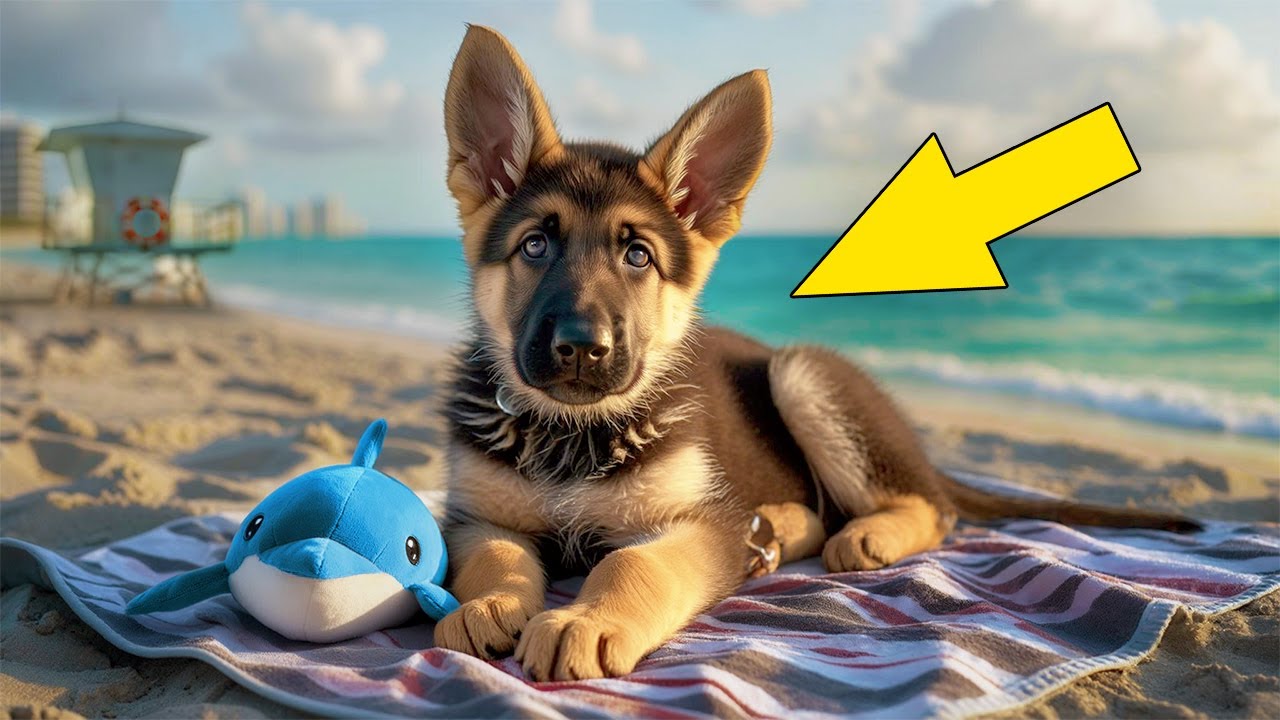
He was sitting on a towel, not curled up, not sleeping, just sitting. Back staring out at the waves like he was waiting for someone who never showed up. A six or seven-month-old German Shepherd, sand covered, ribs slightly visible, eyes scanning every movement along Miami Beach. Tourists passed him all day.
Some smiled, some tossed him bits of food. One kid even tried to take a selfie with him, but no one asked where he came from. No one stayed long enough to see that he never moved from that one towel. The thing that got me wasn’t the stillness. It was the dolphin toy beside him. It was the kind kids win at arcades.
Bright blue plastic eyes, a torn flipper. It sat right next to him, half buried in sand, and he kept glancing at it like he wasn’t sure if it meant something or everything. My name’s Meg. I’m 35, a lifeguard at South Point. I’ve seen a lot on this beach. Heat strokes, jellyfish stings, kids lost and found. But I’d never seen a dog like that. Not like Murphy. I didn’t know his name then, of course.
I didn’t even approach him that first day. I just watched from the tower. He didn’t bark, didn’t chase birds. He didn’t act feral. He acted abandoned like he knew he wasn’t supposed to be there, but he didn’t know where else to go. By sunset, most people had cleared out, but he was still there. I climbed down from the tower and walked slowly toward him.
He saw me coming and stood, not to run, not to defend, just stood ears back, unsure. It’s okay, I said softly, crouching. I’m not going to take anything from you. He didn’t come closer, but he didn’t move away either. I knelt in the sand, maybe 10 ft from him. He stared at me, then at the ocean, then at the dolphin.
I stayed there, breathing slow, letting him decide. After a minute, he sat down again, right back on the towel. The next morning, he was there. Same spot, same posture. But now, the dolphin was gone. I don’t know why that hit me so hard. Maybe because it meant someone had approached while no one was watching. Maybe because for a dog who had nothing, that toy might have been everything and someone had taken it.
I brought him water, a clean towel, chicken from my own lunch, left them a few feet away. He waited until I walked off, then slowly crept forward to eat. That night, I didn’t go home. I sat in the tower and watched him curl into the towel I’d left. The breeze came in stronger. He didn’t shiver. He just waited.
The third morning, animal control came. Someone had reported a stray shepherd left on beach property. I saw the van from the tower and my whole body tensed. I climbed down before they could reach him. I’ve got him, I said, waving them off. The officer raised an eyebrow.
you his owner? No, I admitted, but he’s not a threat. He’s just here. They gave me 24 hours. Either he left or they’d come back. I walked over to the towel. He stood again, this time wagging his tail barely, like he wasn’t sure if he was allowed. I knelt. You can’t stay here, I whispered. They’ll take you and not to a good place. He licked my hand. It was the first time he touched me. I named him Murphy right then. I don’t know why.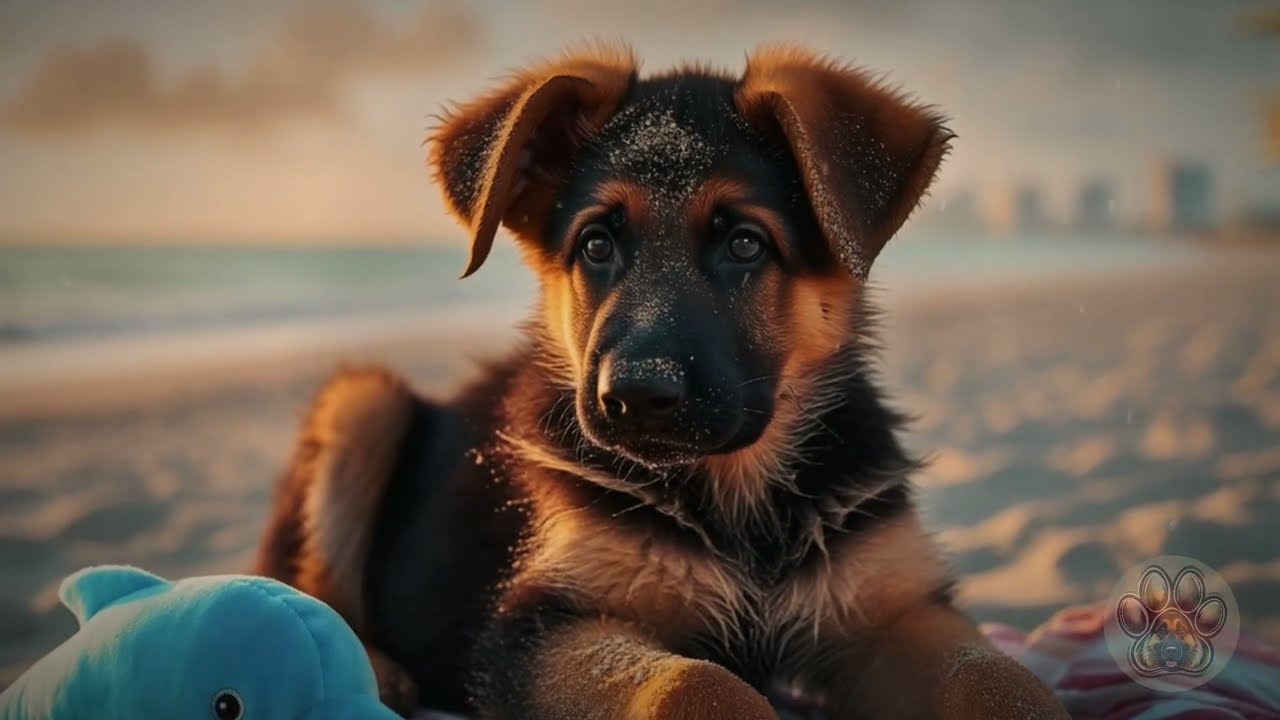
It just came out. Murphy, I said again, and he wagged harder. When I reached for the leash, he didn’t pull away. He came with me, quiet, willing, like he’d just been waiting for someone to say his name. Murphy walked like he wasn’t sure what the ground meant anymore. He kept glancing behind us at the beach, at the towel, like something had been left undone.
I held the leash loosely, giving him space, but he never tried to pull. He stayed close as if proximity was the one thing that made sense. I didn’t take him home. Not yet. There’s a back room at the lifeguard station, small, barely insulated, but dry and quiet.
I laid down a blanket, filled a bowl with water, and sat beside him on the concrete floor. He didn’t eat right away. He paced three slow circles, then curled in the corner with his head resting on his front paws. He didn’t sleep, just kept watching the door like he was afraid the ocean might come in and take everything again. I watched him for an hour. Then two. When I finally got up to leave, he didn’t move, just tracked me with those eyes.
“You’re safe now,” I told him. More for myself than for him. “That night, I didn’t sleep much. The apartment felt too quiet, too still. I kept hearing phantom waves through the windows. And every time I closed my eyes, I saw him curled up on that towel, eyes locked on the horizon like he was waiting for a ghost.
I came back at sunrise. Murphy hadn’t moved. The blanket was crumpled under him, the water untouched. But when he saw me, he stood, ears perked, tails slightly wagging. Not joy, recognition, and maybe relief. I opened the door, knelt down, and said, “Let’s try again.” This time, he followed me without hesitation. I took him to the vet first. He was underweight, but not dangerously so.
No chip, no tags, no sign anyone had even tried to claim him. The vet guess 6 to 7 months old, male, no signs of abuse, just neglect, and something else. Shepherds are smart, the vet said, rubbing Murphy’s ears gently. He’s been watching, processing, waiting for permission to trust again. That hit me harder than I expected.
Back at the station, I made calls. Every shelter, lost dog registry, local rescues. Nothing. No one had reported a missing shepherd fitting his description. A few people posted on Facebook with is this your dog photos. Still nothing. I bought him a proper collar, deep blue with a tag that read Murphy. I didn’t know how long he’d be mine, but I needed him to know he belonged somewhere.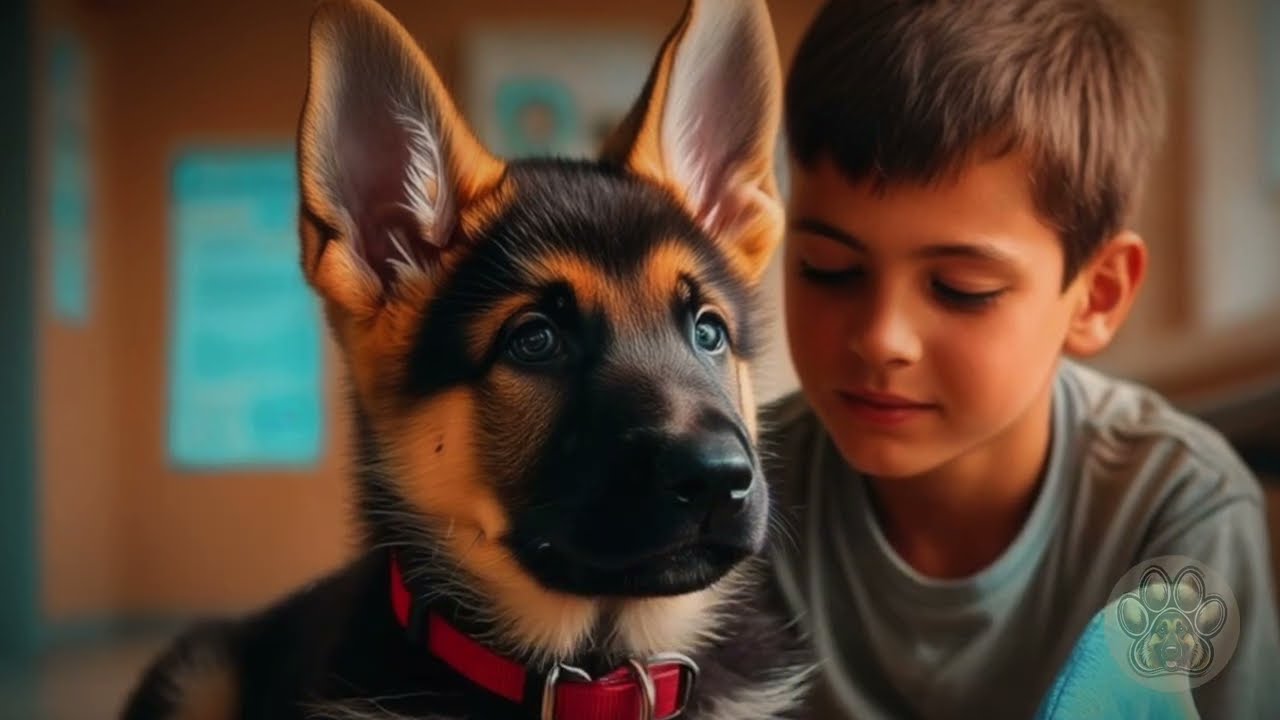
We started walking together every morning before my shift down the beach, just the two of us. At first, he stayed close, never straying. Then slowly, he began to explore, nose in the wind, paws dancing through the foam where waves kissed the shore. He never went far.
But the first time I saw him chase a bird, ears up, tail wagging, sand flying, I felt something crack in my chest. Joy. Real, messy, unexpected joy. He came running back, panting, tongue out, eyes bright. I laughed. I hadn’t laughed like that in a year, maybe longer. We became a pair. People started noticing. “Is that the dog from the towel?” a kid asked one day. “Yep,” I said. “Cool.
He looks happy now.” And he did. But the thing about healing is it doesn’t erase what came before. One morning, I brought a replacement dolphin toy. Not identical, but close. I placed it beside the blanket in the lifeguard station, hoping he’d accept it.
He didn’t touch it, just stared at it, then looked at me like he remembered the original, like he was asking if I thought this one could replace what he’d lost. That’s when I realized Murphy didn’t need a new toy. He needed someone who wouldn’t leave. And I had to decide, was I ready to be that person? The last time I had to make a decision like that, I froze. It was last summer. Two pink lines, one heartbeat, then silence. A hospital room with too much white and too little sound.
I remember sitting in the car after they told me, keys in the ignition, engine off, my hand on my stomach like I’d hold on to something that was already gone. I never told anyone. Not really. I just got back to work, filed it under life happens, and stopped looking at baby shoes and store windows. So when Murphy looked at me, silently asking if I was going to stay, it wasn’t just about a dog. It was about that version of myself I’d buried.
The part that still wanted to protect something small and helpless. I didn’t answer him right away. I sat with it. A few days later, the storm came. One of those fast sideways Florida storms that flips umbrellas and empties beaches in minutes and empties beaches in minutes. I was halfway through my shift when the sky cracked open.
Thunder, the whole boardwalk scattering. Murphy wasn’t with me that morning. He’d started staying in the storage room near the tower, safe, dry. But when the rain hit, something in me tightened. I ran back toward the tower, heart pounding for no reason I could explain.
And there he was, not in the storage room, not curled up. He was standing in the open, soaked, eyes wide, ears down. He’d left the room, gone looking for me. Murphy,” I shouted, sprinting across the sand. He saw me, froze, then bolted right toward me. I dropped to my knees as he skidded across wet sand into my chest. His whole body trembled, not from fear, but from sheer release. He buried his head against me, soaking me through.
I wrapped my arms around him and whispered, “I’m here. I’m not going anywhere.” And I meant it. That night, I took him home. Not for a trial run, not for a few days. I brought him into my apartment, into my life. I dried him with my favorite towel. He didn’t flinch.
He followed me from room to room, even waited outside the bathroom door like he was afraid I might vanish behind it. At bedtime, he paced once around the bed, then jumped up, curled at my feet, and exhaled like he’d been holding his breath for weeks. So had I. In the morning, I woke up before the alarm. He was still there, one paw stretched out toward me like he’d fallen asleep midreach.
I lay still for a while, staring at the ceiling, realizing my apartment didn’t feel like a box anymore. It felt like a space with a heartbeat. Over the next week, Murphy started changing. He began to smile. You know that shepherd smile, ears back, tongue out, eyes soft like he’s letting the world back in. He started greeting people at the tower.
Tourists asked to take pictures with him. He let them carefully. Not every time, but enough. And every morning we walked the beach. She’d run ahead, then circle back like he needed to know I was still there. Like he was checking that I hadn’t disappeared. He stopped watching the ocean. He started watching me. And that’s when I knew he wasn’t waiting for someone to return anymore.
He decided I was the one worth staying for. A few weeks later, I took Murphy to the beach with me on a Sunday. Not just for a walk, with me on duty. I got special permission from the station chief. Technically, dogs weren’t supposed to be on the tower, but everyone already knew Murphy. Honestly, he’d become part of the beach.
People asked about him more than they asked about the tide. That morning was different. Crowds were thick, heat climbing fast, kids running in all directions. The kind of day lifeguards dread because everything happens at once. I was scanning the water when I noticed Murphy tense beside me. Not bark, not growl, just freeze. Then he bolted down the steps. I shouted after him, heart hammering.
I thought maybe a kid had dropped something or someone tossed food. But Murphy wasn’t chasing. He was heading toward the far end of the beach where the sand thins out where the tourists don’t usually go. I jumped down and followed barefoot, radio clipped to my hip. Murphy darted between umbrellas and coolers, never losing his line.
When I finally caught up, he was standing at the edge of the dunes, staring at something. A stroller, half buried in sand, no parent nearby, no movement. Then I heard it, a faint, muffled sound, crying. I ran forward. The stroller was tilted. A baby, maybe 10 months old, red-faced, sweating, trapped under a canopy someone had yanked too tight. The heat index that day was over a hundred, and no one had noticed. I pulled the baby out, cradled him, radioed in.
A woman came sprinting seconds later, hysterical. She’d gone to throw out a diaper, turned for just a minute, lost track of time. The baby had been there alone for almost 20 minutes. If Murphy hadn’t seen it, I didn’t want to finish that thought.
When the paramedics cleared the baby and the mother sobbed her thanks, I turned to Murphy. He was just sitting, watching, not proud, not excited, present. Like always, the news never picked it up. No viral story, no medal. But the team knew, and more than that, I knew. This dog, the one who’d once sat silent on a beach towel for three days, had just saved a life again.
That night, I made him a medal myself. Nothing fancy, just a circle of driftwood carved with his name strung on a leather cord. I tied it to his collar. He wore it like it meant something, because it did. After that, people treated him differently, not like a mascot, like a presence. A few even started calling him beach guardian.
Kids would run up with drawings of him. One little girl handed me a crayon portrait labeled Murphy the protector. He kept them all. I taped them up in the tower. By the end of the month, we had a whole wall, Murphy’s corner. But he never let it go to his head. He still followed me quietly. Still watched the water like it held secrets only he could hear.
Still curled up at my feet at night like the world was only safe if we were touching. He didn’t forget where he came from. And neither did I. Because every time I looked at that patch of beach, the one where he waited alone beside a dolphin toy, I remembered the girl I used to be. The one who’d stopped believing anything fragile could survive.
Murphy reminded me it could. And maybe so could I. The beach changed after that. Or maybe I did. People still came and went. Families with wagons, couples in matching swimsuits, joggers chasing sunrises. But ever since that day, the way they looked at Murphy shifted, like he wasn’t just a dog anymore, like he was something more permanent, a piece of the place, a kind of silent protector.
One morning, a teenage boy with headphones came up to the tower. He didn’t say anything at first, just stood there, awkward. Then he pulled out a folded piece of paper from his pocket and handed it to me. It was a drawing. Murphy lying in the sand, eyes calm, body half in shadow with the words written above.
He doesn’t talk, he just understands. The kid didn’t wait for a response, just nodded and walked off down the shore. That one hit hard because it was true. Murphy had become more than a companion. He was a mirror. People saw in him the kind of stillness they couldn’t find in themselves, and somehow that made them feel less alone.
But the truth is, he wasn’t just saving them. He was still saving me. There were days I still woke up with that ache. Not sharp anymore, just dull and constant. The kind of pain you carry like an invisible weight. The memory of what could have been, of a heartbeat I only heard once. On those mornings, I didn’t talk. I didn’t pretend. I just walked the beach with Murphy beside me. And that was enough.
One evening, just after closing, I found Murphy sitting at the base of the tower, staring at something buried in the sand. It was the dolphin toy. I froze. It was faded now. Sunble bleached, torn, water logged. But it was the same one. I would have known it anywhere. Some kid must have dropped it. Or maybe the tide brought it back.
Or maybe something else. Murphy didn’t move. I sat down beside him, heart racing like I’d uncovered a ghost. I picked up the toy and held it in my lap. Murphy watched, ears low, eyes locked on mine. “You remembered?” I whispered. He leaned forward and nudged it with his nose, then rested his head in my lap.
I didn’t cry. Not right then, but I wanted to. Not from sadness, but from the way life sometimes loops in on itself. From the way something lost can find its way back. Not to hurt you, but to heal something deeper. I brought the toy home, washed it, sewed the seam on the fin with trembling hands.
It wasn’t perfect, but it was whole. Murphy took it gently in his mouth that night and placed it on the foot of the bed before curling up beside it. He didn’t chew it, didn’t guard it, just let it be there like a symbol, like a memory reclaimed. A few days later, someone stopped me on the boardwalk. “You’re the one with the dog from the towel, right?” I nodded.
“Just wanted to say he changed something in my son. He doesn’t talk much, but ever since he met Murphy, he asks if we can go to the beach again.” I thank them. unsure what else to say. What do you say when someone tells you their world has shifted because of your dog? That night, I looked at Murphy as he lay beside the repaired dolphin, chest rising and falling in rhythm with mine, and I thought, “Some dogs bark to be heard. Murphy, he stays to be felt.
” Not long after, a reporter showed up at the beach. She wasn’t loud. No big camera crew, just a handheld mic, a notepad, and soft eyes. She’d heard about Murphy through word of mouth, locals talking about the beach dog, the shepherd with the eyes that see straight through you. She asked if I’d be willing to talk. I hesitated.
Murphy wasn’t a story to me. He was a life, a breath, a second chance I didn’t think I deserved. But then she knelt in front of him, said nothing, and waited. He stepped forward, sat down right in front of her, and let her rest her hand on his chest. That was his answer. So I told her everything. the towel, the dolphin, the silence, the storm, the baby, the return of the toy, all of it. She didn’t write while I spoke, just listened.
When I finished, she smiled gently and said, “He’s not just a rescue dog, he’s a recovery dog.” I didn’t know what that meant until I saw the piece air 3 days later. The segment opened with drone footage of South Point, the waves rolling in, families laughing, umbrellas scattered like candy. Then the camera panned to Murphy sitting in the tower, wind in his fur, eyes forward.
The voice over said, “Some heroes wear vests, others wear fur, and wait patiently on a towel until someone sees them.” I cried, not because it was sad, because it was true. After the story ran, something changed. Kids started bringing Murphy gifts. Small toys, handdrawn cards, treats, and ziplockc bags.
One woman drove from two counties away just to see him. She’d lost her husband the year before. She sat beside him for 30 silent minutes, tears falling freely. When she left, she whispered, “Thank you for staying.” That became the theme. Not, “Thank you for saving, not thank you for being cute, just thank you for staying.” Because Murphy didn’t fix anyone.
He didn’t heal people with tricks or wagging or licks. He healed by presence, by being exactly what the world doesn’t know it needs until it’s right in front of them. One afternoon, a group of veterans from a nearby rehab program came by.
One of them, a man with a cane and deep shadows under his eyes, sat down near the tower while the others kept walking. Murphy walked over, sat beside him, didn’t move for 40 minutes. The man didn’t speak, just let his hand rest on Murphy’s back. When he finally stood, he said to me, “I haven’t touched another living thing in months. I forgot what calm feels like.” Murphy followed him a few steps, then returned to me. We didn’t say anything. We didn’t need to.
That night, I added another picture to Murphy’s corner. This time, one of him with the veteran, both of them facing the water, the sun beginning to set behind them. And I wrote underneath in marker, “You don’t have to say a word to make someone stay.” Because that’s what Murphy taught me. That sometimes the greatest rescue doesn’t begin with running in.
It begins with sitting still. and being there. That weekend, I brought Murphy to the beach on my day off. No lifeguard duty, no radios or towers, just us. The morning was quiet, early enough that the sand still held the chill of night, and the only sounds were the gulls and the steady hush of waves. We walked the shoreline, slow and aimless. Murphy didn’t rush ahead like he used to.
He stayed beside me, step for step, occasionally pausing to sniff at shells or look out across the water like it still whispered secrets only he could hear. I’d brought the dolphin with me, clean now, stitched up along the seam, faded but intact. I wasn’t sure why. Maybe I just needed it near. Maybe I was ready to give it back to him if he wanted it.
We sat on the same stretch of sand where I’d first seen him, that exact patch where his towel once lay. I placed the dolphin down between us. Murphy looked at it then at me and gently lay beside it without touching it, not clinging, not guarding, just acknowledging like it was a memory we shared and no longer needed to hold in our teeth. I must have sat there for an hour barefoot in the sand watching tourists begin to arrive.
Families in bright swimwear setting up umbrellas, unloading coolers. A little girl ran by us chasing bubbles, squealing as the wind took them. Murphy’s ears perked, but he stayed by my side. Then a woman approached. Late 40s, maybe. Sun hat, big sunglasses, holding the hand of a boy who looked about 10. Excuse me, she said softly.
Is this Is this the dog from the news story? I nodded. This is Murphy. The boy stepped forward slowly. He had that careful way of moving like the world had been too loud for too long, and he didn’t quite trust its volume. He doesn’t talk much,” the woman said quickly, glancing at the boy.
After the accident, he well, he doesn’t like being touched or loud places. But he saw Murphy on TV, and for the first time in months, he asked if we could come here. Murphy stood and approached without hesitation. Not fast, just present. The boy didn’t flinch. He just watched as Murphy stopped in front of him, ears low, eyes gentle.
Then, slowly, the boy reached out. Not with both hands, just two fingers. He touched Murphy’s head. Brief. Barely a second, but enough. Enough to make the woman cover her mouth with both hands, eyes brimming. “He hasn’t touched anything alive in over 3 months,” she whispered. Murphy sat beside the boy like they’d known each other forever. Just leaned into him.
And the boy smiled. Not wide, not dramatic, just enough to let the light back through the cracks. We sat together for a long time. No one rushed it. The boy eventually sat in the sand, Murphy lying beside him, their bodies almost parallel. I didn’t say much, didn’t need to.
When they left, the woman hugged me tightly. She whispered, “You don’t know what this means.” But I did because it wasn’t the first time. Murphy didn’t just save people, he gave them permission to feel, to return, to believe something good could still find them. Later that night, back at home, I found the dolphin toy nudged beside my pillow.
Murphy lay curled near the foot of the bed, eyes half closed, ears twitching in response to dreams I’d never know. I picked up the toy, held it against my chest for a second, and whispered, “You really are something, aren’t you?” He didn’t move, just breathed, and that was his answer. The next week, something shifted. It started small. Murphy didn’t get up when I grabbed my keys for work.
Normally, he was already at the the door, tail wagging, waiting for his leash. But that morning, he stayed curled up on the couch, eyes open, but distant. I walked over, knelt beside him, and gently touched his paw. “You okay, Murf?” He didn’t flinch, didn’t whine, just looked at me like he wanted to answer, but didn’t have the energy.
I stayed home that day, called in sick, sat with him on the floor for hours. He eventually stood, drank water, and went outside with me. But his usual spark was dimmer. I told myself it was just a slow day. Even heroes get tired.
But something about the way he moved, the slowness, the stiffness in his back legs kept tugging at my gut. The vet ran a full panel. Blood work, scans, movement tests. We waited in the little room for nearly 40 minutes. Murphy lying on the tile floor with his head on my boot. I kept stroking behind his ear, whispering nonsense just to hear myself say something. Anything. When the vet came back, she sat down instead of standing.
“Not a good sign. It’s not life-threatening,” she said gently. “But it’s something we’ll need to manage. Early onset joint degeneration. Not uncommon in shepherds, especially ones that have spent time malnourished, walking on sand, hard pavement. It’s not painful yet, but it’s tiring him.” I swallowed hard. Will it get worse? she nodded.
Likely, but with proper supplements, hydrotherapy, controlled movement, we can give him a great quality of life. I looked down at him, those same steady eyes staring back. He didn’t look afraid. He looked like he was waiting to see how I’d take the news. “Okay,” I said, hand firm on his fur. “We’ll manage it together.” That night, I laid on the floor beside him. Didn’t care about work.
Didn’t care about the dishes in the sink or the laundry still in the dryer. just laid there breathing with him, heartbeat sinking. And I thought, so this is what commitment really looks. It’s not grand gestures or viral moments. It’s vet bills and early mornings. It’s lifting him into the car when his back legs feel sore.
It’s finding a pool to do therapy sessions in. It’s learning what foods help and what stairs to avoid. It’s watching someone who once saved you now need saving in return and showing up over and over no matter what. Murphy adjusted quickly, better than I did. He started recognizing the Vette by scent, let them guide him through underwater treadmills like it was a game.
He wore a special harness now, bright orange with side support. The first time I strapped it on, I apologized out loud. He licked my chin in response. There were days he slowed down on the beach, couldn’t run like before. But he still walked with me, still greeted kids, still curled up under the tower in the shade, watching waves like they were stories only he understood. And people noticed. Not just the way he moved, but the way he kept moving.
Does it hurt him? A boy once asked. Sometimes, I answered honestly. But he doesn’t let it stop him. The boy knelt down and whispered to Murphy. Me too. I never asked what that meant. didn’t need to because Murphy had already heard it, felt it, absorbed it into that silent well of understanding he carried like a second heart.
And that’s when I realized Murphy’s power was never in what he did. It was in what he allowed others to feel. In a world obsessed with speed and noise, he gave people a reason to slow down, to sit, to stay. It was a Thursday when Murphy disappeared. Not for long, not miles away, but long enough to feel it in my throat like a rising tide.
and I couldn’t stop. We’d gone for our usual walk just before sunrise. The air was thick with salt, the sky painted in soft orange and blue. He was a little slow that morning, his back legs stiff, but he didn’t seem in pain. We walked halfway down South Point, stopped at the bench near the dunes, his favorite lookout spot.
He sat beside me, resting his head on my knee. I watched the waves. He watched me. At some point, I got distracted talking with a co-orker about schedules, shifts, permits for the weekend. When I turned around, he was gone. No sound, no warning. No leash to tug. Just absence. At first, I didn’t panic. He’s smart, I told myself.
He probably wandered back to the tower or the storage room or maybe to one of the kids he recognized. But something felt wrong. The bench still held the warmth of his body. His name still echoed in the back of my mouth. And he never walked off without me. Not once.
Not since that day in the storm when he ran to me instead of away. Uh, I searched the length of the beach, called his name so many times it started to lose meaning. Ask joggers, lifeguards, early vendors. Nothing. Then I saw it. At the far end of the shoreline, just beyond the rocks, a small knot of people stood in a circle. Their heads were down.
One of them had a hand over their mouth. I ran, feet digging into wet sand, heart in my throat, lungs burning before I got there. And then I saw him, Murphy, curled up next to something in the sand. It was a woman, mid-30s, face pale, lips blue, a lifeguard already kneeling beside her, performing CPR. EMTs on the way.
Someone said she collapsed during a sunrise run, alone, no ID, and Murphy had found her, had stayed with her. The people said they’d seen him pacing, barking, a soft, low bark, like he was trying not to scare her, but wouldn’t leave until someone noticed. He wasn’t trained for this, but he did it anyway because he knew. Because he always knew.
I knelt beside him, wrapped my arms around his neck, whispered, “You scared me. You know that?” He didn’t wag, didn’t smile, just leaned into me, body heavy, tired. But there, the woman survived. She came to in the ambulance.
No one could explain how she’d been found so quickly, how she hadn’t slipped under without a trace. But I could. And when the EMT looked down and asked, “Who’s the dog?” I answered, “That’s Murphy. He stays.” That night, he slept deeper than I’d ever seen him, curled against me like the weight of the day had finally caught up to him. I stayed awake for a long time, hand on his side, counting each rise and fall like it was the only sound that mattered.
Because in that moment, it was. it always would be. Two days later, he collapsed. Not dramatically, not like in the movies. He just folded. We were halfway through a slow walk near the edge of the pier. He paused to sniff at a patch of seaweed, then sat down. I thought maybe he was just resting.
The sun was hot and he’d already walked more than usual. But when I knelt to offer him water, his legs gave out beneath him. His body slid to the side like a string had been cut. I called his name, touched his ribs. His eyes were open, alert, but his limbs didn’t move. A wave of cold swept through me, hotter than the Miami sun, deeper than panic.
I lifted him, 45 lbs of trust and loyalty, and ran barefoot across the sand. People moved aside, some stared, others asked if I needed help, but I barely heard them. I got him into the car, drove one-handed to the vet clinic 10 minutes away, and yelled for help before I’d even stopped the engine. They rushed him inside, and I waited.
That kind of waiting you never forget. It’s different from any other kind. Your body stays still, but your mind plays every scene you’ve ever lived with them. Every walk, every blink, every sound they’ve ever made. The vet came out after what felt like a week, but was probably 20 minutes. We stabilized him, she said. It looks like a neurological episode, possibly brought on by spinal inflammation. My voice cracked.
Will he recover? She sighed. We need to monitor. We’ve started anti-inflammatories, fluids. If there’s no response in 24 hours, we’ll need to re-evaluate. I was allowed to sit with him in recovery. He looked small in the stainless steel cage, smaller than I remembered. They’d shaved part of his leg for the IV.
His breathing was shallow but steady. I sat beside him on the floor, fingers through the bars, whispering, “Stay with me, Murf. Please stay.” The nurse brought me a blanket. I didn’t leave that night. didn’t even think about leaving. I woke at dawn to the sound of him shifting. Murphy’s eyes met mine, slow, groggy, but aware.
And then he did something I hadn’t seen in two days. He moved his paw just a little, just enough to touch my hand. The vet called it a good sign, promising, but cautious. They kept him for observation another night. I returned home only to shower, feed myself, and grab his dolphin toy from the bed.
When I brought it back, the nurse placed it gently in the cage with him. He rested his chin on it. That was all I needed. The next morning, he stood shaky, wobbly, but standing. I cried harder than I had in years. When they released him, I carried him back to the car like a parent would a sleeping child.
At home, I laid him on the softest blanket I could find. Sat beside him as he drifted off the dolphin between his paws. I realized something that day. All this time, I thought I was the one who rescued him. But no, he’d been rescuing me again and again in silence, with softness, with stillness.
And now, when it was finally my turn to carry him, I did it without fear. Because loving him meant showing up, even when it was hard, especially then. Recovery was slow, not linear. Some days Murphy walked a full block with his harness, tail swaying gently, nose in the breeze. Other days, he didn’t want to move at all. Just lay near the sliding door, watching the sunlight creep across the floor like time itself was waiting for him.
I adjusted my schedule. Fewer hours on the tower, more time at home. My boss understood. Everyone did because everyone knew Murphy now. He wasn’t just a beach dog anymore. He was a part of the place, a symbol. The soul you didn’t realize was holding the whole shoreline together until he disappeared for a day and everyone asked where he was. I began journaling again.
Not full paragraphs, just lines. Scraps of thought I’d scribble while watching him sleep. Some hearts never bark. They just stay. A dog on a towel taught me how to grieve. If healing had a shape, it would look like him. One afternoon, I found an envelope slipped into the mail slot at the lifeguard station.
No return address, just my name in crooked handwriting. Inside was a photo, a printed image of Murphy sitting beside the boy from the beach, the one who hadn’t touched another living thing in months. There was no note, just the picture. On the back in pencil, three words, “He made me.” That photo went on Murphy’s wall.
Murphy’s corner, as everyone called it, had spread. What started as a few crayon drawings now filled the inside of the tower’s back wall. Photos, letters, newspaper clippings, thank you notes from strangers. There was even a small blue plaque someone anonymously installed beside the bench where I first found him. This is where he waited.
This is where hope began. One night, just before sleep, I lay beside Murphy on the floor. He was curled tightly, the dolphin toy pressed to his chest. I whispered, “You know you don’t have to do anything else, right? You’ve already done more than most souls get to do in a lifetime.
” He blinked slowly, exhaled like he’d been holding the breath of a thousand other people for them. In that moment, I knew it wasn’t about how long we had. It was about what we made with it. I’d spent so long afraid of loss that I forgot the beauty of being present.
I built walls around my heart, convinced it was safer to feel nothing than to lose something again. But Murphy changed that. He showed me that grief doesn’t mean something’s broken. It means something mattered. Something lived. Something left a shape in the world big enough to ache when it’s gone. I wasn’t afraid anymore of endings, of starting again, of staying. Because he stayed. He stayed through pain, through silence, through being left behind and not understanding why.
And somehow, instead of turning bitter, he turned gentle. Instead of shutting down, he leaned in. And by doing so, he reopened the part of me I thought I’d buried for good. Not long after, I took a photo of him sleeping, curled beside the window, the dolphin toy tucked under his chin, the golden Miami light spilling across his fur like a blessing.
I posted it online with a caption that simply read, “Not all heroes need a second chance. Some give you one.” And in that quiet moment, I understood something I’d never put into words before. Murphy hadn’t just changed my life. He’d given it back to me. I think some stories don’t need loud endings. They just need to keep echoing in the hearts they’ve touched.
Murphy never went viral. There were no billboards or brand deals, no dramatic final act, just a slow, steady presence that shaped everything around him like the tide on soft sand. He still walks with me, slower now, shorter roots, but he walks. Kids still come by the tower to ask for him. Some bring drawings, others just sit quietly beside him without saying a word. and Murphy.
He always gives them that same calm, steady look. The one that says, “You’re safe. I’m here.” I once asked myself if I was ready to love again. Turns out love didn’t need an answer. It just needed an invitation. Murphy gave me mine. His dolphin toy sits on the windowsill now, sun bleached, a little ragged, but still whole, just like us.
He doesn’t play with it anymore, but he knows it’s there. Like a bookmark in the story we’ve written together. He came into my life during a time I was convinced nothing soft could survive inside me again. That joy was a risk I couldn’t afford. That connection only led to loss.
And yet this little guy’s journey from abandonment to rehabilitation shows how important nonprofit rescue groups really are. Caring for a rescued puppy is more than love. It’s responsibility. It’s pet care. If there’s one thing Murphy taught me, it’s that you don’t always get to choose who heals you.
Sometimes healing walks toward you in silence, curls up beside your broken pieces, and stays long enough to help you gather them back into something stronger. He was just a dog on a towel, but to me and to everyone who met him, he was so much more. A quiet hero, a steady companion, a reason to stay. Join our Bravepaws family. Be their voice. Be their hope.