The 97th Academy Awards promised the usual blend of Hollywood glamour, carefully curated comedy, and predictable victories. Yet, what unfolded on the grand stage was a chaotic, emotionally charged, and utterly unscripted evening that transcended the ceremonial, transforming the broadcast into a live current affairs forum and a source of viral, unmissable drama. From a shocking, controversial kiss to a powerful wave of political activism, the Oscars of 2025 will be remembered not for the dazzling couture or the polite speeches, but for the raw, human moments that cracked the gilded façade.
Host Jimmy Kimmel, returning for his latest turn, set the tone with a monologue that, while cutting, struggled to contain the unpredictable energy simmering beneath the surface. He wryly noted the absurdity of Hollywood’s “biggest night” starting at 4:00 in the afternoon, joking about the industry’s reliance on “child labor” rather than AI, and introducing new, desperate measures to curtail long-winded acceptance speeches—including cutting to John Lithgow in the audience looking “slightly disappointed.” These attempts at controlled irreverence, however, were quickly dwarfed by the night’s real, unscripted developments.
The Kiss Heard ‘Round the World: A Moment of Viral Chaos
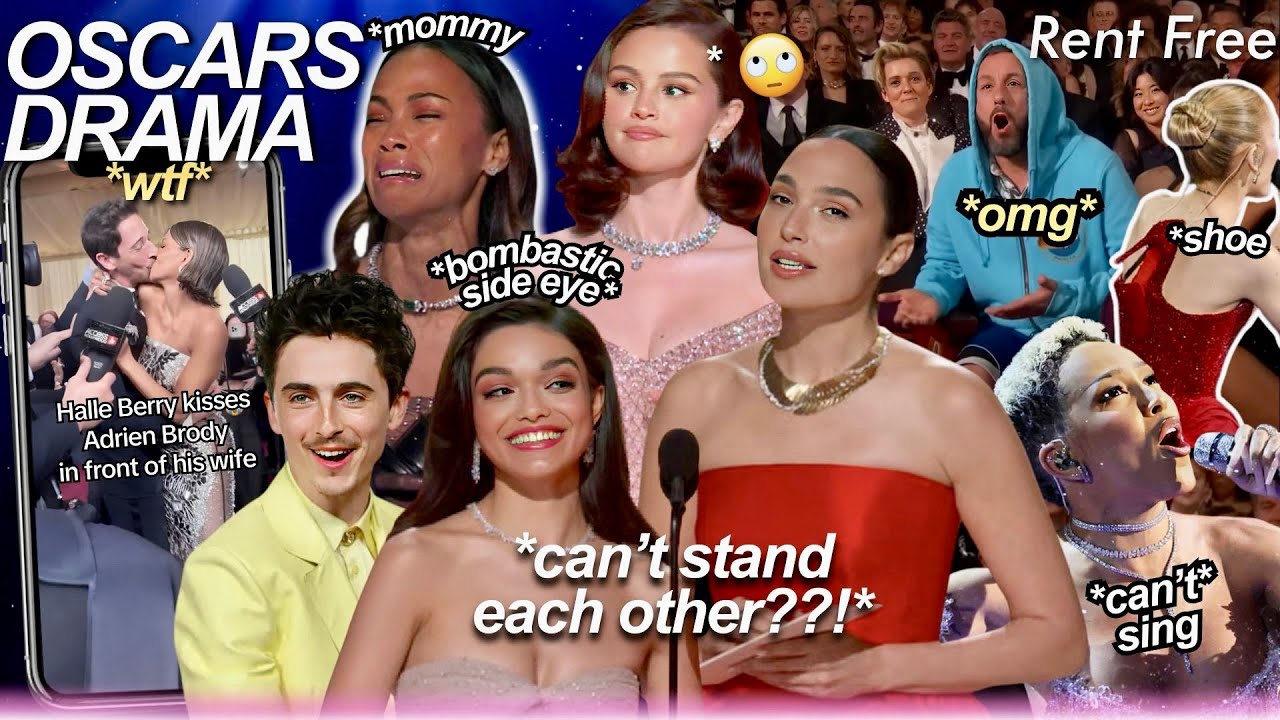
The most explosive and instantly viral moment came unexpectedly when Halle Berry strode onto the stage and recreated her infamous, unannounced 2003 kiss with Adrien Brody. While their original kiss, following Brody’s win for The Pianist, was a spontaneous act of romantic exuberance, the 2025 rendition carried a profound and uncomfortable weight. Berry approached Brody and planted a kiss on his lips, turning to his current partner, Georgina, who was seated in the audience, and offering a quick, slightly sheepish, “Sorry, Georgina, I have to do this.”
The entire sequence was a masterclass in cringeworthy, must-see spectacle. In 2003, Brody was single and Berry was separated. This year, Brody is in a committed relationship, and the act of recreating the kiss in front of his partner instantly created a tidal wave of social media drama. It raised sharp, immediate questions about boundaries and the legacy of the original moment—which some have historically framed as an act lacking full, informed consent, as Berry later admitted she was not told about the kiss beforehand. The sheer audacity of the moment, the palpable awkwardness, and the clear distinction between the “old Hollywood” spectacle and modern sensitivities guaranteed it would be the most discussed headline of the entire ceremony.
The dramatic kiss served as a high-contrast prelude to Brody’s own lengthy and deeply personal acceptance speech moments later. After winning Best Supporting Actor, the legendary performer gave an emotional, sprawling address that stretched into a lengthy segment, where he offered profound thanks to his partner. He credited Georgina for not only reinvigorating his own self-worth but also his “sense of value” and perspective as an actor. The juxtaposition of the two moments—the chaotic, public kiss, followed by the deep, intimate public tribute—encapsulated the bizarre, unpredictable human drama of the night.
A Golden Mic for Global Crisis: The Political Firestorm
Beyond the celebrity drama, the 97th Oscars proved to be a powerful, urgent platform for global current affairs, overshadowing any attempt at lighthearted escapism.
The first moment of profound political urgency came during the presentation for Best Documentary Short. After winning for In the Shadow of the Cypress, the Iranian filmmaking team dedicated their precious award to their “fellow Iranians who are still suffering.” It was a stark, immediate reminder of real-world hardship, grounding the celebration in a necessary reality check.
However, it was the win for Best Documentary Feature that truly stopped the show. The award went to No Other Land, a searingly powerful film on the Israeli-Palestinian conflict. The acceptance speech delivered by the joint Palestinian and Israeli production team was a courageous, unified call for justice that went far beyond typical award-show platitudes. The speaker, two months after becoming a father, expressed the hope that his daughter would not have to live the same life he is living now, and then made a direct, forceful plea: “We call on the world to take serious actions to stop the Injustice and to stop the ethnic cleansing of Palestinian people.”
Crucially, the team presented a unified message that directly challenged divisive foreign policy narratives. They stressed the fundamental, interconnected humanity of the situation, declaring, “my people can be truly safe if basel’s people are truly free. There is another way.” In a room full of Hollywood elites often criticized for their silence or ambiguous political positioning, this moment of clear, direct, and collaborative advocacy was a stunning act of moral courage, making the ceremony feel less like an awards show and more like an essential news broadcast.
The Independent Uprising: Anora Shocks Hollywood
On the cinematic front, the night belonged unequivocally to the underdog. The dark horse indie comedy-thriller Anora, directed by the visionary Sean Baker, pulled off one of the biggest upsets in recent Academy history, sweeping the major categories and defying all expectations for a big-budget blockbuster night.
Anora, which was noted by Kimmel for its prodigious use of profanity, took home statuettes for Best Picture, Best Actress in a Leading Role, Best Original Screenplay, and Best Film Editing. The collective victory for a film shot entirely on location in New York City for a modest $6 million budget, with only about 40 crew members, was heralded by many as a much-needed validation of independent filmmaking.
Director Sean Baker used his multiple acceptance speeches to transform into an impassioned advocate for the artistic community. He made sure to thank the “worker community” who shared their life experiences with him over the years, underscoring the film’s roots in authentic, gritty storytelling.
Perhaps the most heartfelt moment came during the final speech for Best Picture, where Baker’s battle cry resonated: “Filmmakers, keep making films for the big screen. I know I will. My mother introduced me to cinema at 5 years old. Today is also her birthday. Happy birthday, Mom.” He later urged aspiring filmmakers: “Tell the stories you want to tell that move you. I promise you, you will never regret it. Long Live independent film.”
The sheer, raw emotion on the face of Mikey Madison as she accepted the Best Actress Oscar for her stunning performance was infectious. Calling the experience “very surreal,” Madison, who grew up in Los Angeles but felt Hollywood was “so far away,” was clearly overwhelmed by the honor. Like her director, she made a point to recognize the “tax worker community,” pledging to “continue to support and be an ally.”
Red Carpet Report: High Fashion and Savage Critiques
No Oscars night is complete without a viral fashion critique, and the 97th Academy Awards provided plenty of material for the merciless post-show commentary.
Pop icon Ariana Grande found herself at the center of a social media firestorm over her ensemble, with commentators savagely comparing her look to everything from a “lampshade” to a “Barber shaving brushes.” The critique was aimed not at the star herself, but at a stylist accused of trying to “humble her” by placing her in “washed out colors.” Meanwhile, the highly anticipated looks from Demi and Kylie Jenner were mercilessly described as resembling “a damp ceiling” or “burnt foil.” The fashion hits were often overshadowed by the high-profile misses, as Troye Sivan was cruelly noted for looking like “margarine spread,” adding a layer of viral, brutal humor to the ceremony’s lighter side.
The Craft Wins: Wicked, Dune 2, and History Makers
Amid the political firestorms and the Anora sweep, the night also celebrated monumental achievements in craft filmmaking. The musical adaptation Wicked saw a historic win for its detailed costume work. Paul Tazewell took home the award for Best Costume Design, making history as the first Black man to receive the accolade for his work on a major picture. The film also secured the Oscar for Best Production Design.
The highly anticipated sci-fi epic Dune Part Two, which Kimmel joked had a director so strict he banned smartphones because actors kept Googling “What is this movie about?”, was recognized for its technical mastery, winning for Best Visual Effects and Best Sound. The Polish drama The Brutalist secured wins for Best Cinematography and Best Original Score.
The 97th Academy Awards was a night that firmly broke the script, proving that even Hollywood’s most highly regulated event can be hijacked by raw, human emotion, unexpected political urgency, and the triumphant voice of independent cinema. It was a messy, essential, and unforgettable ritual that reminded the world that while the industry thrives on fantasy, the real drama often plays out in the unscripted truth.