little girl asked. Can you fix our door? Mommy’s scared. The CEO next door showed up at midnight. The houses on this block lined up in quiet rows, all sharing the same cracked walkway that stretched out toward the main road. But there was a line, unmarked yet unmistakable, between one part of the street and the other.
At the far end stood a home that always looked like it belonged in another neighborhood. clean siding, a porch light that clicked on every evening at 6 sharp. The hedges were trimmed, the walkway swept, and the door never squeaked. That was Nathan Hail’s house. He was 36, lived alone. No one really knew what he did, though they guessed it was something important, something that required silence and order.
People in the neighborhood called him the man at the end. Always polite, never warm. Just a few houses down in a worn rental with chipped paint and a sagging porch, Clare Bennett lived with her three-year-old daughter, Winnie. Their front door had given up being useful a long time ago. The wooden frame was warped from years of weather.
The lock stuck more often than it worked. To close it, Clare had to pull hard with both hands in a grunt. One of the boards had already started to peel from the top, and the gap it left behind whistled when the wind passed through. Every night, the cold crept in, brushing against their legs as they sat near the living room heater.
She had thought about getting it fixed. Many times, but rent came first, groceries next, and everything else. That had to wait. That morning, the rain had paused, but the wind was still biting. Clare tugged Winnie’s hood up and buttoned the top of her coat as they stepped outside. “Cold, huh?” she said, adjusting her own scarf with one hand while holding Winnie’s tiny fingers with the other.
Winnie nodded, her boots making soft slaps on the wet pavement. They walked toward the edge of the block where the path opened up to the main road. Clare’s mind buzzed. Last night’s shift had run too long, and she hadn’t slept much. The image of the door creaking through the wind kept returning.
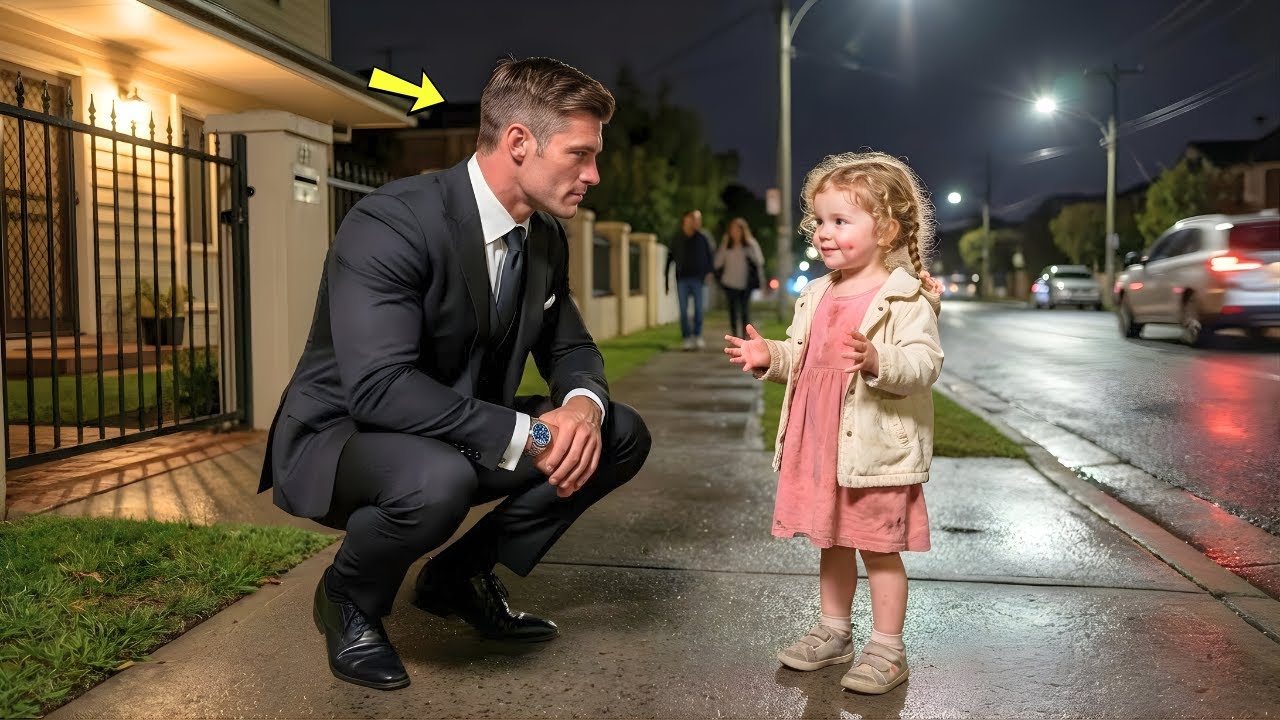
Up ahead, Nathan was locking his front door. Dressed neatly, hair perfectly in place. His movements were smooth, mechanical. Clare lowered her gaze slightly. Just another neighbor passing by. But Winnie let go of her hand and took two quick steps forward. She stopped a few feet from Nathan, tilted her head up, and said calmly, clearly, “Can you fix our door?” Mommy’s scared. Clare froze.
Her breath caught in her throat as if the words had struck her in the chest. She rushed forward, scooping Winnie into her arms. “I’m so sorry,” she said, her voice uneven. “She just says things sometimes. I’m sorry if she bothered you.” Nathan didn’t move. Clare looked away, heart pounding. She had learned long ago people like him, people with safe homes and clean coats, they did not want to be part of messy lives like hers.
Without waiting for a response, she turned and walked away faster than necessary. Winnie looked over her mother’s shoulder, confused. She did not understand why the moment felt heavy. Nathan remained by his gate. He did not promise anything. He did not call out, but the little girl’s words echoed louder than the wind. Mommy scared.
That night, the storm rolled back in. Wind pushed against the rooftops with growing force. Rain splattered windows like scattered gravel. Inside his home, Nathan sat by the window. The walls did not creek. The lights did not flicker. The silence inside was warm, wrapped in calm.
But out of the corner of his eye, through the blurred shadows of the rain, he saw the light from Clare’s front window flicker. The door, it was moving again, not wide, not open, but trembling, as if it could not decide whether to stay or give in to the storm. He set down his book. For a moment, he did nothing. But the sound of that little voice returned.
Can you fix our door? Nathan stood. He reached for his raincoat, pulled it on, then walked down the hallway and picked up a small, well-worn toolbox. He paused once at the door, then stepped into the night. The rain had not stopped completely. It fell in thin, steady sheets, swept sideways by wind that howled through the narrow alley between houses.
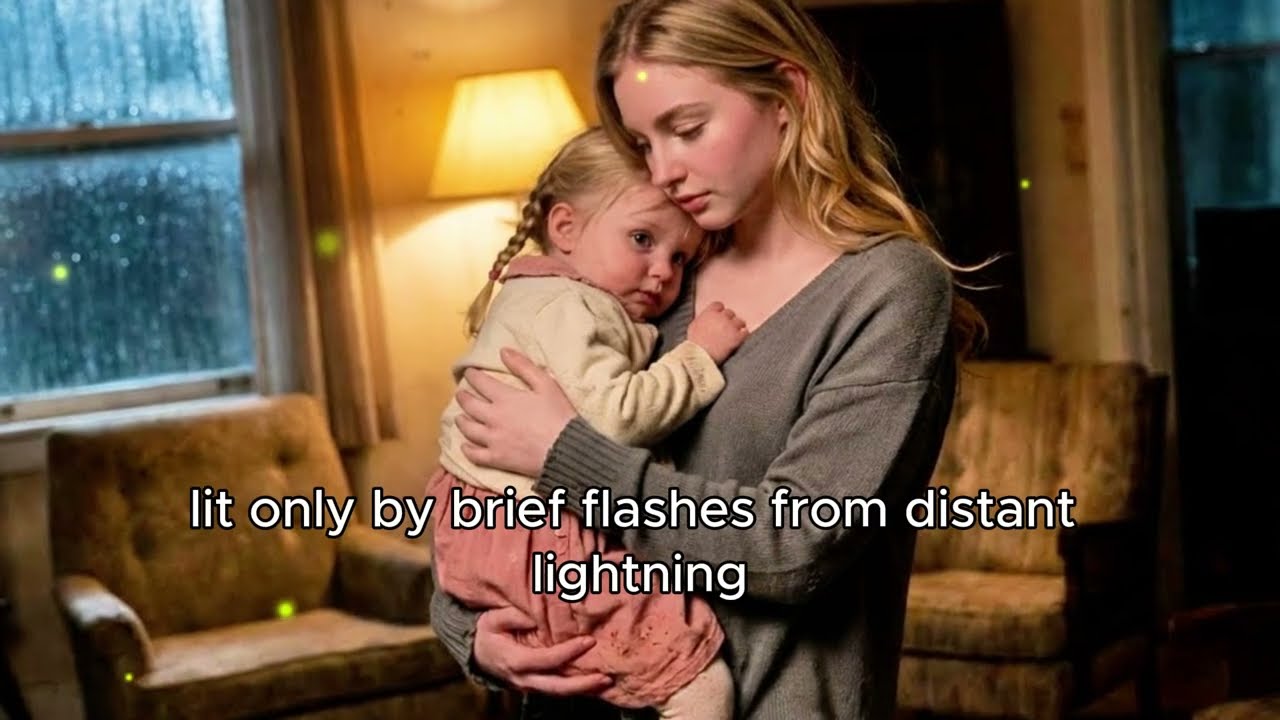
The sky outside was a deep slate, lit only by brief flashes from distant lightning. Inside, Clare was gently rocking Winnie, humming low, trying to ease her into sleep. The little girl stirred but did not fuss. The wind outside pressed against the walls like a stranger wanting in. Then a knock, soft, not hurried, not aggressive, just enough to make its presence known.
Clare froze, her heart briefly caught between fear and instinct. She laid Winnie down gently, tucked the blanket close, and moved toward the door. Through the small glass pane at the top, she saw a silhouette, tall still. She opened the door just a crack. Nathan stood there. His raincoat clung wet to one shoulder. In his hand was a small metal toolbox. No umbrella,no smile, just calm.
“I came to take a look at the door,” he said. If now is not a good time, I can come back later. His voice was steady, neither familiar nor distant. Clare hesitated, then opened the door wider. It’s okay. Just thank you. Nathan stepped up under the porch awning, but didn’t enter. He turned toward the door and studied it for a moment.
The hinge is off here, he said, pointing near the top. I can fix it from outside. Clare stood to the side, arms crossed. not from cold, but from habit. She watched him carefully. He did not glance into the house. He did not ask questions. His eyes stayed on the door, the tools, the task. It was a small thing, but it settled something in her chest behind her.
Winnie peeked through the edge of the curtain, at Nathan, at his dog. The dog, Buster, she remembered, sat obediently beside him, not barking, not restless, just there, like this was nothing new, Nathan crouched near the lower hinge. For a moment, he paused. His eyes narrowed slightly. The splintered frame, the rusted latch, the chill that seeped in from the gap, it all reminded him too vividly of another night, another home.
a woman standing by the door, holding her fear behind a tired smile. His mother. He blinked once, shook his head faintly, as if trying to release the memory, and said, “Do you mind shining a light here?” Clare nodded. She took out her phone, turned on the flashlight, and held it just above his shoulder.
She angled it carefully so it lit the metal, but not his eyes. Rain started to fall harder. Without a word, Clare stepped away and returned with a worn old umbrella. She opened it gently and held it just enough to shelter him. One side of her sweater was soon soaked. Neither of them said anything.
There was only the sound of wind, rain tapping against the porch, and the soft click of tools against metal. Nathan worked slowly, precisely, not rushed, as if he was repairing something far more delicate than just a door. When he finished tightening the screws, he removed his raincoat and rolled it up. He tucked it into the crack where the panel had warped, blocking the wind from slipping through again. He stood up.
The door no longer rattled. Clare reached for it, pushed it gently. It moved cleanly, smoothly, and then settled. No creek, no shake. She let out a breath she did not realize she had been holding. I Her voice caught. Thank you. No one’s ever helped me with this kind of thing before. Nathan gave a slight shake of his head as he closed his toolbox.
Everyone deserves a door that closes right, he said. Matter of fact, like stating the time or weather. He reached into his coat pocket and placed something on the small shelf beside the door. A card, no title, no company, no number, just Nathan across the street. Then with a polite nod, he called softly, “Buster!” The dog rose without a sound, following Nathan as he stepped down into the rain.
Clare stood at the doorway, watching as they disappeared into the storm. She closed the door slowly behind her. It clicked into place. The rain continued outside, but inside something was quieter than before. Something had shifted. Not the wind, not the hinges, something deeper. After the night, Nathan fixed their door. Winnie talked about him every day.
She called him Mr. Fix It, like he was a character from one of her picture books. She told Clare how he stood in the rain, how he didn’t look inside their house, how his dog just sat there quietly. Then one morning, she sat down with her crayons and drew a picture. a house with a glowing yellow light, a closed front door, and a dog resting peacefully on the porch.
That afternoon, as Clare walked Winnie home from preschool, the little girl held the drawing tightly. As they approached Nathan’s house, she spotted him standing on his front porch. “Mommy,” she whispered, tugging at Clare’s sleeve. “I want to give him this.” Clare paused. She wasn’t sure if it was a good idea, but then she gave a quiet nod.
When he walked up and held out the drawing, Nathan knelt slightly, took the paper carefully, and looked at it for a long time. Then he gave a soft smile. “Thank you,” he said. That was all. Clare stood nearby, watching in silence. She didn’t say much as they walked away, but later that evening, Nathan pinned the drawing to the front of his refrigerator.
It was the only thing in his home, not tied to work or function. It stayed there. On the way home, Clare began to feel uncertain. The moment had felt warm, but now doubts crept in. Had Winnie overstepped? Was Nathan just being polite? The next day, Clare took a different path home, one that didn’t pass his house.
And the day after that, she did the same. Winnie noticed. She stood at the window after school, crayons in her hand, and asked quietly, “Mommy, do you think Mr. fix it will be sad if I don’t say hi anymore. Clare didn’t answer. A few days later, Nathan was out front watering his plants.
He looked up and saw Clare atthe far end of the row, mostly hidden by a few parked cars. He was about to look away until he noticed something. An older woman nearby, had lost her balance and stumbled. Clare, though clearly in a hurry, set her grocery bag down and rushed over. She helped the woman sit on the curb, pulled tissues from her coat to clean a scrape on her hand, offered her water, and stayed until a family member arrived.
When the woman was safe, Clare picked up her bag and continued walking, never once checking to see if anyone had noticed. But Nathan had, he stood frozen, still holding the garden hose, and thought of his mother, who had always stopped to help others, even when she had little herself. But when she had needed someone, no one had stopped for her.
In that moment, he saw Clare clearly. Not through hearsay or passing glances, but through action, and he understood. She didn’t help others because she needed something in return. She helped because it was who she was. The next morning, Clare found a small box on her porch. Inside was a basic smart lock kit and a folded piece of paper that read, “Use it or don’t.
Just keep her safe.” No name. But she knew. That night after working late, she came home to find a paper bag near her front steps. Inside was a warm sandwich and a bottle of milk. She stood for a long time before picking it up and quietly going inside. From that day on, every time she and Winnie came home after dark, the porch light was already on.
No one ever mentioned it. Gradually, things began to change. Clare started nodding when she saw Nathan. A small gesture, no longer afraid, he nodded back. Buster walked beside him, as calm as ever. One afternoon, as he passed by their yard, Nathan paused. “Buster’s getting old,” he said gently.
He likes having someone to sit with him on the porch. If you two aren’t busy, you’re welcome to join us sometime. Clare looked down at Winnie, who was already smiling up at her. That evening, they sat outside. Clare on the steps, Winnie beside her, petting Buster like an old friend. Nathan sat across from them, not too close.
He talked about the breeze, a squirrel that had climbed into his attic once, and the strange noises it made. It was small talk, but the kind that makes space for something more. When the sky turned darker, Clare stood and took Winnie inside. She closed the door gently, and for the first time in a long while, she realized she didn’t feel the need to lock it immediately.
The fear that used to settle in her chest each night was still there, but lighter. It had made room for something else, something small, something like trust. That afternoon, Clare and Winnie walked the familiar path to Nathan’s house. A small bundle wrapped carefully in brown paper held gently in Clare’s hands. Inside were simple homemade pastries.
Nothing extravagant, just something warm, soft, and made with care. Nathan opened the door, surprised to see them. His expression softened as Clare handed him the package. “I thought you might like these,” she said. He smiled faintly, then paused. There was a brief flicker in his eyes, the kind that comes before someone says something they do not say often. “Today is my birthday,” he said.
The words came out almost unsure, as if they were unfamiliar to his own ears. Clare blinked. “Oh, we didn’t know.” Nathan nodded. “I figured still.” He glanced at Winnie, who was already smiling at the sight of Buster lying near the living room rug. “If you’re not busy,” he said. “Would you like to stay for dinner?” “It was not a formal invitation. It was quiet.” Simple.
Clare hesitated. But Winnie had already taken a step forward, tugging at her hand. Clare looked at her daughter, then at Nathan, and gave a small nod. Dinner began with small motions. Nathan opened his fridge, pulled out ingredients he hadn’t really planned on using. Clare washed vegetables at the sink, sliced bread with slow, careful strokes.
Winnie sat at the kitchen table, coloring in a notebook and talking to Buster, who seemed to understand every word. The warmth in the room did not come from the stove. It came from the quiet sounds of people moving around each other, filling a space that had long been too quiet. At some point, Nathan began to talk, not loudly, not with drama.
He told them about his mother, about nights when the rain leaked in through broken windows, when their own door never quite locked, and when sleep never really came because he had to listen to every creek, every shuffle in the hallway just in case. He spoke slowly, like someone opening a box that had been sealed for years, unsure of what might still be inside.
Clare listened without interrupting. She didn’t ask questions. She didn’t need to. The way he told it, without anger or bitterness, said enough. Near the end of the meal, the silence shifted. Clare looked down at her empty plate, then began to speak. Her voice was lower, almost a whisper. She told him about being pregnant alone, about the day herfamily stopped answering her calls, about hospital rooms and long bus rides, about the night she gave birth and walked out the sliding doors to no one.
Nathan didn’t say anything for a while. Then he said, “No one saw me off the day I left for college. I packed my bags and walked out the door alone. It was not a comparison. It was recognition, a quiet acknowledgement that sometimes pain sits in places words do not always reach. Later, after dinner, Clare offered to help clean.
She moved to the sink, sleeves pushed up, hands submerged in warm water. The sound of dishes clinking was the only thing between them. Winnie had fallen asleep on the sofa. Buster curled up beside her. Clare kept her eyes on the soapy plates. Her voice when it came was unguarded. “No one’s ever stayed,” she said.
“Not to help, not really. She was not complaining. It was just a truth.” Nathan stood a step away, letting the silence settle before moving closer. He waited until she turned slightly, just enough to face him. Then, gently, he reached up and brushed a tear from her cheek with the back of his hand.
His touch was light, not claiming anything. Then tonight I’ll stay, he said softly. Just tonight if that’s all right. Clare didn’t respond with words, but she did not step back. The kitchen felt different now. Not brighter, not quieter, just full. There was no promise made, no declaration, only the fragile, powerful feeling of two people finally letting someone stand beside them.
In the same moment, Nathan started showing up in small ways. He helped Winnie fix a toy robot with a missing arm. He did not make a big deal out of it. He sat cross-legged on the floor beside her, holding tiny screws in one palm while she watched with quiet fascination. When Clare struggled to mount a simple wall shelf in the kitchen, he brought over his level drill and calm demeanor.
He worked carefully, never assuming control, always asking first. “You want it here?” he’d ask. His voice even respectful. Clare nodded, watching him move around her small, imperfect kitchen. She felt something she had not in a long time. Ease. There were no grand gestures, no promises, just gentle hands fixing small things that had long been broken.
But small things don’t stay unnoticed for long in places where everyone watches everyone else. Whispers began to stir. That’s the rich guy from the end of the street, right? She must have caught his attention somehow. Single moms these days know how to work it. Clare heard one of them outside the laundromat.
A woman said it just loud enough. Not to her face, but close enough to land like a slap. She walked home that day with her head down, shoulders tight. When Nathan found out, he did not get angry. Instead, he got his tools. The next Saturday morning, Nathan rolled out a folding table near the community mailbox with a sign that read, “Free fix it day.
” Nothing flashy, just him, a few extra light bulbs, nails, a cordless drill, and a cooler with bottled water. He went house to house, asking what needed repairing. He replaced broken bulbs on porches, tightened loose steps, fixed a squeaky gate that had annoyed a neighbor for months. When people asked why he was doing it, he simply said, “We all share the same street. It should feel safe.
” He didn’t mention Clare or Winnie. Not once. Later that week, two motion lights were installed at the end of the alley. A few new locks appeared on old doors. When asked about it, Nathan said, “It’s from the community safety fund.” There was no such fund. He paid for it himself.
One evening, as the sun began to sink and the first porch lights blinked on, Winnie sat next to Nathan on Clare’s steps, legs swinging over the edge. She looked up at him and asked, “Why do you help us so much?” Nathan paused. He thought about all the times he wished someone had stood on their porch while his mother tried to hold their door shut against a storm.
He looked at Winnie and said, “Because someone should have helped my mom.” Then quieter. No one did. That night, a heavy wind moved in from the north. Just before 1000 p.m., the entire street went dark. A transformer had blown. The houses on Clare’s side lost power entirely. The darkness was complete. No porch lights, no distant hum from fridges or heaters.
Clare had just put Winnie to bed when she noticed movement outside. The faint sound of footsteps in the gravel. Not hurried, but close. She froze. Her hand hovered over her phone. Her eyes went to the window. There was no light to see anything, just the shape of her own fear. Suddenly large again. A minute later, there was a soft knock.
She opened the door a crack. Nathan stood there with a flashlight in one hand and Buster at his side. I’ll stay out here, he said, until it comes back on. Clare wanted to say something, something polite or dismissive, but the words did not come. Instead, she left the door a jar and sat inside with her back to it, her hands clasped.
From outside came the soft sound of Bustersettling down, and Nathan’s voice, low, steady, humming, something she didn’t recognize. An hour passed. Then, two, the lights flickered on just after midnight. Clare stood and opened the door wider. Nathan looked up, nodded once, then stood. She did not stop him. But for the first time in a very long time, Clare turned back into her home, exhaled slowly, and felt safe.
Truly, completely safe. That night, there was no rain, but the wind roared through the alleyways like something restless and unseen. Clare was wiping down the kitchen counter, getting ready to take Winnie to bed when she noticed something was wrong. The motion sensor light outside had not turned on. It always did.
She walked to the window and pulled the curtain aside. The alley behind the house looked darker than usual, swallowed by shadow. Then she heard it, a faint metallic sound. Not loud, not clear, just enough to make her stomach tighten. Winnie tugged at her shirt. Mommy, why is it so dark? Clare didn’t answer. She locked the back door, then checked the front.
Her heart was beating faster now, each thud heavy in her chest. Her phone was already in her hand. Nathan’s name sat at the top of the screen. She stared at it. Then she stopped. She had lived too long, believing she had to handle everything alone. If she called him now, would she be pulling him into danger? That wasn’t his responsibility.
She turned off the lights in the house and guided Winnie into the bedroom. “Lie down, sweetheart,” she whispered. I’m right here. Just as she pulled the blanket over her daughter, a short, sharp sound came from the back door. A single chime, not a break-in, a test. Someone had tried the lock. Clare froze where she stood, her body locked in place as if even breathing might give her away.
Across the street, Nathan was working in his office when his phone buzzed with an alert. The security system he had installed for the block. A small project he had quietly funded was reporting unusual activity. The lights behind the houses had been manually shut off. Nathan went to the window.
Clare’s house was completely dark. No movement, no noise, no call for help. It was the silence that unsettled him. He grabbed his jacket and stepped outside. Nathan moved through the narrow path behind Clare’s home and activated the flood lights. Bright white light spilled across the alley, erasing every shadow. A man stood there, caught in the open.
He wasn’t shouting. He wasn’t drunk. Just someone who had been testing doors and hadn’t expected to be seen. Nathan didn’t rush forward. He didn’t chase him. He stood where he was and spoke clearly, his voice steady. This area has cameras. The police are already on their way.
The man backed away, then turned and disappeared into the darkness. No one was touched. No one was hurt, but the danger had been real. Clare opened the front door slowly. Light flooded in from the alley. She saw Nathan standing a short distance away, close enough to protect her, far enough to respect her space. Her knees felt weak.
She held on to the door frame to steady herself. Nathan met her eyes. You didn’t do anything wrong by being scared. He said the police arrived soon after. They checked the area, took statements, and issued a warning. There were no arrests. When they left, the street fell silent again. Nathan didn’t leave. He invited Clare and Winnie to his house just for a while, just to have something warm, he said.
Not because the danger was gone, but because Clare could barely stand. They sat by the fireplace. Winnie fell asleep quickly on the couch, curled against Buster’s side. Clare held a mug with both hands, staring into the flames. Then she looked at Nathan. Her voice broke. I’m not scared because of tonight, she said. I’m scared of what it means.
If I can’t keep standing on my own. I’m scared that if I ever stop being strong, everyone will leave. Nathan didn’t rush to comfort her. He said slowly, clearly, “I’m not here because you’re weak. I’m here because you’ve been strong by yourself for too long.” He didn’t touch her, but he didn’t go anywhere. Clare lowered her head.
A single tear fell, not from fear, but from something unfamiliar. Someone had stayed after the danger passed. Later that night, Nathan walked them back home. He checked every lock, every light, every corner. Only then did he leave. Clare stood behind her closed door, her hand resting on the new lock. For the first time, her thoughts didn’t race toward tomorrow.
They settled on one quiet truth. She didn’t have to pretend she wasn’t afraid anymore. Clare and Winnie stayed at Nathan’s house for a few days after the scare. It was meant to be temporary, just until things felt stable again. But something about being there felt lighter. Nathan made an effort. That much was clear.
He tried cooking breakfast the next morning and burned the toast. The eggs were oversalted and he forgot to warm the milk. But when he placed the crooked plate of food in front of Winnie andsaid, “Voila, chef special.” She giggled and clapped her hands. “You’re silly,” she said. You’re still Mr. Fix It. Nathan chuckled.
I fix doors, not omelets. Clare laughed, too. Not politely. Not because she felt she should. It was a real laugh. Brief, sudden, and honest. The first in a long, long time. Later that afternoon, Nathan sat on the living room floor with Winnie, showing her how to fold paper into the shape of a tiny robot. His large hands struggled with the delicate corners, but he kept at it.
“This one has wings,” he explained. “So, he can fly away if he’s scared. But if he flies away,” Winnie asked. “Who helps the others?” Nathan looked at her, then smiled gently. “Maybe he stays.” Just long enough to help build something safer. Clare stood in the doorway, watching them. She wasn’t holding herself like she used to, arms crossed, shoulders raised.
Instead, she leaned softly against the frame, eyes relaxed. Something in her chest had shifted. Not disappeared, but loosened. That evening, Nathan suggested they take a walk in the garden behind his house. The late sun turned the flowers gold. A breeze moved gently between them. Winnie skipped ahead, chasing a butterfly.
Clare stood beside Nathan near a bed of maragolds. “The air was still warm,” Nathan glanced at her, then down at his feet, then back up. “I keep thinking about that night,” he said quietly. “Not the danger, just what came after,” Clare turned to face him. “I never wanted to just fix your door,” he continued.
“I want to build something, a place, a home where you and Winnie feel safe with me.” He didn’t reach for her hand. He didn’t step closer. He just said it clearly. Without pressure, without fear, Clare’s eyes filled. She looked away, trying to hold it in, but the tears came anyway, soft and quiet.
Winnie returned just in time to see her mother wiping her cheeks. She looked between them, then ran up and wrapped her arms around Nathan’s leg. “You can stay,” she said simply. Nathan knelt down and hugged her back. Clare took a breath, then another, and nodded. Not with hesitation, but with something calm and real.
A yes that came not from being rescued, but from being seen. Not a fairy tale, not a fix. Just the beginning of something whole. Nathan spent the next few months working quietly, piece by piece, transforming Clare’s old house into something new, not grand, but solid, safe. He replaced the roof, reinforced the walls, and rebuilt the front steps where the wood had once bowed beneath weary feet.
Clare offered to help, but he always smiled and said, “Just tell me where you want the shelf.” One day, she came home to find a new mailbox with her name on it. Not just hers, Claire Bennett and Winnie Hail. She blinked, then looked up at Nathan, standing on the porch with paint on his hands.
“You bought the house?” she asked, stunned. I did, he said. But I didn’t keep it in my name. He handed her a folder with the new deed. Two names printed clearly. Not his. You and Winnie own it now. It’s yours. All of it. Clare opened her mouth, then closed it. There were no words strong enough to hold what she felt.
Only tears and a quiet thank you whispered into his shoulder later that night. A year passed. Nathan continued to run his company, but his schedule changed. He worked from home more often. He walked Winnie to school whenever he could and made it home in time for dinner most nights. Clare, with encouragement from both Nathan and Winnie, returned to her passion, interior design.
She took small jobs at first, local cafes, a friend’s nursery, but each project brought her confidence back. One sketch, one color palette at a time. The walls of their home filled with laughter. Paper robots hung from Winnie’s ceiling. Potted plants thrived in corners that used to be cold. And on the fridge, beneath magnets and crayon art still hung that first drawing Winnie made, a closed door, a glowing light, and a dog on the porch.
Winnie had stopped calling him Mr. Fixit. Now she called him Daddy Nate. One evening, almost exactly 1 year after that first stormy night, the rain returned. It was soft at first, then heavier, tapping against the windows like familiar fingers. Clare was in the kitchen, humming while Nathan read a book on the couch. A loud creek echoed through the hallway.
Then, bang! The front door had blown open, pushed by a gust of wind. Winnie ran toward it with wide eyes, her hair bouncing behind her. Daddy,” she called out, beaming. “The door is broken again.” Nathan stood, walked over, and scooped her up in one smooth motion. He looked at the door, then at Clare, who had come to stand beside him, smiling softly.
“Then we fix it,” he said, lifting Winnie a little higher. “Together. Outside the rain kept falling. But inside, everything was steady. The lights glowed warm. The house stood strong, and in front of that door, now firmly shut, stood a family of three. Not perfect, but whole, where it all began, and where they had finallyfound their way home.
Thank you for watching this heartwarming journey of love, healing, and second chances. If this story touched your heart, please consider subscribing to Soul Stirring Stories for more powerful emotional tales that remind us of the goodness still left in this world. And don’t forget to hit the like button to show your support.
It means the world to us and helps these stories reach more hearts in need of hope. Until next time, take care, stay kind, and remember, sometimes the smallest gestures can open the biggest doors.