Introduction: The Primal Fear
Forget the image of the chest-thumping caveman, spear in hand, fearlessly tracking a woolly mammoth. Forget the popular narrative of man as the born hunter, the natural apex predator of the prehistoric world. This story, while flattering, is a fiction. It is the end of the book, not the beginning. To find the real, visceral origin of humanity, you must go back further, to a time when our ancestors were small, weak, and terrified. You must go back to a world that was not ours, a world ruled by giants, where we were not the hunters.
We were the hunted.
This is the story of our evolution as told not through our aggression, but through our fear. It is the chronicle of a desperate, million-year-long battle for survival, fought by creatures three feet tall against bear-sized hyenas, lion-sized otters, and cats with teeth like daggers. This is the narrative of “Life Million Years Ago,” a brutal, unforgiving epoch where the defining human traits—our intelligence, our cooperation, our very society—were not forged for conquest, but as a desperate defense.
We descend from a long line of prey. And in that terrifying truth lies the secret to our greatest strengths. The story of humanity is not the story of a predator. It is the story of the most successful prey animal that ever lived.
A World of Monsters: The Predators of the Pliocene
To understand our ancestors, we must first understand the world that tried to eat them. The Africa of the Pliocene and Pleistocene epochs, spanning from roughly 5.3 million to 11,700 years ago, was not the familiar landscape of today. It was a realm of megafauna, a place where the predators were larger, more numerous, and more terrifying than anything we can comprehend in the modern era.
Imagine walking through the expanding grasslands and shrinking forests of East Africa. You are an Australopithecus afarensis, perhaps four feet tall on a good day, weighing 60 to 100 pounds. You are, in essence, a small, bipedal ape. You have no tools, no fire, and no natural weapons. Now, look at your neighbors.
There are the cats. The Smilodon and its relatives, the saber-toothed cats, were not just lions with bigger teeth. They were robust, powerful ambush predators built to take down prey far larger than themselves. Their iconic fangs, which could be seven inches long, were not for biting, but for a precise, stabbing puncture to the throat, causing massive blood loss. Fossil evidence, including skulls of early hominids with puncture marks that perfectly match the fangs of a saber-tooth, tells a gruesome story. Our ancestors were, without a doubt, on their kill list.
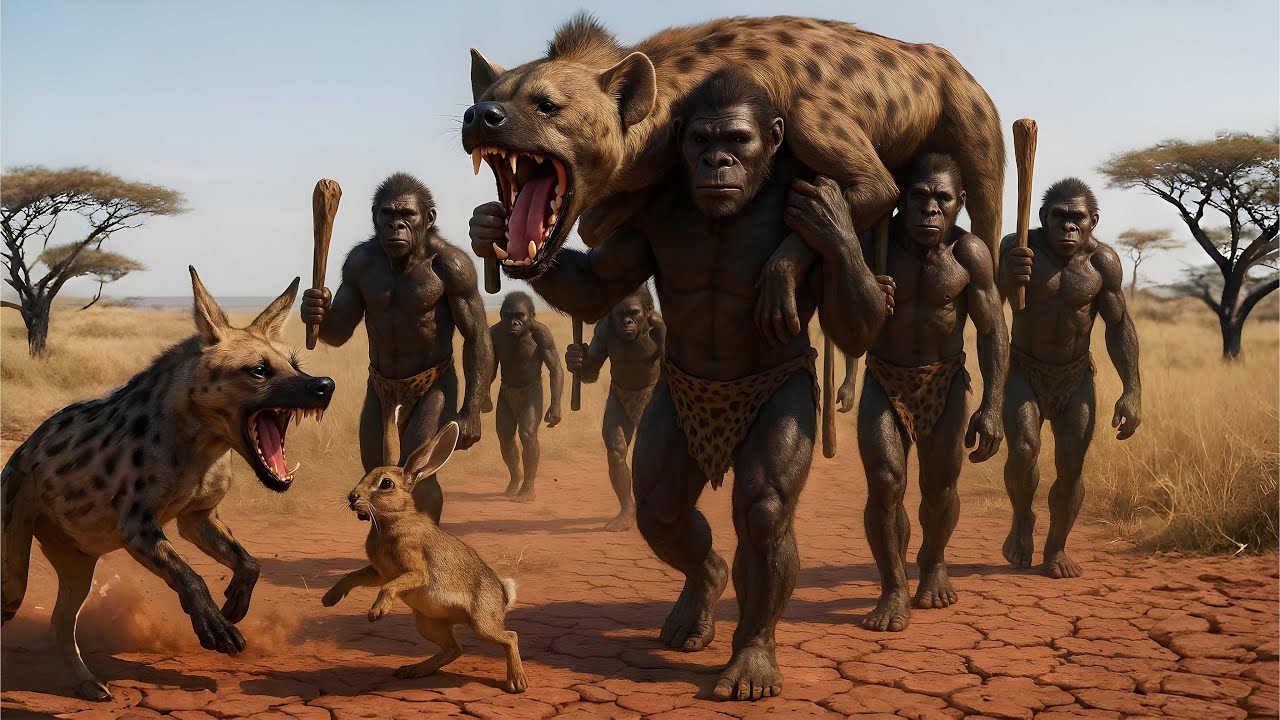
Then there were the hyenas. Modern hyenas are formidable, but their prehistoric cousins were the stuff of nightmares. Pachycrocuta brevirostris, the giant hyena, stood about three feet tall at the shoulder—the size of a modern lioness—but was far more massively built, weighing over 200 pounds. It possessed a skull and jaw of incredible power, designed to crush the largest bones. These were not solitary scavengers. Like modern hyenas, they likely hunted in large, coordinated packs, capable of overwhelming almost any prey. For a small hominid, a pack of giant hyenas would have been an inescapable, bone-shattering end.
But the threats didn’t just come from cats and hyenas. The landscape was saturated with danger. Crocodiles, far larger than today’s Nile giants, lurked in the streams and rivers our ancestors needed for water. Wild dogs, hunting in packs, would have easily run down a bipedal ape. Even the skies were hostile. The fossil record includes hominid skulls with talon marks, evidence of predation by large eagles, which, like modern crowned eagles in Africa, would have viewed a small hominid child as just another primate to be plucked from the ground.
This was the gauntlet our ancestors faced every single day. The world was a B-movie monster-scape, and we were the defenseless protagonists.
The Vulnerable Ancestor: Portrait of the Prey
For decades, the prevailing theory of human evolution was “Man the Hunter.” This theory, popularized in the mid-20th century, argued that hunting was the primary driver of our evolution. It claimed that the need to hunt large animals spurred the development of bipedalism (to see over grass), tool use (for spears), and large brains (to coordinate the hunt). It was a compelling, masculine-coded narrative.
It was also, as anthropologist Robert W. Sussman argued, almost completely wrong.
Sussman’s “Man the Hunted” theory, first proposed in his 2006 book, flipped the script. He and his colleagues looked at the fossil record and asked a simple question: What does the evidence actually say?
First, they looked at the hominids themselves. Creatures like Australopithecus were not built for hunting. Their teeth were small and flat, very much like our own, ideal for grinding fruits, nuts, and tough plant matter. They lacked the sharp shearing blades necessary to slice meat. “These early humans simply couldn’t eat meat,” Sussman stated. “If they couldn’t eat meat, why would they hunt?”
Second, Australopithecus was small and slow. While bipedalism was a huge evolutionary leap, it did not make us fast. A running human is hopelessly outmatched by any quadrupedal predator. Our ancestors were, as Sussman described them, “edge species.” They lived in the liminal space between the forest and the savanna. They could climb trees to escape predators and forage for fruit, but they could also walk on the ground to exploit new food sources.
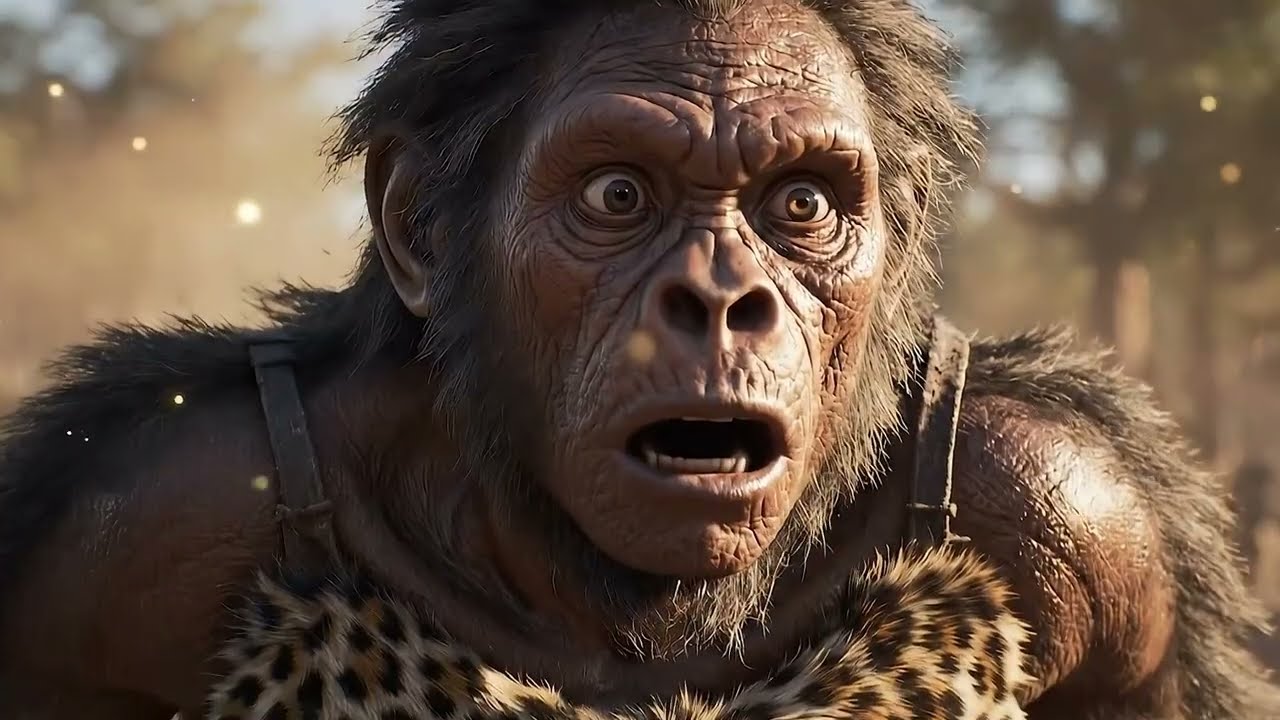
This “edge” was a place of high opportunity, but also high risk. They were constantly exposed. They were, in ecological terms, perfect prey: a small, soft-bodied, slow, and relatively abundant food source with no physical defenses.
The evidence for this is written on our ancestors’ bones. Paleoanthropologists have found numerous hominid fossils that show clear signs of being eaten. The puncture marks from saber-tooths, the gnaw marks from hyenas, the V-shaped cuts from eagle talons—this is not the record of an apex predator. This is the fossilized menu of a dozen different carnivores. One study estimated that as much as 6 to 10 percent of the entire early human population was preyed upon. This wasn’t a rare occurrence; it was a constant, driving evolutionary pressure.
Survival Strategy 1: The Power of the Pack
So, how did this defenseless ape survive? If our ancestors were so weak, so slow, and so tasty, why are we here today?
The answer is the first and most important human survival trait: cooperation.
The “Man the Hunted” theory argues that our complex social nature—our greatest and most defining characteristic—evolved not to hunt, but to defend. When you have no claws, fangs, or armor, your only defense is in numbers.
All diurnal primates (those active during the day) live in permanent social groups, and ecologists agree that predation pressure is the main reason. A lone baboon on the savanna is a dead baboon. A troop of fifty baboons, however, is a formidable force. They have a hundred eyes and ears to scan for leopards. If a predator is spotted, a chorus of alarm calls goes out. And if the predator attacks, the large males will “mob” it—cooperatively attacking the threat, biting and screaming, to drive it away.
Our ancestors, under the same intense predation pressure, would have evolved the same strategy, only more so. Living in a group became a non-negotiable requirement for survival. A hominid alone was a snack. A hominid family group, however, could defend itself. They could watch each other’s backs. They could raise their young in a communal setting, where some adults foraged while others watched for danger.
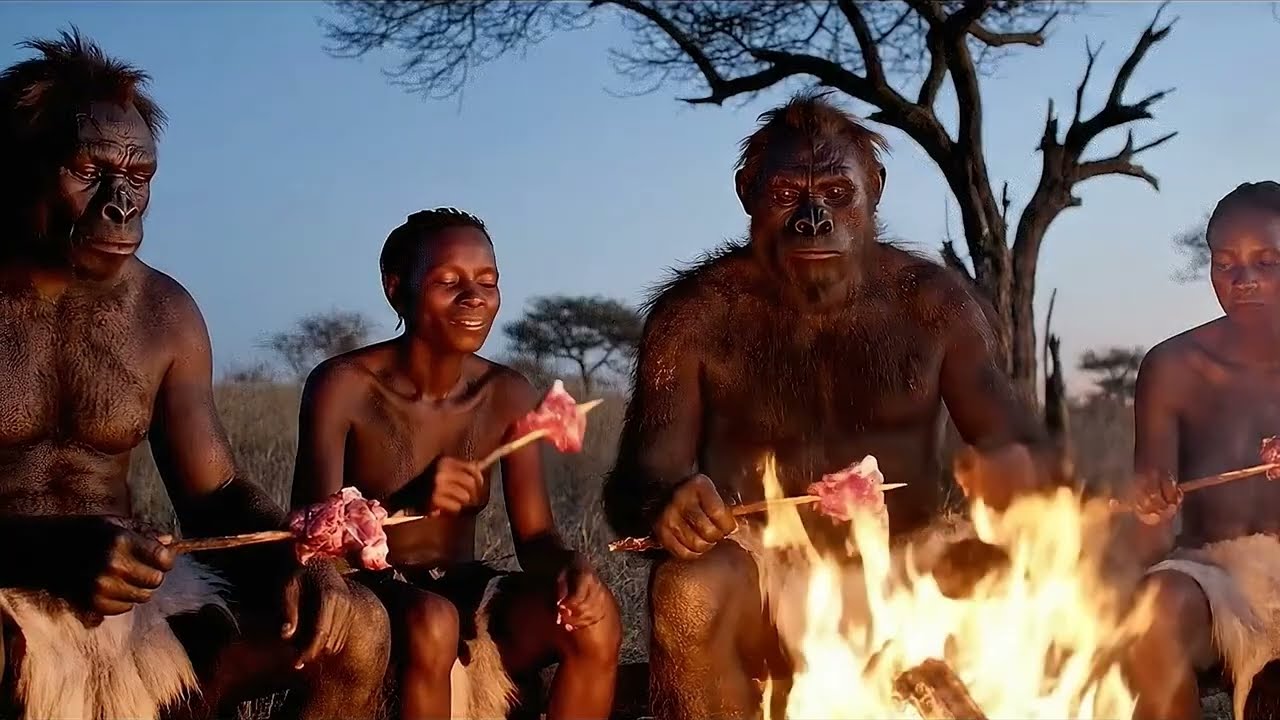
This intense, life-or-death need for the group would have selected for new psychological traits. The individuals who were more cooperative, more empathetic, and better at communicating would have been more effective at group defense. They would have been more likely to survive and pass on their genes. The antisocial, the selfish, and the poor communicators would have been picked off by the predators.
Over millions of years, this relentless pressure forged the human mind. Our need for community, our capacity for friendship, our ability to feel empathy, our advanced communication—all of it stems from this primal need to band together against the monsters in the dark. We are not just social; we are obligatorily social. We were “Man the Hunted,” and the pack was our only salvation.
Survival Strategy 2: The Dawn of Intelligence and Fire
Social bonding was the foundation, but it wasn’t the only strategy. The other great human advantage was our “big brain.” But like our sociality, our intelligence was also likely a defensive adaptation first and an offensive one second.
The human brain is an incredibly clever, tricky thing. Our ancestors, lacking brawn, had to rely on wits. This wouldn’t have looked like advanced calculus. It would have looked like finding a cave with a small, defensible entrance. It would have looked like understanding, through observation, the hunting habits of the local saber-tooth pride and knowing when it was safe to go to the river. It would have meant using a stick to test a dark hole for a snake before reaching in.
And, of course, it meant tools. The earliest tools, like sharpened rocks or sticks, are often imagined as hunting weapons. But it’s just as, if not more, likely that they were defensive. The ability to throw a rock with speed and accuracy is a uniquely human skill. A single rock won’t stop a giant hyena, but as anyone who has seen a chimpanzee troop throwing stones knows, a hailstorm of rocks from a dozen angry apes is a powerful deterrent. A sharpened stick, while not great for killing a mastodon, is an excellent “keep-your-distance” weapon against a probing cat.
The true game-changer, however, was fire. The control of fire by early humans was perhaps the single most important event in our evolutionary history. Its warmth allowed us to move into colder climates, and cooking unlocked a new world of calories.
But its first and most important use was almost certainly protection.
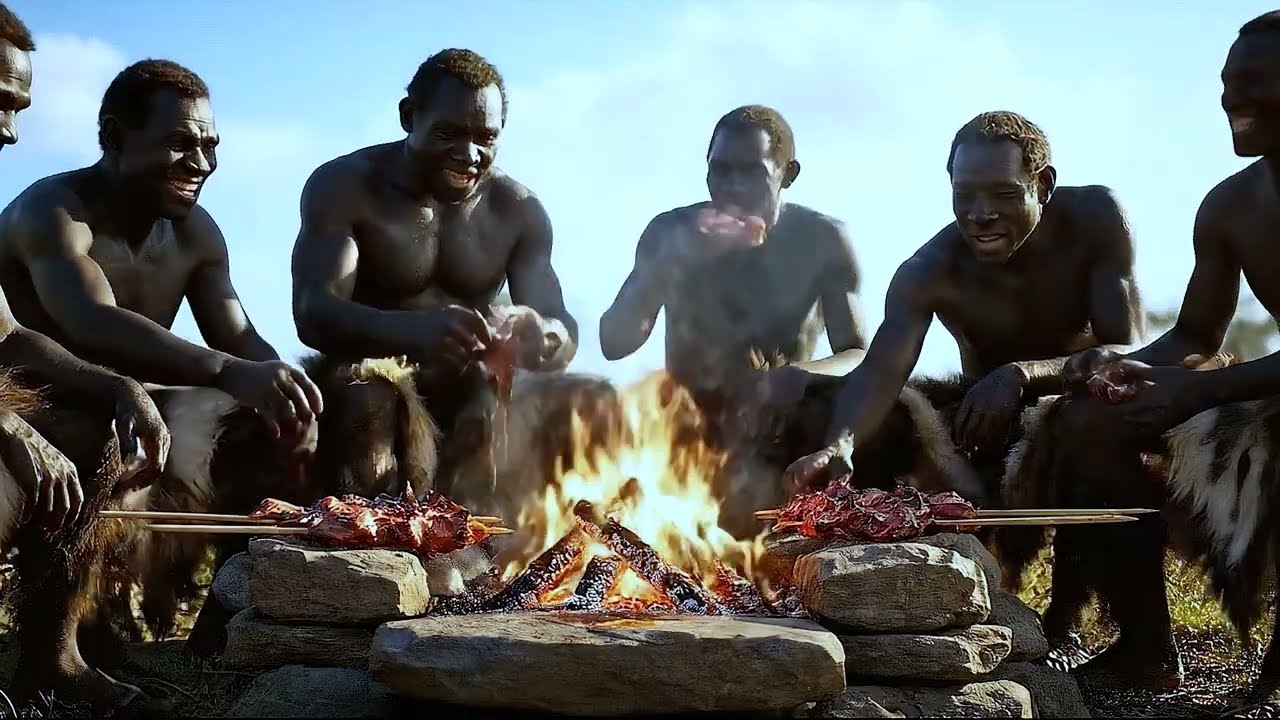
A wall of fire is a barrier no predator on earth will willingly cross. A burning torch is a weapon that can turn a charging lion. For the first time in our history, the night was not a time of absolute terror. Our ancestors, gathered around the hearth, were finally safe. The fire kept the hyenas at bay. It blinded the big cats.
This new-found safety had profound social consequences. The hearth became a social center. It extended the waking day, allowing for more time for social interaction, for mending tools, for sharing food. It may have even been the crucible for language, as our ancestors sat in the protective circle of light, communicating, planning, and solidifying the social bonds that were their ultimate survival tool. Fire was the physical manifestation of our intelligence, and it was our first great shield against the world that wanted to devour us.
Survival Strategy 3: The Great Game of Scavenging
As our ancestors grew more confident, more social, and better-equipped, their relationship with the mega-predators began to change. They were still prey, but they were also becoming something new: a competitor. They entered the high-stakes world of scavenging.
The Pliocene savanna was a landscape of enormous kills. When a saber-toothed cat brought down an elephant or a giant ground sloth, it was a huge event. The cats would eat their fill, but they could not consume the entire carcass. What was left was a massive, calorie-rich prize, and a new battle would begin.
This was the battle of the scavengers. Our hominid ancestors, with their stone tools, were now in direct competition with the giant hyenas. This was an incredibly dangerous gambit. New research, using computer simulations, has explored this very dynamic. The models suggest that a lone hominid, or even a small group, would have been no match for a solitary giant hyena. They would have been outcompeted and likely killed.
But the models showed something else. When the hominids banded together in larger, cooperative groups—say, five or more—the dynamic shifted. A coordinated group of hominids, yelling, waving sticks, and throwing rocks, could successfully challenge and drive off a solitary hyena. When predator numbers were high, and thus carcasses were plentiful, these cooperative scavenging groups could thrive.
This was the intermediate step. We were no longer just prey. We were not yet hunters. We were opportunistic, cooperative scavengers. This behavior reinforced all the traits that predation-defense had already selected for. It required even more complex communication and coordination (“You watch the hyenas, he’ll throw rocks, I’ll cut the meat”). It required bravery and teamwork. And the payoff was immense. Meat, with its dense concentration of fat and protein, provided the fuel our energy-hungry brains needed to grow even larger.
We were, in effect, fighting fire with fire. We were using the social cooperation born of defense to challenge the very predators that hunted us, stealing their food from right under their noses.
The Turning of the Tide: From Hunted to Hunter
This dynamic—of hunted, of prey, of cooperative scavenger—was the status quo for millions of years. It was the crucible that forged Australopithecus and early Homo. But as brains grew larger, as tools became more sophisticated, and as social structures became more complex, the balance of power, ever so slowly, began to shift.
With the arrival of Homo erectus and later Homo sapiens, we see a profound change. We see the regular, systematic use of advanced hunting weapons, like long-range spears. We see the coordination of complex, large-scale hunts. The same cooperation, communication, and intelligence that had been honed for millions of years to defend against predators were now being turned on them.
The prey had finally become the predator. And not just a predator, but the most effective and deadly apex predator the world has ever known.
This brings us to the end of the story, to the Quaternary extinction event. As humans migrated out of Africa, a wave of extinction followed them. North America, arriving 13,000 years ago, lost 72% of its large mammal genera—the mammoths, the mastodons, the ground sloths, the saber-toothed cats themselves. South America lost 83%. Australia lost 88%.
These animals had survived countless ice ages and climate shifts. The only new factor was a small, upright ape that hunted in terrifyingly smart, coordinated groups—the very groups that had been forged in the fires of predation millions of years before. The legacy of “Man the Hunted” was that we became lethally good at working together. The strategies that kept us alive for a million years were the same ones that allowed us to conquer the globe.
Conclusion: The Legacy of Fear
We are the children of survivors. We are the descendants of the fearful, the cooperative, and the clever. We are not the offspring of the lone, aggressive hunter, but of the social group that huddled together in the dark, whispering warnings and sharing warmth while the roars of monsters echoed outside the cave.
This ancient, primal fear is still with us. It is in our DNA. It is the foundation of our psyche.
When you feel the need for community, when you seek out the comfort of friends and family, that is the legacy of “Man the Hunted.” It is the echo of the absolute necessity of the group for survival. When you feel a chill in the dark, a primal fear of what lies just beyond the light, that is the memory of the giant hyena and the saber-toothed cat.
And when we work together, when we communicate and cooperate to solve a problem—whether it’s building a company or raising a family—that is the ultimate expression of our evolutionary journey. Our greatest intelligence, our deepest social bonds, our very humanity—we owe it all to the fact that for millions of years, in the vast, dangerous cradle of Africa, we were not the hunters. We were the prey. And we were smart, and social, and lucky enough to survive.