At 85, he is the last titan of Motown—a living icon whose smooth, sensitive voice earned him the title “The Poet Laureate of Soul.” For more than six decades, William “Smokey” Robinson Jr. has stood for elegance, heartbreak, and the soulful sincerity that defined American music. His face, remarkably youthful for his age, has become a fixture of viral fame, a symbol that some legends truly never fade.
But in late 2025, that golden image was struck by a thunderbolt of unprecedented magnitude. A $50 million lawsuit, initially focused on labor disputes, was drastically amended to include chilling accusations that suggest the private life of this musical statesman harbors a darkness few ever dared to imagine. This is not just a courtroom drama; it is a battle for history, reputation, and the soul of Motown itself, forcing the world to ask a painful question: Can a 60-year legacy of genius withstand its most brutal test?
The Blueprint of a Golden Era
To understand the severity of the current crisis, one must first appreciate the magnitude of the legacy at risk. Smokey Robinson’s life began not in glamour, but in the harsh industrial smoke of Detroit in 1940. When his mother, Flossy, passed away when he was only ten, the future seemed ready to crush the young boy. It was his grandmother’s small, struggling home, and a cabinet holding over 2,000 blues, doo-wop, and jazz records, that offered him a lifeline.
At just 15, while still a schoolboy, Smokey formed his first group, The Matadors, later renamed The Miracles. Destiny knocked in 1957, when the 17-year-old brought his group to audition for a struggling songwriter named Barry Gordy. The words Gordy spoke that day would echo for the rest of his life: “You just showed me the future of music.”
Smokey was the trailblazer. After signing The Miracles in 1958, he absorbed every lesson Gordy offered on writing addictive hooks and crafting storytelling R&B. The result was immediate and explosive. His 1960 composition, “Shop Around,” was Motown’s first single to truly break into mainstream America, selling over a million copies and rocketing the tiny label to national relevance.
From that moment until 1967, Smokey and The Miracles were Gordy’s “golden goose,” delivering generation-defining anthems like “You’ve Really Got a Hold on Me,” “Ooo Baby Baby,” and the immortal “Tracks of My Tears.” But his greatest power came from behind the desk.
Smokey was the engine of the Motown machine. He turned Marvin Gaye into a star with “Ain’t That Peculiar,” gifted The Temptations their timeless masterpiece, “My Girl,” and helped Mary Wells become the first Black woman to dominate American radio with “My Guy.” His songwriting catalog swelled to over 1,500 credited compositions. Such was Gordy’s trust that, by 1969, Smokey Robinson was appointed Vice President of Motown Records at the tender age of 29—the second most powerful figure in the company. Motown became a $50 million annual empire, and Smokey was its blueprint.
The Private Price of a Public Persona
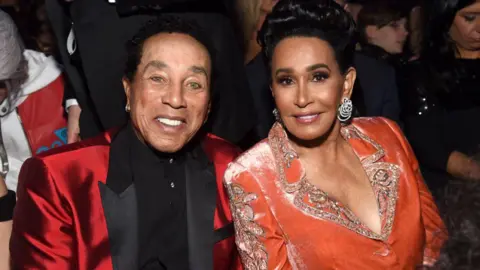
The chaos of Motown’s early ‘70s—the conflicts, the egos, the crushing pressure—took its toll. After 15 years, an exhausted Smokey stepped away from The Miracles in 1972. His subsequent solo career produced the velvet-smooth sensuality of hits like “Crusin'” (1979) and the global mega-hit “Being With You” (1981), proving his star power was undiminished.
Yet, behind the glittering lights, his private life was fractured. The image of the perfect golden couple with his first wife, Claudette Rogers (a fellow Miracle), was shattered in 1984 when Smokey publicly admitted to fathering a child, Trey Robinson, outside his marriage. The man who wrote songs full of honesty and tenderness had become the one causing the heartbreak, leading to a tearful, painful divorce that dragged on until 1986.
Even darker shadows loomed. In the early 1980s, Smokey fell into a devastating spiral of cocaine addiction—a battle he described as when “darkness becomes your most dangerous friend.” He was consumed, his career nearly freezing, his health collapsing to the point where he later admitted, “I came very, very close to dying.” He survived, but the personal tragedies—the addiction, the infidelity, the divorce—formed a foundation of complexity and deep wounds beneath the polished surface of the legend.
The $50 Million Storm and the Chilling Allegations
These past struggles were merely prelude to the crisis that erupted in May 2025.
At 85, Smokey Robinson was named in a $50 million lawsuit filed by four former employees who worked inside his California home. The initial complaint focused on labor issues, alleging they were denied proper minimum wage, overtime pay, and were subject to a professionally toxic environment. While serious, these claims were initially dismissed by Smokey’s attorney, Christopher Frost, as a cynical attempt to exploit his fame.
Then came the shocking twist in November 2025.
Two former employees, identified as Jane Doe 5 (a housekeeper) and John Doe 1 (an auto detailer), filed an amendment that sent shockwaves through the industry. Jane Doe 5, who worked for the Robinsons from 2005 to 2011, detailed allegations that crossed workplace boundaries and made her feel professionally violated. The complaint alleges that Robinson frequently called her to the second-floor bathroom, requiring her to “scrub his back,” and asked for assistance in “private areas of the house.” She claimed this resulted in long-term panic and psychological distress, so severe that she underwent breast reduction surgery years later in 2015, believing it would help her avoid drawing attention.
The housekeeper also pointed a direct finger at Smokey’s second wife, Frances Robinson, accusing her of creating a hostile work environment, yelling at and blaming staff, and crucially, ignoring complaints about her husband’s alleged behavior.
The claims involving John Doe 1, who was hired in 2013, were less detailed but equally disturbing. He claimed he experienced situations where Smokey made “personal remarks” and invited him into an inside room, moments that left him “unsure how to react.” The naming of Frances Robinson means the case is now a legal attack against the entire family, dramatically raising the stakes.
Defense, Division, and the Legacy Under Siege
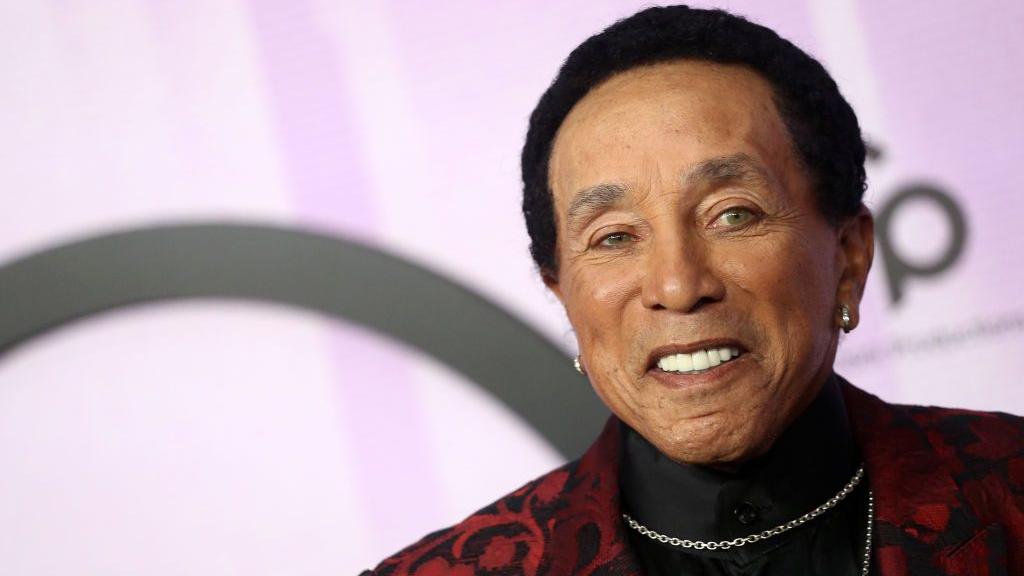
Smokey Robinson’s camp has mounted a staunch and aggressive defense. Attorney Christopher Frost rejected all allegations as a “coordinated fabrication meant to damage the reputation of an American music icon.” Frost stated that the plaintiffs were hiding behind anonymous identities to make “baseless” claims, vowing the Robinsons would fight to clear their names.
But the court of public opinion has already delivered a fractured verdict.
The moment the amended complaint went public, the internet split in two. On one side are the loyal fans who grew up with Tracks of My Tears, seeing Smokey as a spiritual father of soul. They believe this is a cynical “money grab,” a plot to destroy a good man.
On the other side are those who ask a terrifying, existential question: is this Motown’s dark side finally surfacing? Motown’s history, for all its glamour, was marked by tight control, internal battles, and shadows tightly covered during the 60s and 70s. This group does not rush to judgment but wonders if the public is finally seeing what was hidden.
American media has placed Smokey Robinson on a “danger list,” drawing uncomfortable comparisons to other older icons whose reputations were destroyed by similar accusations, such as Bill Cosby and R. Kelly. The trial is set for a long, painful public airing in October 2027. The biggest question is no longer just whether the allegations are true; it has become: Can Motown’s legacy survive this storm?
The Untold Legacies of a Poet
The cruel nature of scandal is that it often erases the good, amplifying only the trauma. Yet, Smokey Robinson’s story is incomplete without the full picture of the human being beneath the icon.
In the mid-to-late 1990s, the “voice of an angel” nearly vanished forever. Decades of non-stop touring had weakened his lungs and inflamed his vocal cords. He reached a point where his voice was so raspy, he couldn’t sing a full line. Doctors warned that continued performance could cause permanent damage, pushing him to the brink of retirement. It was the deepest fear of his life—losing the gift that saved him and lifted him out of poverty. He committed to a “brutal” discipline: daily breathing exercises, meditation, and dieting, all to protect his voice.
Furthermore, following his addiction and divorce, the man who wrote the world’s most beautiful love songs considered an entirely new path: becoming a minister. He sought peace through spirituality, spending months attending Bible classes and sermons, sincerely contemplating leaving music to heal others after he had healed himself.
Perhaps the most potent rebuttal to the image of an entitled, misbehaving icon is his decades of unsung community work. Smokey Robinson never stopped paying his “debt of gratitude” to Detroit. He funded schools, rebuilt music rooms, bought instruments for students, and created programs for Black children trying to escape poverty. A volunteer once noted, “He showed up early, helped with everything before the tables were even set, and left last. No one would ever guess he was an international superstar.”
It was this silent persistence and profound impact on society that led President George W. Bush to award him the Presidential Medal of Freedom in 2002. He received the highest civilian honor not just for the music he gave the world, but for the lives he transformed behind the scenes.
As the 2024/2025 storm hits, the truth will take years to surface. The man standing at the center of the courtroom is a glorious paradox: the poet who made millions cry, the sole writer of Motown, the man who nearly died from addiction, and the humble philanthropist who saved his community. He is a 60-year legend, but he is also a human being full of flaws and conflict.
What will remain when the dust settles? Will the integrity of the man who saved Detroit with his heart overshadow the image of the man accused of devastating his own household staff? Smokey Robinson is one of the last living links to the generation that created modern soul music, and his life, in all its light and darkness, is about to be told in full. The only question now is whether the poetry of his life is strong enough to survive the brutal prose of the courtroom.