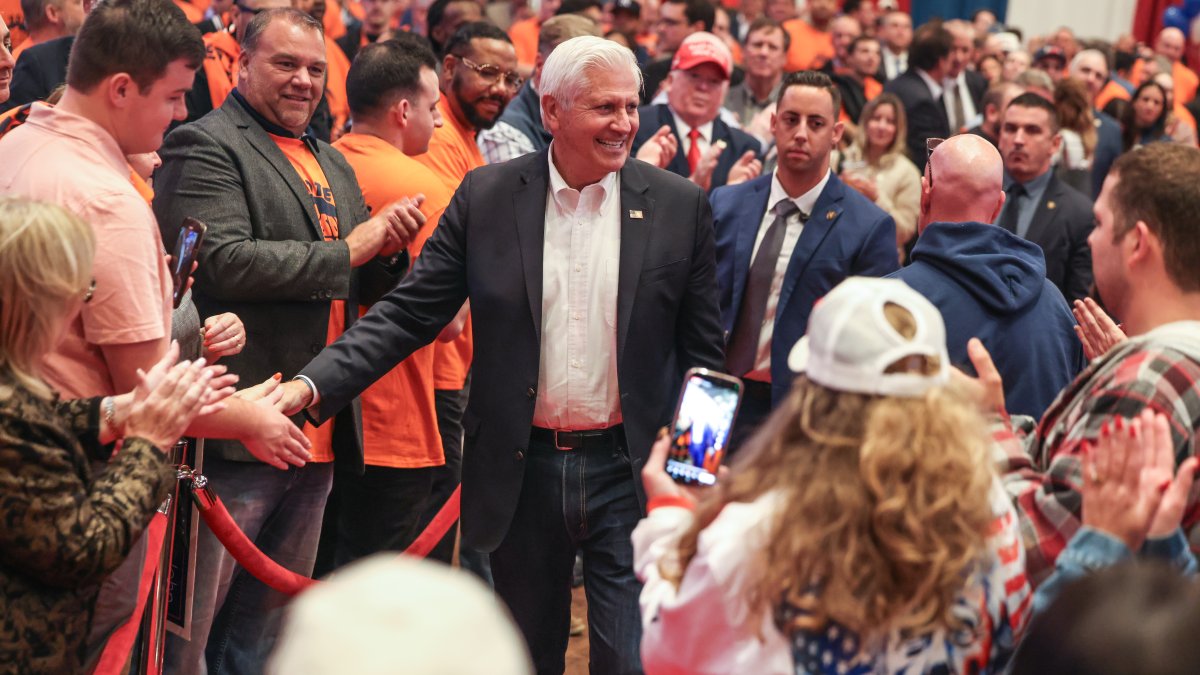
The political landscape of New York State—long considered an impenetrable fortress of progressive ideals—was rocked to its foundations this week, as one of the state’s most successful Republican county executives formally declared his candidacy for governor. Nassau County Executive Bruce Blakeman, an undeniable electoral powerhouse in one of New York’s most Democrat-heavy counties, announced his bid to seek the Republican and Conservative nominations, promising a return to sanity, safety, and economic prosperity in a state he argues has been failed by its current leadership.
Blakeman’s announcement was not merely a ceremonial declaration of intent; it was a rallying cry and an immediate declaration of political war against the entrenched progressive establishment. Speaking on national television, the veteran politician wasted no time in establishing the central emotional core of his campaign: a forceful defense of community safety and a scathing critique of what he perceives as a dangerous slide toward far-left radicalism in New York City and Albany.
The timing of his entry into the race could not be more significant, coming on the heels of controversial moves by New York City’s Mayor-elect, Montami. Blakeman first seized the narrative by addressing the outrage surrounding Montami’s selection of a criminal justice advisor—an individual who is an ex-convict for armed robbery—and an education advisor who reportedly idolizes a cop killer. But the most immediate and visceral point of contention was Montami’s explicit instructions on how New Yorkers can resist Immigration and Customs Enforcement (ICE), including tips like asking repeatedly, “Am I free to go?” and filming agents.
To Blakeman, this was more than just a political difference; it was an abandonment of foundational duty. He characterized the Mayor-elect’s actions as a “breach of his fiduciary responsibility,” emphasizing the fundamental principle that “the responsibility of every public official is to keep our communities safe.” This is the emotional hook for his entire campaign: contrasting the perceived chaos and lawlessness of the Democrat-run cities with the proven stability he has achieved in Nassau County.
Blakeman’s record serves as the stark counter-narrative. He proudly detailed Nassau County’s “most comprehensive agreement with ICE in the United States,” a policy choice he insists is not divisive but unifying. The support, he claims, comes overwhelmingly from the people Montami purports to protect: Hispanic Americans and Latinos in Nassau County. “They want safe communities,” he asserted, “they don’t want overcrowded schools, they don’t want homelessness in their communities.” By focusing on common, deeply-felt needs—safety, education, and stability—Blakeman has successfully turned what is often a polarizing issue into an example of cross-community solidarity behind his tough-on-crime, pro-community policy. This establishes his platform as one that transcends traditional partisan lines, tapping into the fundamental desire for a stable quality of life that unites all residents.
The announcement itself was a powerful affirmation of purpose. “I’m running for governor of the state of New York,” he declared with resolute confidence. His mission is clear and concise, boiled down to three core commitments that resonate deeply with the frustrations of New York voters weary of high taxes and rising insecurity: “We want to put New York first. We want to make it more affordable. We want to make New York safer, and we want to make people in New York happy again.” This focus on safety and affordability directly addresses the palpable migration of residents leaving the state—a phenomenon he aims to reverse by restoring the state’s luster as the “Empire State.”
In a state where Republicans are often written off before the first vote is cast, Blakeman’s strategy is rooted in hard-won evidence, not wishful thinking. He preemptively tackled the inevitable skepticism head-on: “Does a Republican in New York have a shot at being governor?” His answer was definitive, shouted with conviction: “Yeah, we’re going to win!”
The engine of this confidence is his unprecedented success in Nassau County, which he positions as a “mirror image” of New York State demographics. The statistics he cites are nothing short of stunning and immediately inject credibility into his statewide ambition. In a county with 110,000 more registered Democrats than Republicans, Blakeman won “substantially back-to-back.” This victory was not achieved by mobilizing the base, but by capturing a massive, historically Democratic crossover coalition.
He revealed that he captured nearly a third of the African-American vote, dramatically higher than the typical 9% a Republican usually secures. Even more impressively, he secured 56% of the Hispanic American vote. These numbers, combined with broad support from “independent women… independent men, [and] crossover Democrats,” paint the picture of a candidate who can successfully build a winning, multi-ethnic, and multi-partisan coalition that has eluded New York Republicans for decades. His victory margin of 36,000 votes in a heavily Democratic county serves as the tangible proof that his message of safety and fiscal common sense resonates across demographics. This deep-seated belief in his electability is perhaps the most emotionally powerful aspect of his campaign launch.
Of course, a major gubernatorial race is never without immediate fireworks. Blakeman’s announcement immediately drew the ire of the Democratic incumbent, Governor Kathy Hochul, who launched a stinging, personal broadside. Hochul dismissed Blakeman as a “bootlicker,” accused him of losing nearly every previous race, and claimed he “takes money out of New Yorkers’ pockets.” Her most direct attack, and perhaps the most loaded, was the warning that she would not “let him turn the governor’s mansion into Mar-a-Lago North,” attempting to tie him inextricably to the former President, Donald Trump.
Blakeman’s reaction was swift and cutting, transforming the attack into an opportunity to contrast his record against hers. He ignored the personal insults and focused entirely on results, calmly detailing his success story: “I made Nassau County the safest county in America,” he countered. He highlighted his fiscal stewardship, including being one of the most prosperous counties, cutting taxes, and not having “raised taxes a penny in four years.” The decisive blow was the revelation that Nassau County’s poverty rate is only “one-third of the poverty rate of the state of New York,” leading to his definitive conclusion: “She’s the one that’s been a failure.” This exchange showcases the high-stakes, bare-knuckle nature of the race and establishes Blakeman as a formidable counter-puncher who prefers data over partisan rhetoric.
The race also features a major primary challenge from Congresswoman Elise Stefanik, a national figure and also a close ally of Donald Trump. While Trump has signaled support for both candidates, calling them “great,” he has wisely chosen to withhold an official endorsement for the time being. Blakeman expressed his deep admiration for Trump, aligning his campaign goals with the former President’s focus on “economic development” and “creating prosperity,” but his primary appeal remains his local record of success. He acknowledges the tough road ahead—both the primary and the general election—but remains undaunted. “Absolutely, I’m ready for the fight,” he pledged, emphasizing the fight is ultimately “for your children and your grandchildren so that they have a bright future.”
Bruce Blakeman’s entry into the New York gubernatorial race is a political event of the highest magnitude. It is the culmination of years of building a successful, results-driven brand that has now reached critical mass. His campaign is built on the foundational promise of restoring common sense, fiscal discipline, and above all, safety to the Empire State. Backed by a proven ability to win a historic crossover vote, his resolute declaration—“We’re going to win!”—is no longer a boast, but a credible warning to the state’s powerful Democratic machine that their control is far from secure. He is offering New Yorkers a chance to make their state happier, safer, and more affordable, a message that clearly resonates with an electorate tired of high taxes and a feeling of growing instability. The battle for the soul of New York State has officially begun.