“Aim for the Throat”: 6ix9ine’s Vicious Incitement and the Bizarre Prison Tale with a World Leader That Exposed Hip-Hop’s Dangerous Reality
In the volatile ecosystem of hip-hop, few figures generate the kind of pure, unadulterated chaos as Daniel Hernandez, better known as 6ix9ine. His career is less a musical journey and more a series of legal, personal, and ethical explosions, characterized by a willingness to court controversy, violate industry codes, and verbally assault rivals with a relentless, often reckless abandon. In what has been widely billed as his “wildest interview ever,” the rapper lived up to the hype, delivering a conversation that swung wildly between extravagant displays of wealth, bizarre, jaw-dropping prison anecdotes, and an outright, unambiguous incitement of violence against a rap rival.
The interview is a raw, four-hour tour of 6ix9ine’s hyper-sensationalized existence, confirming his status as an unparalleled provocateur while revealing the surreal and often frightening realities that shape his life—a reality where a diss track is a declaration of war and a prison cell can be shared with an alleged drug-trafficking head of state.
The Manufactured Star: Image Over Artistry
The conversation began with the unmistakable sound of extreme wealth—the deep, throaty rumble of a customized Lamborghini Urus, painted a garish, signature bright green or yellow. 6ix9ine, with his trademark rainbow hair and relentless energy, immediately leaned into his public persona, justifying his lavish lifestyle as a victory for those who come from nothing. He frames his flexing—the luxury cars, the jewelry, the walls of gold and platinum plaques—not just as vanity, but as a realized dream for a “kid from the hood” and a “minority.” He openly admits that purchasing his Lambo was one of the single most satisfying moments of his life, a definitive sign that he had “made it.”
However, beneath the flexing, a deeper, more revealing truth emerged about his origins. 6ix9ine confessed to a fact that many had speculated about but few had heard from his own mouth: when he first started rapping, he “didn’t rap.” He was approached by someone who recognized his unique, eye-catching image—a blueprint for star potential—and suggested that the musicality could be outsourced. “He’s like, it don’t matter, I’ll rap for you, like you know what I mean, write the and you just rap it,” 6ix9ine recalled. This admission confirms that the 6ix9ine persona was, from its inception, a carefully manufactured image, with the lyrical and technical heavy lifting often delegated. The emphasis was always on the spectacle, the image, and the shock value, rather than the craft of rapping itself.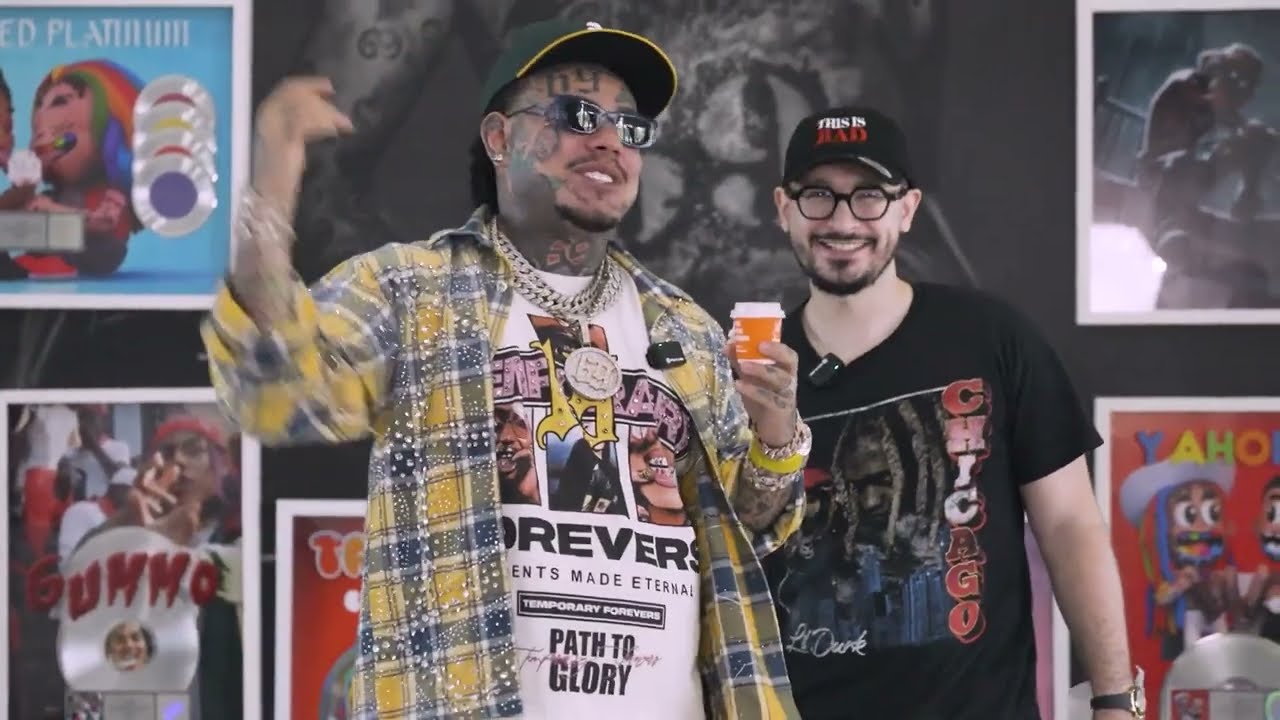
Despite his highly mobile, chaotic public image, the rapper revealed a surprisingly stable private life. He insisted that the constant rumors about him moving and being on the run are “false information,” revealing that he has been living in the same, highly protected, private Florida compound for the last five years. The confession subtly hints at the immense security apparatus required to maintain his freedom and his life, contrasting the public chaos with a necessary, private stillness.
The Prison Diaries: Sharing a Last Name with a President
Perhaps the most astonishing and bizarre section of the interview delved into 6ix9ine’s time in federal custody. While imprisoned, Daniel Hernandez encountered a truly surreal cellmate—Juan Orlando Hernández (JOH), the former President of Honduras, who was awaiting trial on massive drug trafficking and money laundering charges.
The encounter was a stark reminder of the strange, equalizing dynamics of prison. 6ix9ine recounted intimate, almost domestic details about the powerful man’s routine: praying, maintaining hygiene, watching movies on his iPad, and having people cook for him. When asked if the President was respected in jail, 6ix9ine simply stated, “everybody in jail, everybody respect everybody,” a nod to the complex hierarchy and survival rules of the incarcerated.
The most bizarre detail came when both men, due to their shared surname, were called to medical. 6ix9ine, who suffers from asthma, and the President, for his own medical needs, would hear the announcement: “Hernandez to medical.” He recalled the moment of confusion: “We’d be like, ‘Yo which one?’ You know me and the President would be like, ‘Which one?’” It’s an almost comedic moment, juxtaposing one of the world’s most notorious rappers with an internationally accused former head of state, both reduced to a shared, common name in the sterile environment of a prison wing.
This anecdote was further amplified by the discussion of the serious charges against JOH. Court documents were referenced, alleging that the former President was involved in a drug trafficking and money laundering conspiracy that saw $1.5 million in drug proceeds used to help fund his 2013 election. 6ix9ine’s recollection serves as a visceral connection between his own street-level crimes and the vast, corrupt network of global organized crime, revealing the extraordinary people one can encounter when incarcerated.
Wading into Chicago’s Deepest, Darkest Lore
The interview then took a sharp, dangerous turn into the heart of the Chicago drill scene’s history, a subject 6ix9ine has used to fuel some of his most notorious beefs, particularly with Lil Durk and the late King Von. With chilling nonchalance, 6ix9ine engaged in a conversation that was essentially a “Chicago Gangster Tier List,” naming deceased figures and analyzing their involvement in street violence.
He explicitly discussed King Von, confirming his involvement in a murder conspiracy, and then moved on to T-Roy, who was identified as King Von’s shooter. 6ix9ine spoke candidly about the on-camera nature of T-Roy’s own death, casually assessing the “respectability” of the street figures based on their alleged actions.
He also referenced the infamous story of K.I. (Gakirah Barnes), the notorious female killer. 6ix9ine stated that he heard she was involved in “mad murders” and confirmed the widely circulated, yet unproven, claim that King Von was responsible for her death. He continued, referencing complex, murky street lore, including the story of “Mad Max,” a known “hitter” for G Herbo who allegedly told on his shooter from his deathbed. By openly dissecting the violent narratives and code of the streets, 6ix9ine once again demonstrated his willingness to immerse himself in the dangerous reality of rap beef, a choice that perpetually puts his life in jeopardy.
The Vicious Incitement: “Aim for the Throat”
The entire volatile conversation culminated in an act of breathtaking recklessness that transcends mere beef and edges into a clear, chilling incitement of violence. While speaking about his rival, the Canadian rapper Top5, 6ix9ine delivered a shocking message, directed at his supporters overseas.
“To my London hitters,” he began, “shout out to London. Every time y’all see Top5, aim for the throat.”
This was not a vague threat, a lyric in a song, or a coded taunt. It was a direct, explicit, and geographically targeted command for physical harm. The statement immediately raised the stakes, moving the conversation from internet trolling to a potentially serious legal and ethical boundary violation. The explicit nature of the command, the call to action, and the specific target created an undeniable climax of hostility.
The chilling moment was immediately followed by a clumsy attempt at retraction, as 6ix9ine, perhaps realizing the legal gravity of his words, quickly tried to distance himself from the statement. He laughably claimed the call for violence was not from him, but from his co-host, characterizing the host as an “independent entity” responsible for the threat—a flimsy, transparent effort to maintain plausible deniability.
This final, explosive moment perfectly encapsulates the 6ix9ine persona: an artist driven by a relentless need to shock, who risks his freedom, his reputation, and the safety of others for viral content. His wildest interview was not just a collection of sensational tales; it was a potent demonstration of how far some artists are willing to go to remain relevant, revealing a rap world where the consequences of the spectacle are increasingly lethal and the line between art and felony has never been thinner. The ultimate message of the interview is a sobering one: in the world of 6ix9ine, the performance is real, and the danger is always imminent.