The Dangerous Freedom: Pooh Shiesty’s High-Stakes Comeback Pits A Sober Mind Against A Deadly List of Street Enemies
For Trell Don Williams Jr.—known globally as the controversial rap powerhouse Pooh Shiesty—the simple act of stepping out of federal prison on October 7, 2025, was not a celebration, but the first move in a high-stakes chess match. After serving approximately three long years of a 63-month sentence for firearm charges stemming from a chaotic Miami drug deal, his freedom is not marked by relief, but by profound, creeping danger.
The tension was palpable even before he crossed the threshold. A recent viral clip showed the rapper on his knees, his posture tense, his eyes conveying a mix of anxiety and grim acceptance as the city whispered a single, terrifying question: Is Memphis Most Wanted truly back? The streets, as the adage warns, never forget. For an artist whose ascent was fueled by raw lyrics, explosive beefs, and a brazen disregard for consequences, the danger lurking outside those federal gates may be far more lethal than the regulated confinement he just left behind.
In a calculated move that spoke volumes about the threats he anticipates, Williams didn’t waste a second on welcome parties or risky meetups. Within hours of breathing free air, he linked up with his trusted Memphis crew, K Carbon and Big 30, for an immediate studio session. It was a smart, defensive maneuver—a decision to dodge the attention of both old enemies and the law enforcement agencies still scrutinizing his every step. The action signaled his priority: straight back to work, straight back to the craft that made him a global sensation, and straight out of the line of fire.
The Chaotic Downfall: A McLaren, A Draco, and $40,000 on the Freeway
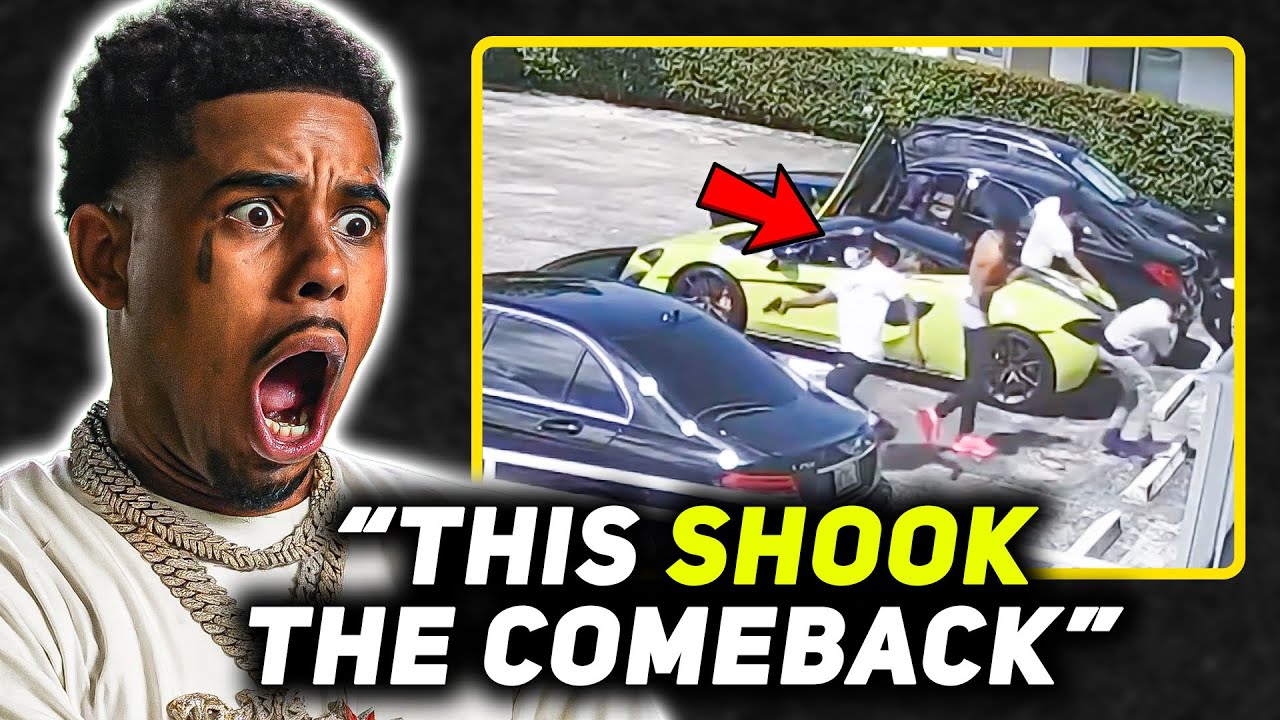
The source of Williams’ three-year disappearance from the spotlight traces back to a spectacular, reckless incident on October 20, 2020. What began as a plan to buy designer sneakers and a stash of marijuana from two sellers, arranged through Instagram, spiraled into a Hollywood-grade heist and shootout outside the sleek Landon Hotel in Bay Harbor Islands, Florida.
Williams, just 21 at the time, and his associate, Bobby Brown, arrived in a rented white McLaren 720S—clean, flashy, and carrying an unmistakable air of overconfidence. They were also heavily armed. Williams carried a potent Draco AK-47 pistol, while Brown had a handgun. Things quickly went sideways when one of the sellers attempted to shortchange them. In the resulting chaos, both Williams and Brown pulled their weapons. According to federal reports, Williams fired a shot, hitting one man in the backside and the other in the hip. Miraculously, no one was killed.
The violence was matched only by the ensuing frenzy. After snatching the cash and merchandise, they sped off up the Palmetto Expressway. In the rush, a critical piece of evidence—a Louis Vuitton bag stuffed with an astounding $40,684—flew right out of the high-speed McLaren and landed on the street. Police recovered the bag, along with shell casings matching the Draco’s ammo. Hotel security footage captured the entire sequence: the flashy arrival, the gunfire, and the money drop.
But the most damning evidence came from Williams himself. Just hours later, he brazenly posted clips on Instagram, flexing in the same white McLaren and flashing cash as if nothing had happened. That move sealed his fate. Fingerprints, traffic cameras, the recovered money, and his own social media receipts left investigators with an undeniable mountain of evidence.
The King of Diamonds Controversy and the Plea Bargain That Saved His Career
The Miami hotel incident was not an isolated event. Months later, Williams found himself entangled in another highly publicized shooting at the King of Diamonds strip club on May 30, 2021, just after a Memorial Day weekend performance. Witnesses claimed an accidental bump caused anywhere between $3,000 and $40,000 in cash to spill onto the floor, leading to a mad scramble. When a security guard named Door attempted to grab Williams to diffuse the situation, the rapper allegedly pulled a concealed gun and fired, hitting the guard in the ankle. Surveillance footage captured Williams flashing the weapon and later slipping it back into his waistband during his exit in a black Cadillac Escalade.
The charges were severe: aggravated battery with a deadly weapon, carrying a potential sentence of five to 30 years. Though the security guard later filed a sworn affidavit recanting his story—claiming pain medication had him confused and that his injury was from the stampede—prosecutors suspected witness tampering. However, the video evidence remained, ensuring the case retained its gravity.
With two major violent incidents and a mountain of evidence stacked against him, Williams had no choice but to cut a deal with federal prosecutors. The original indictment was devastating, hitting him with charges like conspiracy to commit Hobbs Act robbery and discharging a weapon, the gun charge alone carrying a mandatory minimum sentence of ten years, with the potential for life behind bars.
The resulting plea bargain was a game-changer. On January 4, 2022, Williams officially pleaded guilty to a single, reduced charge: conspiracy to possess firearms in furtherance of violent crimes and drug trafficking. This pivotal deal wiped out the mandatory ten-year sentence, dropped the robbery charges, and folded in the King of Diamonds shooting without requiring extra time. Had he gone to trial and lost, he would have been staring down twenty years or more. Instead, the agreement locked his sentence at a maximum of eight years, which, coupled with credit for taking responsibility, led to the final sentence of 63 months (just over five years) handed down on April 20, 2022, by Judge K. Michael Moore.
Redemption Behind Bars: Sobriety and the First Step Act
Williams’ time in the federal correctional system—bouncing through facilities like USP Pollock, FCI Tallaladega, and USP Coleman 2—was not marked by idleness. He kept his head down and focused on self-improvement, a dramatic shift from his previously reckless lifestyle. He spoke about his time being a forced immersion into total sobriety, a process that provided a much-needed clarity after years of heavy drug and alcohol use.
In conversations from behind the walls, Williams conveyed a genuine shift in mindset, maturity, and a drive to build a clean life. He saw serious violence up close—fights, stabbings, and deaths among inmates—experiences that pushed him further away from the life that sent him there. He actively pursued programs designed to tackle criminal thinking, took the ASVAB exam, and even worked as a recreation supervisor. Crucially, he stacked credits for good behavior under the 2018 First Step Act, a piece of legislation designed to cut time for inmates engaged in rehabilitation and learning. This dedication paid off handsomely, knocking about 15% off his sentence and moving his projected release date from July 2027 all the way up to October 2025—a major break that changed his entire path.
The Unstoppable Juggernaut: A Legacy Built on Streams

Despite his incarceration, Pooh Shiesty’s commercial power never waned. The loyalty he received from industry heavyweights—Lil Baby, Lil Durk, Don Trip, and Gucci Mane—underscored his undeniable value. His catalog, built mostly between 2020 and 2021, racked up over two billion Spotify streams and earned more than 20 RIAA certifications, solidifying his status as a controversial but commercially unstoppable force.
His breakout hit, “Back in Blood,” featuring Lil Durk, became a street anthem, going eight times platinum and pulling in 1.2 billion streams. His feature on Drake’s “Wants and Needs” became a career-defining moment, peaking at number two on the Billboard Hot 100 with a massive 800 million streams. Even his 2021 project, Shiesty Season, peaked at number three on the Billboard 200, proving his dominance extended beyond singles. In a powerful testament to his enduring relevance, his streaming numbers shot up by another 30% following his October 2025 release, proving fans are ravenous for the next chapter of his story.
Walking into a Warzone
The sober, reflective man who walked out of prison is stepping back into a world where rap feuds are not just talk, but deadly realities. The music industry has recently lost too many major figures—King Von, Pop Smoke, Young Dolph, Takeoff, PnB Rock—to gun violence, robberies, and feuds that originated online but ended tragically in blood. That dangerous wave now looms over Williams.
His early, aggressive rise was built on bold lyrics and explosive rivalries, creating a long and silent list of enemies across Memphis and beyond. The danger is magnified by his home city, which the FBI names among America’s most dangerous. In Memphis, the street code is an iron law: respect, revenge, and reputation dictate survival. Once a name carries weight, it becomes both a source of power and a magnet for peril.
Williams’ decision to immediately link up with his crew and dive back into the studio was less about artistic ambition and more about pure self-preservation. It was a clear effort to dodge the attention of those who may seek revenge or attempt to claim his fame.
The central conflict of Pooh Shiesty’s comeback is a terrifying dichotomy: the newly focused, sober man who accepted responsibility for his past is now walking straight into the violent, unpredictable chaos that his former self created. The stakes are monumental, pitting a reformed mindset against the raw, uncompromising street code that still holds power over his life. The question remains: Can the new Pooh Shiesty survive the old one’s enemies? The city is watching, and the countdown has already begun.