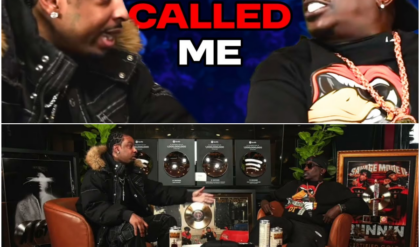
The rise of G-Unit was a triumph of audacity and street-level genius, but its history is equally defined by a painful, predictable pattern of attrition. At the center of that triumph—and its subsequent fallout—stood Sha Money XL, the architect of the crew’s sound and the co-founder and first President of G-Unit Records. Sha Money XL was more than a producer; he was the structural engineer who helped translate Curtis Jackson’s ambition into a corporate entity.
Yet, as revealed in his own unflinching account, the partnership did not end with a handshake or a mutual decision. It ended with a devastating act of cold, executive betrayal, delivered not by 50 Cent himself, but through a chilling phone call from his business manager. The reason for the collapse? A classic, yet often fatal, violation of an unspoken rule codified in a book that Sha Money XL himself introduced to his partner: “Never Outshine the Master.”
The Architect of the Invasion
Sha Money XL’s role in the Get Rich or Die Tryin’ era was foundational. While the album propelled 50 Cent to stardom, Sha Money XL served as his dedicated manager, traveling city-to-city, state-to-state. The relentless touring schedule made it impossible for him to focus on beat-making with his large MPC unit. Recognizing the necessity of constant creative output, he quickly pivoted.
Instead of trying to be the sole producer, Sha Money XL transitioned into an A&R and management powerhouse. He began scouting and managing a roster of talented, unheralded producers, including Black Jarus, Chad Beats, and Ill Mind. His approach was simple: he didn’t judge them; he only cared about their talent. He would compile their best work onto beat CDs without their names, knowing 50 Cent simply wanted “good music.” This ingenious move created the foundation of the G-Unit sound and ensured a constant supply of heat for the label’s nascent roster.
This strategy quickly grew into Money Management, which then became the bedrock upon which the G-Unit Records empire was built.
From Manager to Mogul
When Jimmy Iovine, head of Interscope, greenlit the G-Unit label, 50 Cent turned to Sha Money XL. “Yo, you going to be the president?” he asked. Sha Money XL accepted, taking on a monstrous new responsibility. He transformed overnight from a touring manager and producer into a full-fledged record label executive and co-founder.
The job involved building the enterprise from scratch. This meant finding and setting up the office, establishing the yearly budgets, determining employee salaries, and assembling an entire promotional infrastructure: hiring a promo team, securing a radio team, and creating a cohesive, functional corporate body (3:09-3:23). It was a complex operation built on 50 Cent’s vision but executed by Sha Money XL’s tireless dedication and industry acumen.
As the label gained traction, Sha Money XL’s ambitions expanded beyond managing music. He started observing the moves of industry titans like Chris Lighty. He realized he could leverage his own relationships to create massive, non-traditional deals. The breakthrough came when he was approached about getting 50 Cent to wear S Dot sneakers. Sha Money XL suggested customizing them with the G-Unit logo. The result was a box of personalized S Dots, worn by 50 Cent on stage, which immediately sent the crowd—and the internet—into a frenzy. This organic promotion quickly led to the lucrative Reebok deal, where 50 Cent ended up selling more sneakers than top-tier athletes (5:04-5:10).
This success was definitive proof of Sha Money XL’s executive trajectory. He was no longer just the co-pilot; he was moving parallel to 50 Cent, demonstrating an ability to generate massive wealth and brand recognition. In the realm of power dynamics, this level of executive independence was a dangerous threshold.
The Inevitable Downfall: The Ferrari and the Law![Sha Money XL Takes It Back To The Block With "Never Did You Wrong" [Video]](https://bossip.com/wp-content/uploads/sites/28/2020/05/15883597062991.jpg)
The turning point was painfully clear, marked by an expensive, symbolic purchase. Sha Money XL bought a Ferrari.
Pulling up to an all-hip-hop party in his new luxury car, Sha felt the justifiable pride of success. He had grown up with Matchbox cars and Hot Wheels; this was the physical manifestation of his years of grinding. But in his neighborhood, he noted a phenomenon where “the hater is more stronger than the love.” This energy, amplified by outside whispers, eventually reached 50 Cent.
The confrontation was swift and brutal. “Yo, Sha, you making too much money, man,” 50 Cent declared (5:34-5:40). Sha Money XL, bewildered, tried to rationalize, “Son, I’m just making some money, bro.” But 50 Cent’s resentment was palpable: “Yo, bro, I ain’t even got a Ferrari yet.”
It was the moment Sha Money XL violated the most sacred and unforgiving rule in the power playbook: Law 1: Never Outshine the Master.
He had been reading the very book that contained this decree: Robert Greene’s The 48 Laws of Power. His success, his confidence, and his new car were not celebrated; they were perceived as a direct threat. The emotional damage was compounded by the fact that the two had been in the trenches together, from the days of recording in Sha Money XL’s basement and paying the electric bills (6:42-6:46). But once money entered the equation, the counting began, and the suspicion that “he’s making money from me” started to poison the partnership.
The Poisoned Gift
The irony of the betrayal is almost Shakespearean. Sha Money XL was so enamored with The 48 Laws of Power that he recommended it to 50 Cent, believing the insights would help him elevate his thinking. “Yo Fif, this book right here is fire, bro,” he told him (7:51-7:56).
What followed was a slow, calculated application of the book’s principles by 50 Cent, who, unlike Sha Money XL, was willing to act on its darker, more ruthless advice. Sha admits he was more “religion based” and couldn’t embrace the more manipulative aspects of the laws (8:53-9:02). 50 Cent, however, “literally read that in and out” and weaponized the wisdom.
Sha Money XL watched, stunned, as their dynamic shifted. “We went from partners, I went to an employee and all kind of shit,” he recalls (8:15-8:21). 50 Cent, whose eventual collaboration with Robert Greene resulted in the book The 50th Law, proved to have an “ill” mind for executing these power plays, using the very insights gifted to him by his partner to gain control and solidify his mastery.
The internal tension was intensified by a fundamental disagreement over equity: 50 Cent refused to give up a percentage of G-Unit ownership that Sha Money XL felt he was owed (9:48-9:55).
The firing, when it finally came, was delivered with the cold detachment of a true executive decision. After years of service, after helping launch every G-Unit album from the beginning up until Lloyd Banks’ The Hunger for More and Young Buck’s Buck the World, Sha Money XL was not informed by his partner. His business manager delivered the news: “Fif don’t want you to be the president of label one” (7:11-7:16).
Sha Money XL recognized the move as part of a recurring pattern, a “ticking time bomb” within 50 Cent’s orbit (10:10). The Game was dropped first, and eventually, the rotation came for him.
Today, Sha Money XL holds no bitterness, reframing the departure philosophically: “It’s not beef, it’s just a bad the way business sometimes it don’t work out” (10:26-10:30). Yet, his story remains a powerful, cautionary tale of hip-hop’s biggest success story—a narrative in which loyalty, friendship, and collaboration ultimately succumbed to the inescapable, destructive force of ultimate power, guided by a book meant to instruct, but which was ultimately used to betray.