The first class cabin of flight 437 was everything money could buy. Spacious leather seats that reclined into beds. Ambient lighting that mimicked sunset. Attentive flight attendants who anticipated every need before it was voiced. It was a cocoon of luxury 35,000 ft above the earth. Designed to make wealthy travelers forget.
They were hurtling through the sky in a metal tube. Christopher Hayes settled into his seat by the window and immediately pulled out his laptop. He was 37 years old with dark brown hair styled precisely back from his face and he wore a tailored gray suit that probably cost more than most people spent on rent. As CEO of Hayes Capital Management, one of the fastest growing investment firms in the country, Christopher was used to luxury, used to efficiency, used to every moment being productive and every interaction being transactional. He had
a presentation to refine for tomorrow’s board meeting in San Francisco, numbers to review, projections to analyze. His assistant had booked him on the red eyee specifically so he could work without interruption, and Christopher intended to use every minute of the 6-hour flight productively.
He was already deep into spreadsheets when he became aware of movement in the aisle beside him. A flight attendant was helping a small child settle into the seat next to his. Christopher’s jaw tightened slightly. He’d paid for first class specifically to avoid crying babies and restless children. This was supposed to be his workspace.
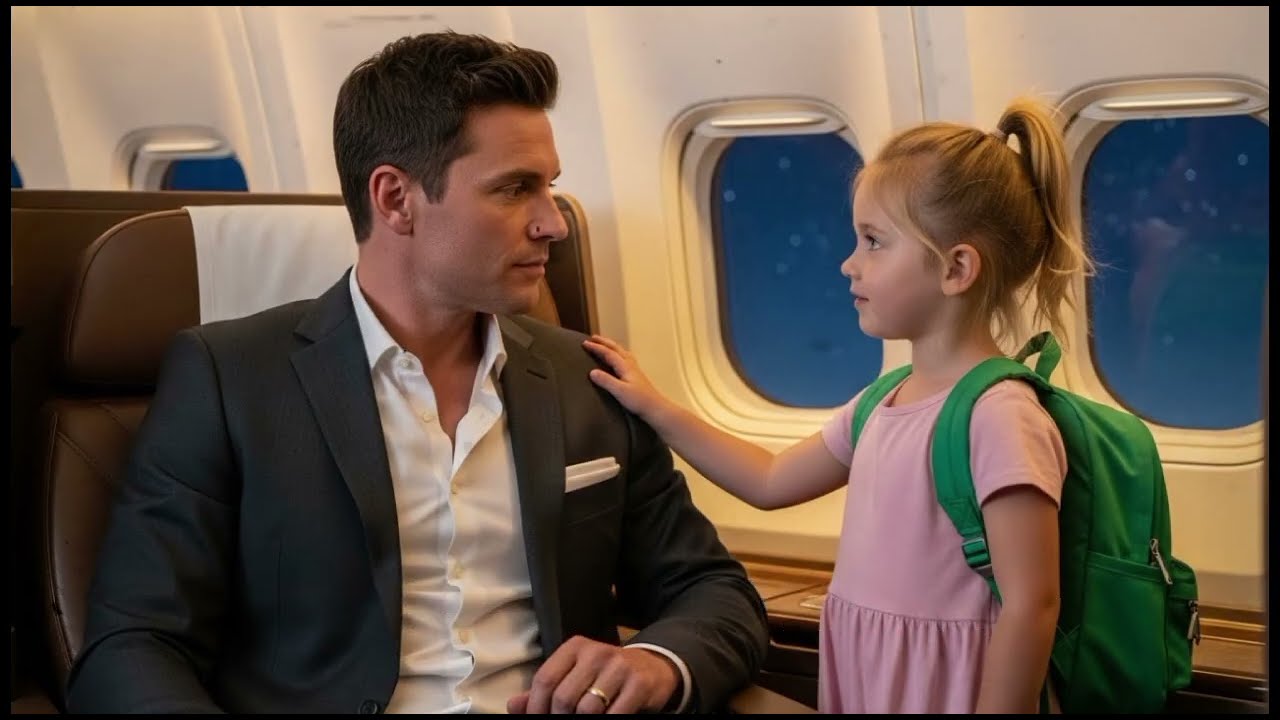
The little girl was maybe four or 5 years old with reddish blonde hair pulled back in a ponytail. And she wore a pink dress with a green backpack that looked nearly as big as she was. She climbed into the large seat and immediately began exploring all the buttons and features with the fascinated wonder that only children possess. Christopher tried to ignore her and focus on his work, but it was difficult when she kept pressing the seat recline button, making it go up and down, up and down, clearly delighted by the mechanism. “Honey, you need to leave
that alone,” the flight attendant said gently. “Let me help you get settled.” “Where’s my mommy?” the little girl asked, and Christopher heard a tremor in her voice. “Remember, your mommy had to stay in Boston with your baby brother because he got sick. But your aunt Diane is in San Francisco and she’s so excited to see you.
You’re going to have a fun visit. The little girl nodded but didn’t look convinced. After the flight attendant helped her buckle in and showed her where the airsickness bag was, just in case, she left them alone. The cabin lights dimmed as the plane prepared for takeoff, and Christopher returned his attention to his laptop screen.
They were 20 minutes into the flight when he felt a small hand tap his arm. He looked over to find the little girl studying him with serious blue eyes. “You look tired, sir,” she said with the blunt honesty that only children can get away with. Christopher blinked, surprised both by the observation and by being addressed at all. “I’m fine, thank you. Just working.
That’s what my mommy always says.” That she’s fine and just working, but she looks tired, too, and sad sometimes, even when she’s smiling. Christopher wasn’t sure how to respond to that. He turned back to his laptop, hoping the child would take the hint. She didn’t. “What are you working on?” she asked, leaning over to peer at his screen.
“Financial reports. Very boring stuff. Nothing you’d find interesting. What’s financial reports?” Christopher sighed internally. “It’s information about money, how much people have, how much they’re making, where it should go.” The girl considered this. That does sound boring.
Do you like it? The question was so direct, so guileless that Christopher found himself pausing. Did he like it? He was good at it. He made a lot of money doing it. It was what he’d built his entire adult life around. But did he like it? It’s my job, he said, which wasn’t really an answer. My mommy has a job, too. She works at a hospital helping sick people.
She says it’s hard but important. Is your job important? Christopher looked at this small child who was asking him questions. He normally didn’t let himself consider. I suppose that depends on your definition of important. What’s definition? It means how you think about something, what it means to you. The little girl nodded wisely as if this made perfect sense.
Then she pulled a coloring book and crayons from her green backpack. I’m going to color now. Do you want to help me? I need to work. Okay, but if you get tired of working, I have extra crayons. She bent over her coloring book, and Christopher returned to his spreadsheets, but he found his concentration broken. He kept glancing over at the child, who was carefully coloring a picture of a butterfly, her small tongue poking out slightly in concentration.
Half an hour later, she spoke again. “Sir, do you have any kids?” Christopher closed his eyes briefly. “No, I don’t.” “Why not? because I’ve been too focused on my career and I got divorced three years ago. My wife said I worked too much and didn’t make time for a family. He was startled that he’d said that last part out loud.
He never talked about his divorce. Never admitted that Rebecca had left him because he’d chosen board meetings over date nights one too many times because he’d missed their anniversary 3 years in a row because he’d slowly become someone who could run a company but couldn’t maintain a marriage. That’s sad, the little girl said matterof factly.
My mommy says that work is important but love is important her. That’s not a real word important. But that’s what I say and mommy understands. Your mommy sounds very wise. She is. She’s the bestest mommy ever. Even though she’s tired a lot because she has to work and take care of me and my baby brother Luke by herself. My daddy left before Luke was born.
Mommy says he wasn’t ready to be a daddy, but that’s okay because we’re doing fine without him. The matter-of-act way she recounted her family situation. The absence of self-pity or shame struck Christopher deeply. This little girl had a harder life than most, a single mother stretched thin by work and child care, a father who’d abandoned them.
And yet she spoke about it with simple acceptance and focused on the love that remained rather than what was missing. What’s your name? Christopher asked, realizing he should have asked this much earlier. Olivia Grace Thompson. But everyone calls me Libby. What’s your name? Christopher Hayes. That’s a fancy name. Can I call you Mr. Christopher? Sure.
Libby returned to her coloring, and Christopher tried once again to focus on his work, but now his mind kept wandering. He thought about Rebecca, about the life they could have had if he’d been willing to make different choices. He thought about his empty penthouse apartment, his expensive car, his successful company, and wondered when success had started feeling so hollow.
An hour into the flight, the plane hit turbulence. Not the mild bumping that experienced travelers barely notice, but serious turbulence that made the aircraft drop suddenly and luggage compartments rattle. The seat belt sign dinged on urgently, and Christopher felt his stomach lurch as the plane bucked again. He heard a small gasp beside him and turned to see Libby gripping her armrests, her knuckles white, her face pale with fear.
“It’s okay,” Christopher said automatically. “It’s just turbulence. The plane is fine. I’m scared,” Libby whispered, and he could see tears forming in her eyes. Without thinking, Christopher reached over and took her small hand in his. “Hey, it’s all right. I’m right here. The pilots know what they’re doing.
This happens sometimes, but we’re safe. Libby looked at him with those serious blue eyes, and Christopher saw her making a decision to trust him. She unbuckled her seat belt, and before he could tell her that wasn’t safe, she had climbed over into his lap, burrowing against his chest like a frightened kitten.
“Liby, you need to be in your own seat with your “Please,” she whimpered. “Please let me stay. My mommy holds me when I’m scared. You can hold me like a mommy holds. Please.” Christopher froze. Every rule about liability and appropriate boundaries flashed through his mind, but the plane lurched again, and this small child was terrified and alone, and he found himself wrapping his arms around her and holding her securely.
“It’s okay,” he murmured, feeling awkward but determined to comfort her. “I’ve got you. You’re safe. Just breathe. Okay. In and out. That’s it.” Libby pressed her face into his suit jacket and took shuddering breaths. The turbulence continued for another 10 minutes, and Christopher held her through all of it, feeling her small body trembling against his, murmuring reassurances that seemed to help both her and himself.
When the turbulence finally subsided and the seat belt sign dinged off, Libby didn’t immediately move. She stayed curled against Christopher’s chest, and he realized she’d fallen asleep, exhausted by fear. In the late hour, a flight attendant approached, looking concerned. “Sir, she really should be in her own seat.
” “She was terrified during the turbulence,” Christopher said quietly. “Let her sleep for a bit. I’ll move her back once she’s deeper asleep.” The attendant nodded and moved on. Christopher looked down at the sleeping child in his arms, feeling something unfamiliar and profound shifting in his chest. When was the last time someone had trusted him like this? When was the last time he’d been needed? Not for his money or his business acumen, but simply for his presence and comfort.
His laptop sat forgotten on the tray table, spreadsheets still glowing on the screen, and Christopher realized he didn’t care about them. For the first time in years, work didn’t seem like the most important thing. this child, this moment, this simple act of providing comfort to someone who needed it. This felt more important than any financial projection ever could.
He held Libby for another half hour until her sleep was deep and steady, then carefully transferred her back to her own seat and buckled her in. She stirred briefly, but didn’t wake. Christopher looked at his laptop, then closed it and put it away. He spent the rest of the flight thinking rather than working, looking out the window at the dark sky and the lights of cities far below, contemplating the conversation with a 5-year-old that had somehow cut through years of carefully constructed defenses.
As the plane began its descent into San Francisco, Libby woke up. She looked around, momentarily confused, then saw Christopher and smiled. Hi, Mr. Christopher. Did I fall asleep on you? You did. You were very tired. Thank you for holding me when I was scared. You’re a good holder, like a daddy. Christopher felt his throat tighten. You’re welcome, Libby.
As they deplained, Christopher kept pace with the small girl, making sure she safely met her aunt at the gate. The woman was in her 40s, warm and friendly, and she swept Libby up in a tight hug. “Thank you for looking after her,” Diane said to Christopher. “Flight with a little one can’t have been easy. She was wonderful company, Christopher said, and he meant it. He looked at Livy.
You be good for your aunt, okay? Libby hugged his legs unexpectedly. Bye, Mr. Christopher. I hope you stop being so tired. And I hope you get less sad because you seem like you should be happy. She skipped off with her aunt, and Christopher stood in the airport terminal, watching them go, feeling like something fundamental had shifted in his universe.
He took a cab to his hotel, checked in, and sat in his room looking at the presentation he was supposed to give in 6 hours. It was good. It was brilliant, actually. It would almost certainly secure the investment he was seeking. But looking at it now, Christopher felt a disconnect he’d never experienced before. He thought about Libby asking if his work was important, about her mother working herself to exhaustion to provide for her children, about the way Libby had trusted him to keep her safe during the turbulence, how she’d fallen asleep in his arms as if
she belonged there. Christopher opened his laptop and began to type, but not a business presentation. Instead, he wrote an email to his board of directors. Then, he made some phone calls despite the early hour. By the time the sun rose over San Francisco, he’d set in motion a series of decisions that would have seemed impossible just 12 hours earlier.
At the board meeting that morning, instead of the presentation about aggressive expansion they’d expected, Christopher gave them something different. I’m taking a 6-month sbatical, he announced, effective immediately. During that time, I’ll be transitioning some of my responsibilities to the executive team and restructuring the company to operate less dependently on any one person, including me.
” The room erupted in shocked questions, but Christopher held up a hand. “I’m also announcing a new initiative. Hayes Capital Management will be establishing a fund to support single parents in crisis, child care assistance, emergency financial support, scholarship programs. The details will be worked out by a committee, but I’m committing $10 million of personal funds to get it started.
Christopher, what’s gotten into you? His CFO asked, looking bewildered. A 5-year-old girl asked me if I liked my job, Christopher said simply. And I realized I didn’t have a good answer. She asked if my work was important, and I couldn’t honestly say yes. So, I’m taking time to figure out what actually matters and restructure my life accordingly.
Over the following months, Christopher did exactly that. He found a therapist and worked through the workaholic patterns that had destroyed his marriage. He volunteered at a children’s hospital, reading to kids who were scared and alone. He reconnected with his sister, whose children barely knew him because he’d always been too busy to visit.
He also tracked down Livy’s mother, Sarah Thompson, through the flight records. She was a pediatric nurse, just as Libby had said, working double shifts to support her two children. When Christopher appeared at the hospital with a proposition, Sarah was immediately suspicious. “I don’t know what you want,” she said wearily. “But my daughter isn’t I don’t want anything inappropriate,” Christopher interrupted.
“Your daughter sat next to me on a plane and asked me some questions that made me rethink my entire life. I’d like to thank her by helping your family. And before you say no out of pride, please understand that you’d actually be doing me a favor. I have more money than I know what to do with, and I’ve recently realized that the only thing that makes it meaningful is using it to help people who actually need it.
He offered to pay off Sarah’s student loans and medical debt. He set up college funds for both children. He offered to fund a down payment on a house so they wouldn’t have to live in their cramped apartment anymore. Sarah cried overwhelmed and disbelieving. Why? Why would you do this for strangers? Because your 5-year-old daughter showed me more kindness and wisdom in a 6-hour flight than most adults show me in a year.
Because she held my hand during turbulence and offered me crayons and asked me if I was tired in a way that made me actually think about the answer. Because she reminded me that the most important things in life aren’t spreadsheets and board meetings. They’re connection and compassion and caring about people beyond what they can do for you.
Sarah agreed to accept the help, and Christopher found himself becoming a regular presence in their lives, not romantically, though he and Sarah eventually discovered they had much in common and began dating after several months of friendship. But primarily, he became someone Libby had called him that night, a good holder, someone who showed up, someone who cared.
2 years after that fateful flight, Christopher stood at the altar of a small church. Libby was his flower girl, wearing a pink dress and taking her responsibilities very seriously. Luke, now three, was the ring bearer, though he mostly just toddled around looking adorable. As Sarah walked down the aisle, Christopher felt tears in his eyes.
He thought about the man he’d been on that plane, so focused on work that he’d missed the entire point of life. and he thought about the little girl who’d seen through his expensive suit and busy demeanor to the tired, sad person underneath. At the reception, Libby pulled on his hand. Mr. Christopher, I mean, Daddy Christopher, are you still tired and sad? Christopher knelt down and hugged her.
No, sweetheart. I’m not tired or sad anymore. I’m actually really happy. And that’s because of you. Because I asked you questions on the airplane? Because you cared enough to ask? Because you saw me when everyone else just saw a businessman. Because you reminded me what actually matters. Libby beamed. I knew you should be happy.
You looked like someone who needed to smile more. Are you going to smile lots now? Yes, I’m going to smile lots now. And he did. Christopher restructured his entire company to allow for remote work and family leave. He cut his own hours in half and spent the extra time coaching his stepchildren’s sports teams and volunteering at the hospital with Sarah.
He became known not as the ruthless CEO who would do anything for profit, but as the businessman who’d radically changed his priorities after a conversation with a child. Years later, when Libby was a teenager, she asked him about that night. Do you really remember everything I said on the plane? Every word, Christopher confirmed.
You asked me if I like my job. You told me your mommy said work was important, but love was important to her. You said I looked tired and sad. And you offered me crayons and all that really changed your life. All that saved my life. I was on a path to becoming a very successful, very wealthy, very miserable old man. You showed me there was another way.
That success without love is just emptiness. That being tired isn’t a badge of honor. It’s a sign you’re doing something wrong. Livy hugged him. I’m glad I sat next to you on that plane. So am I, sweetheart. So am I. Because sometimes the most profound wisdom comes from the most unexpected sources. Sometimes a child’s innocent question can shatter years of carefully constructed rationalizations.
Sometimes all it takes to change your life is someone caring enough to notice you’re tired. To offer you crayons, to trust you to hold them when they’re scared. Sometimes the most important meeting you’ll ever have isn’t with investors or board members, but with a 5-year-old girl on a plane who sees through your armor to the person underneath and likes that person anyway.
And sometimes, if you’re very lucky, that 5-year-old becomes your daughter, and you get to spend the rest of your life trying to be worthy of the wisdom she shared and the love she offered so freely. Christopher Hayes had built an empire, but Libby Grace Thompson had taught him what to do with it, and that had made all the difference.