Part 1
“This passport is fake.”
The words, sharp and flat, cut through the low hum of the San Isidro border control station.
“You think I was born yesterday?”
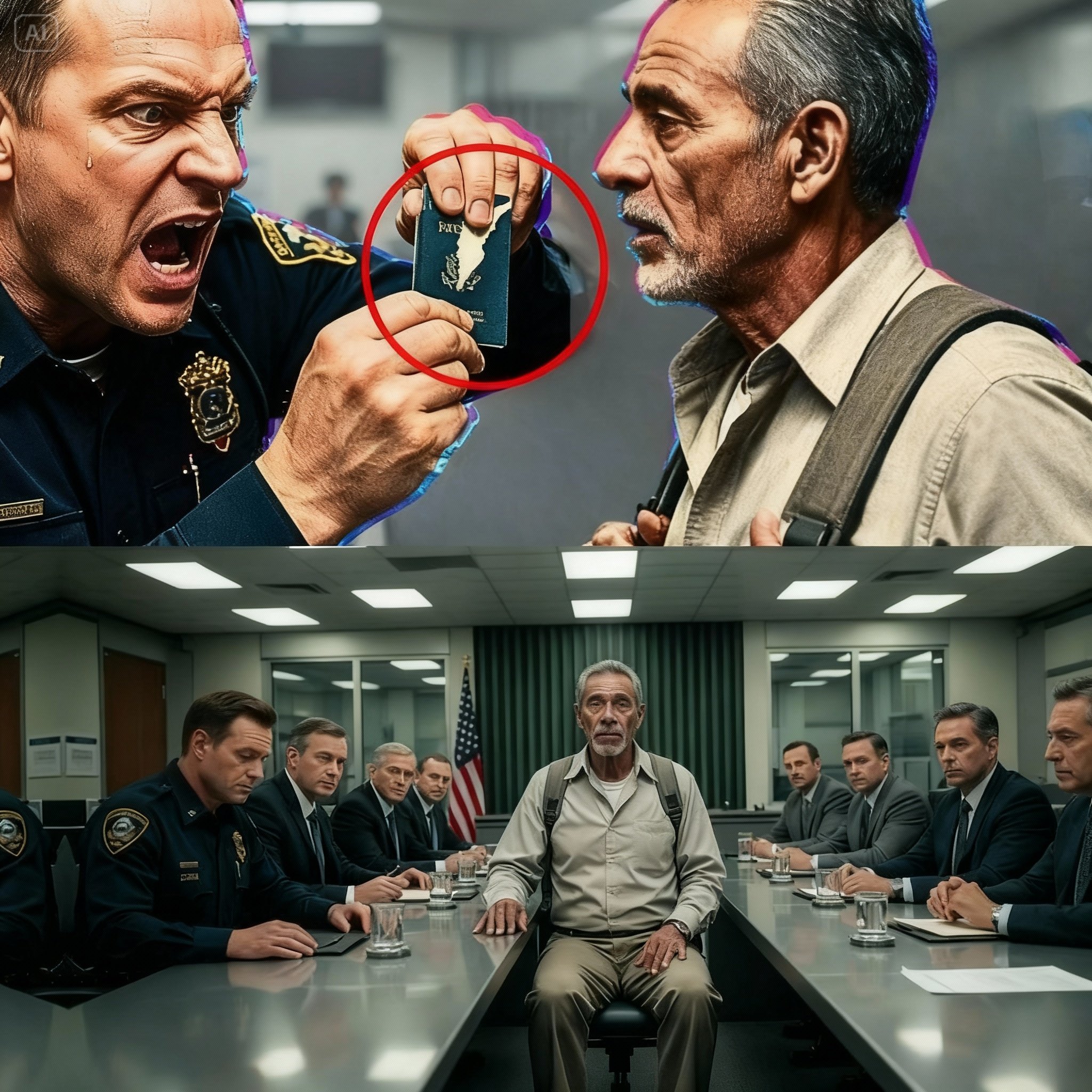
Agent Davis didn’t wait for an answer. With a theatrical rip, he tore my passport in half. The sound was shockingly loud in the small booth. He threw the two pieces of the dark green booklet onto the floor between us.
I watched them land. I didn’t move. I didn’t speak. My name is Miguel Ángel Salazar. I am 52 years old. My old backpack, the one I’d carried since my university days, sat at my feet. My clothes, simple jeans and a worn button-down shirt, were covered in the fine dust of a long drive.
My graying hair and my calloused hands, hands that had built my own garden shed and fixed my own car, told the story he wanted to see. To him, I was just one more desperate man trying to cross the border with a fraudulent document.
“Señor,” I said, my voice calm, the accent of my homeland thick and clear.
“That passport is legitimate. If you would please verify it in the system…”
“I don’t need to verify anything,” Davis interrupted, slamming his open palm on the metal counter. The sound made the woman in the line behind me jump.
“Fifteen years on this border, amigo. I know a forgery when I see one. And you,” he pointed a thick finger at my chest, “are exactly the kind of person who tries to fool me every single day.”
The line behind me was growing. I could feel the eyes on my back. A mix of embarrassment, pity, and the selfish relief that it wasn’t them.
Agent Davis loved an audience.
He stooped down, picked up the two ripped pieces of my passport, and waved them in the air like a trophy.
“Look at this, folks!” he boomed to the room.
“This one’s a real piece of work! He brought a diplomatic passport!”
His laugh was a harsh, barking sound that echoed in the high-ceilinged room.
“A diplomatic passport! Since when does Mexico send diplomats dressed like beggars? How much you pay for this? Fifty bucks in Tijuana?”
I took a slow, deep breath. The air smelled of stale coffee, floor wax, and a faint, underlying metallic tang of fear.
My fingers discreetly touched the simple, older-model smartphone in my pocket. I waited. There was still a chance to resolve this. A civil path.
“Agent Davis,” I said, reading the plastic name tag pinned crookedly to his chest.
“I am asking you to please contact your supervisor. There is a grave misunderstanding happening here.”
“Misunderstanding?” He spat the word. “The only misunderstanding is you thinking you were going to fool me.”
Davis leaned forward, his body looming over the counter, invading my space. He was close enough that I could smell the onion on his breath.
“You know what the problem is with you people? You think you can just waltz in here, do whatever you want. Fake documents, made-up stories… and then you have the nerve to talk about ‘rights’?”
He turned back to his computer and began typing, his fingers pounding the keys. I knew what he was doing. He was preparing the report for attempted fraudulent entry.
This was the protocol. I would be detained. Interrogated. I would probably spend the night, or several, in a cold holding cell before being formally deported. It was the standard procedure for cases like this. And I could see in the smug set of his jaw that Agent Davis applied this protocol with a special, cruel pleasure.
“I’ll have to confiscate your belongings for investigation,” he announced, and without ceremony, he grabbed my worn backpack, hefted it onto the counter, and unzipped it.
He started emptying it, one item at a time, for everyone to see.
A single change of clothes. A small bag of basic toiletries. A well-worn, dog-eared copy of a García Márquez novel. A faded photograph of my wife and children, tucked into the book’s cover.
Everything simple. Everything… well, cheap.
It was the perfect evidence for the narrative he was building.
“No laptop,” Davis narrated, holding up my toothpaste.
“No expensive phone. No leather wallet.” He looked around at his audience again.
“What kind of ‘diplomat’ travels like this? Can anyone explain that to me?”
It was then that a man in the next booth, Cabin 13, stepped forward. He was white, in his 40s, wearing a crisp, expensive suit. He carried a genuine leather briefcase, and a watch on his wrist gleamed even under the dull fluorescent lights.
He, too, had a diplomatic passport.
The agent in that booth, a colleague of Davis’s, barely glanced at it.
“Welcome back, Mr. Richardson,” the other agent said with a warm, genuine smile.
“How was the conference in Mexico City?”
“Productive, Tom. Very productive.”
Davis stopped what he was doing. He heard the name, and his entire body language shifted. He physically snapped to attention. He straightened his posture, adjusted his uniform shirt.
“Mr. Richardson,” Davis called out, his voice suddenly pure honey. All the aggression, all the gravel, was gone.
“I didn’t know you were returning today.”
“All in order, Davis. Thanks for asking,” Richardson replied politely, not really paying attention. He was already picking up his briefcase, ready to pass through the gate.
Davis practically ran to the partition between their booths.
“Do you need any assistance, sir? Can I call for transport? Perhaps…”
“No, no, my driver is waiting. But I appreciate the offer.”
As Richardson walked away, Davis turned his attention back to me. His face, which had been a mask of professional courtesy, immediately contracted into an expression of cruel triumph.
He took the torn pieces of my passport and held them up next to my face.
“You see the difference?” Davis almost spat the words.
“That. That is a real diplomat. Behavior. Attire. Presence. Mr. Richardson represents his country with dignity. He doesn’t show up looking like he just jumped a fence.”
I closed my eyes. Just for a moment.
How many times had I lived this? How many times, in different airports, different checkpoints, different boardrooms, had I been forced to prove my own worth, my legitimacy, my very humanity, simply because of my appearance? Because of my accent? Because of the color of my skin?
“And you,” Davis continued, shoving my backpack off the counter. My belongings scattered on the floor by my feet.
“You are exactly the kind of person that makes my job necessary. You come here with your lies, your fraud, your tricks. And when you get caught, you play the offended. You play the victim.”
I opened my eyes. The weariness was gone. Replaced by something else. A cold, hard finality.
“Agent Davis,” I said. My voice was still quiet, still controlled, but a new firmness had entered it. A new weight.
“Last opportunity. I am asking you to verify the authenticity of my passport in the Department of State system. The verification code is Delta. Eight. Seven. Seven. Tango. Mexico.”
I spoke the code slowly, clearly.
“It will take you thirty seconds.”
Davis actually laughed.
“You memorized random codes? That’s a new one. Creative, I’ll give you that.” He turned to the other agents, who were watching.
“This one studied for his fraud exam!”
More people were crowding around now. I could see the glint of phone screens. They were filming. Discretely, but they were filming. The situation was becoming a spectacle, exactly as Davis loved. A show where he was the hero, protecting the American border from the “invader.”
“You know what? I’ll do you one better,” Davis said, grabbing his radio from his belt.
“I’m going to call ICE. They will love to talk to you about your ‘broken’ diplomatic passport. Maybe you’ll get to stay with us for a few days while we investigate your real identity. Maybe we’ll find you have a few more crimes on your record. Who knows?”
He raised the radio to his mouth.
It was time. I finally pulled my phone from my pocket. My hands were not shaking. My eyes did not waver.
I had given Agent Davis every single opportunity to do his job correctly. To de-escalate. To be a professional. He had chosen, at every turn, to be a bully.
“Just one call,” I said calmly.
“If you’ll permit me.”
“Who are you gonna call?” Davis sneered.
“Your coyote? Your fifth-rate lawyer? Go ahead. It won’t change a thing.”
I dialed a number from memory.
It rang twice.
A professional, alert female voice answered on the other end.
“Embajada de México en los Estados Unidos. Línea directa. Sandra García speaking.”
“Sandra,” I said, my voice changing. The conciliatory, accented tone was gone. It was replaced by the voice of command, a voice accustomed to being obeyed.
“This is Ambassador Salazar. Emergency code Red Eight Sierra.”
Part 2
There was a brief, sharp pause on the other end of the line. Just a fraction of a second, but it was the silence of absolute, high-level attention.
“Señor Embajador,” Sandra’s voice was now all business. “Confirm your position.”
“San Isidro. Border control checkpoint. Booth twelve. I am having a protocol incident with a federal agent.”
Davis had stopped laughing. His hand, holding the radio, was frozen halfway to his mouth. Something in my posture, in the sudden, ice-cold authority in my voice, had finally sent a shiver of doubt down his spine.
“Ambassador, activating diplomatic emergency protocol. Contacting the Department of State now. Please remain on the line.”
I pressed the speakerphone button and set my simple phone down on the metal counter.
The silence that followed was dense, heavy, and absolute. Every agent in the nearby booths had stopped working. The entire processing area was watching.
Davis stared at my phone as if it were a venomous snake.
“What is this, some kind of… clown show?” Davis tried to recover his authority, but his voice cracked. “You paid someone to act? You think I’m…”
BRRRRING.
The sound wasn’t from my phone. It was from the wall.
It was the red phone.
The fixed, hard-line telephone. The one that never rang. The one reserved for emergencies or direct, high-level communications from Washington.
Tom, the agent in Cabin 13 who had been so kind to Mr. Richardson, slowly turned and answered it. His face lost all color.
He looked at Davis, his eyes wide with pure, unadulterated panic.
“Davis… it’s… it’s for you. It’s the State Department. Direct line from D.C.”
With a hand that was now visibly trembling, Davis took the receiver.
“Agent Davis. San Isidro.”
The voice on the other end was a woman’s. It was faint, but it was pure ice. I could hear it, even from where I stood.
“Agent Davis, this is Margaret Shen, Deputy Assistant Secretary for Consular Affairs at the United States Department of State. Am I hearing you clearly?”
“Yes… yes, ma’am.”
“Perfect. Now you listen to me very, very carefully. The man in your booth is Miguel Ángel Salazar. He is the Ambassador Plenipotentiary from Mexico to the United States. He possesses full diplomatic immunity under the Vienna Convention. You have… and I am quoting the alert… torn the official passport of an accredited chief of mission. Do you have any idea of the gravity of what you have just done?”
The world under Agent Davis’s feet crumbled to dust.
All the blood drained from his face. He was a ghostly white. His mouth opened and closed, but no sound came out.
“I… I… he… he didn’t…” Davis stammered. “He didn’t look…”
“He didn’t look like what, Agent Davis?” The voice of Margaret Shen cut like a razor. “Finish that sentence, please. I would love to hear it for the official record.”
Silence. A terrible, crushing silence.
“Exactly,” she continued. “Now, this is what is going to happen. You will, this instant, formally apologize to Ambassador Salazar. You will then escort the Ambassador, with all honors due his station, to his diplomatic vehicle, which is already en route. And then, you will wait in your supervisor’s office, where a team from Internal Affairs will arrive in the next two hours to conduct a formal investigation. Was I clear?”
“Yes, ma’am,” Davis whispered.
“Put the Ambassador on the line.”
Davis, his arm shaking, extended the phone receiver to me. I took it calmly.
“Margaret?”
“Miguel? My God, are you all right? Do you need medical assistance?”
“I am perfectly fine, thank you,” I said. “A little tired from the trip, nothing more.”
“The Secretary has already been informed. He is… personally furious. This is going to generate a formal diplomatic incident. You know that, right?”
“I know,” I said. “And perhaps it’s necessary.”
As I spoke, the motion around my booth increased dramatically. Davis’s supervisor, a man I hadn’t seen yet, had arrived, running, his face a mask of pure panic. Behind him were two officers in dark suits and earpieces—State Department security.
And then, the sight that made Davis look like he was going to be physically ill.
Three black SUVs with diplomatic plates swept into the control area, violating every normal protocol. No one dared to stop them.
From the first vehicle stepped Alfonso Reyes, my Minister-Counselor. From the second, Carolina Mendoza, my head of security. From the third, a team of lawyers from the embassy.
“Ambassador!” Alfonso hurried to my side, bowing slightly. “What an outrage. We have activated all protocols. The press is being notified. This will not stand.”
I raised my hand gently. “Alfonso. Calm. We will resolve this. Properly.”
I turned to Davis. He was now literally backed against the wall of his own booth, surrounded by his furious supervisor and the silent State Department officers.
“Agent Davis,” I said. My voice wasn’t loud, but it resonated in the now-silent hall.
“You offered me several opportunities today. The opportunity to confirm all your prejudices. The opportunity to accept, in silence, the humiliation you distribute so generously.”
I took a step closer. Not threatening, but imposing. The authority I held, the authority he had refused to see, was now a physical force in the small space.
“But I will offer you a different opportunity, Agent Davis. The opportunity to understand that your ignorance is not just personally shameful… it is dangerous. It stains the institution you represent. It damages the relationship between two great nations.”
“I… I’m sorry, sir,” he finally managed to say, his voice breaking. “I made a terrible mistake. I…”
“You did more than make a mistake,” I said, my voice cutting through his apology. “You revealed who you truly are. And that revelation will have consequences.”
Three hours later, we were in a sterile conference room. The regional superintendent of Customs and Border Protection. Two representatives from the State Department. My legal team. And Agent Davis, who looked like he had aged twenty years.
I presided over the meeting. Not because I had to be there, but because I chose to be.
“Ambassador Salazar,” the superintendent began, his voice dripping with formal apologies. “On behalf of US Customs and Border Protection, I offer our deepest, most sincere apologies…”
“But it represents something, doesn’t it?” I interrupted, my voice soft. “It represents a systemic problem. How many others, who do not have diplomatic immunity, who cannot make one phone call and mobilize two governments… how many of them suffer this exact treatment, every single day, at this very border?”
The silence in the room was his answer.
I slid a folder across the table. “In the last three years, over four hundred formal complaints for discriminatory treatment have been filed at this station alone. Four hundred. Less than five percent resulted in any disciplinary action. Agent Davis is not an anomaly. He is a symptom. And today, by pure chance, the symptom ran into someone who had the power to expose the disease.”
Davis kept his head down, staring at his hands.
My team, rightfully, wanted blood. They were preparing formal diplomatic notes. They spoke of international repercussions.
“No,” I said calmly.
Everyone in the room looked at me, stunned.
“There will be no international incident,” I said. “Under one condition.”
I looked at the superintendent. “Agent Davis will be suspended and will undergo a full disciplinary review. But more importantly… this entire border checkpoint will implement a mandatory, comprehensive training program on cultural sensitivity and implicit bias. Not a one-hour video. A real program. Run by experts. With periodic evaluations. And this program will then be expanded.”
“Ambassador,” the superintendent said, “that would require significant resources…”
“Then find the resources,” I said, my voice still quiet, but now unbending. “Because the alternative is that I allow this to become a full-blown international incident. Press conferences. Congressional hearings. A diplomatic embarrassment that will damage trade relations, security agreements, and cooperation at every level. The cost of that will be exponentially greater than a training program.”
It was a checkmate. And everyone knew it.
“We will implement the program,” the superintendent said after a long, heavy silence.
“Excellent.” I stood up. “As for Agent Davis,” I looked at the broken man, “I will not ask for his termination. But he will never again work in direct contact with the public. And he will participate in the new training program… as a case study. He will share his experience today, so that others may learn from his profound failure.”
Davis finally looked up. There were tears in his eyes. Not of anger, but of a deep, devastating shame.
“Mr. Ambassador,” he said, his voice hoarse. “I don’t expect you to forgive me. But I need you to know… I will carry this shame for the rest of my life. And I will do whatever you ask. I will… I will do anything to make sure no other agent makes the mistake I did.”
I nodded slowly. “It is not my forgiveness you need, Agent Davis. It is the forgiveness of every person you humiliated before me. Every worker you treated like a criminal. Every family you made wait for hours for no reason. Every human being whose dignity you trampled because you thought you had the power to do it, and that there would be no consequences.”
I turned to leave, my team following me.
At the door, I paused and looked back at the room.
“True power is not found in humiliating the vulnerable,” I said, my voice filling the space. “True power is in using your position to protect the dignity of all. That is something you will have to learn.”
Outside, the California sun was setting over the border. I got into my diplomatic vehicle. As we drove away, I looked out the window at the long, long line of people still waiting to cross. Each with a story. Each with hopes. Each with a dignity that deserved to be respected.
I had used my power today. Not just to defend myself, but to plant a seed of change. A small seed, perhaps. But it was real.