She washed my hands like hands were the hurt. Rain braided off the westside highway. The kind of cold drizzle that gets under your collar and tells you to go home. I was on a welfare check after an animal control call. Reports of a dog huddled under the chain link near Pier 62. My name’s Rowan.
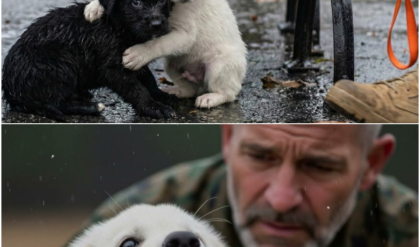
I’ve seen plenty, but this one stopped me at the knees. a German Shepherd puppy by color, just skin and a wishbone, pressed flat to concrete like she could disappear into it. Her eyes didn’t blink much. They just measured distance between my fingers and whatever had happened before me. I turned my shoulder, gave her the soft profile instead of the full stare.
Quiet voice, low and even. I’ve learned in rescue that silence isn’t empty, it’s permission. I crouched a few feet away, laid out a breadcrumb trail of kibble toward a soft crate lined with a towel I’d kept in my trunk for nights exactly like this. The rain clicked on the crate’s fabric. The highway hissed.
The city breathed around us, but I kept my world small. Just me, the food, and the space in between. “Hey, sweetheart,” I said, not reaching, not insisting. Slow blink, slow breath. I let the leash sit slack in my palm like it was asleep. She flinched when a taxi hit a pothole. Didn’t scramble, though. That told me something. Fear wasn’t the only thing living in her.
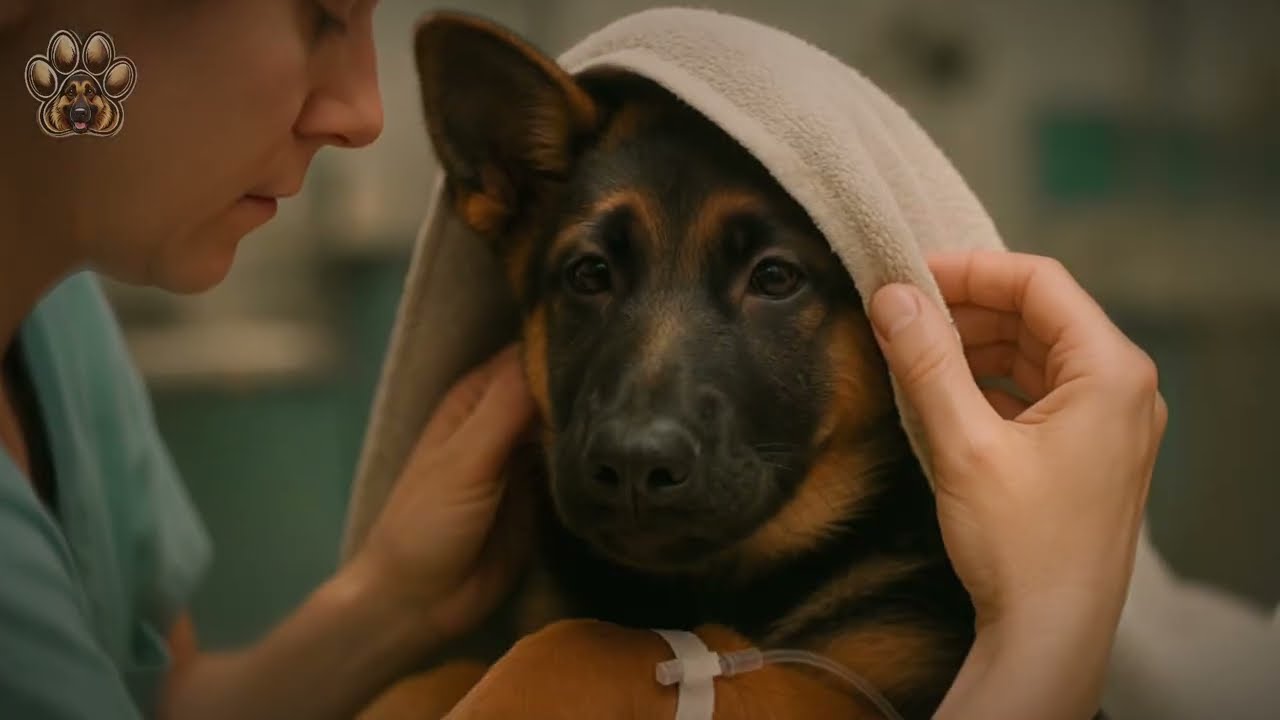
Curiosity pressed its face to the window, fogging the glass. She sniffed the closest kibble without moving her feet. Rain darkened the edges of her ears. A shiver ran straight through to her tail. I slid one piece closer with two fingers. Nothing sudden, nothing brave, just boring kindness, repeated. Good girl, Iris,” I said, giving her a name because sometimes names are little bridges.
The German Shepherd puppy lifted her nose, testing the air like it might break. She took a cautious lick, then another, then glanced at my hands to see if the hurt would come. I didn’t move. She shifted her weight forward, half an inch, an inch. The smallest decision a life can make. The crate’s mouth waited, warm and patient.
A horn barked somewhere up on 11th. Iris froze, eyes on mine, one paw held midair. Would she take the step into shelter or let the city swallow her fear all over again? The first trust sounded quieter than the rain. When Iris finally stepped inside the crate, it wasn’t triumph. It was breathd.
I eased forward, let her own weight carry her the last inch, and with one slow motion, I swung the door shut. No clang, no panic, just the click of safety. I draped a blanket over the top, dimming the world into something smaller, softer. She pressed herself to the corner, ears pinned, but she didn’t thrash.
That silence, trembling but still, was the first fragile thread of trust. I carried the crate to my car, careful to keep it level. The city at midnight has its own tempo. Horns far off, tires hissing, a siren turning down tenth. I slid the crate into the back seat, engine idling low, heater nudging the chill out.
my phone to my ear, I called the nonprofit rescue. “I’ve got her,” I said. “German shepherd puppy, maybe six months. Emaciated but responsive. I’ll bring her in now.” I didn’t mention her eyes, though. They weren’t just scared. They were something more. Something cracked, but watching to see if the pieces could be put back. Driving through Manhattan rain is a study in patience.
Lights reflecting off every surface, wipers keeping rhythm. I kept my voice steady, talking like she could hear me through the blanket. You’re safe, Iris. No hands will hurt you here. She didn’t answer, but the absence of claws against the crate bars felt like a response. Then, midblock near 34th Street, the car jolted over a pothole.
The crate shifted a hair, and her panic spiked. A high, thin wine cut through the hum of the engine. She shoved her nose hard against the mesh, teeth scraping at the bars. My heart jumped. Everything I just built could collapse in seconds. I slowed, pulled to the curb, turned off the radio, let the city’s heartbeat fade. Easy, Iris.
Just me. My words hung in the quiet, softer than the rain, tapping glass. Her wine tapered into breathing again, shallow but steady. She stayed pressed to the corner, eyes wide, waiting for the next jolt. And I sat there with with my hand resting close to the crate, not touching, just there, wondering, had that bump undone everything, or would she give me one more chance? The clinic was a pause, not a sentence.
After the jolt in the car, Iris pressed herself into the blanket, but stayed quiet for the rest of the ride, breathing fast, but steady. By the time we pulled up to the rescue’s partner vet on the Upper West Side, she hadn’t broken that fragile thread of calm. We pulled up to the rescue’s partner vet on the upper west side, a small brick building glowing against the wet sidewalks.
I carried the crate inside like it was filled with glass. The staff knew the drill. No crowding, no sudden movements. One tech dimmed the overheadlight. Another whispered updates instead of calling them across the room. The intake exam came first. Weight barely holding, temperature low but stable. Pulse racing.
They logged everything with the same calm they used for every stray. Like routine itself could calm her heart. The vet knelt sideways, spoke in low tones, then reached for the sedation protocol. Just a light dose, she said. Enough for X-rays, no more. I nodded. This wasn’t about keeping her here. This was a check, a snapshot. Proof that her little body could handle the fight back to normal.
The German Shepherd puppy’s head drooped gently, her chest still rising with quick breaths. They lifted her to the table, careful with every joint, and slid her under the scanner. The black and white images told a story. No fractures, no hidden breaks, just bruises, malnutrition, the ghosts of rough handling, relief mixed with anger in my chest.
Someone had done this, and now it was on us to undo it. Minutes later, she blinked awake. We wrapped her in a soft towel, gave fluids a vitamin boost. A vet slipped a new warm harness over her, not tight, just snug enough to remind her she wasn’t alone. “She’s cleared,” the vet said. “No need for hospital days. Get her somewhere quiet.
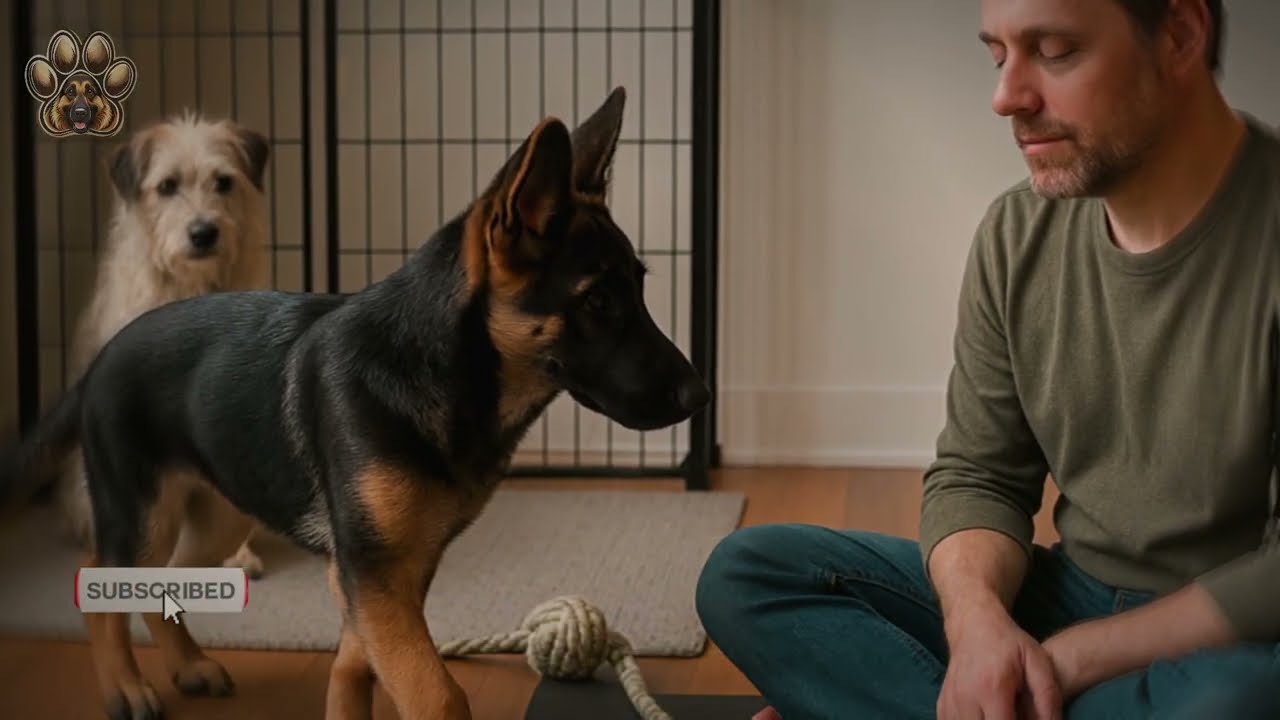
” Iris stirred against me as I lifted her from the table. For the first time, she didn’t fight the crate. She leaned just faintly into the towel’s warmth. At the rescue’s shelter, I sat her down in a quiet room. Low lights, clean bedding, a bowl of fresh water. Fig, the little terrier, waited in the neighboring kennel, watching with calm eyes.
I sat on the floor near the crate, not close enough to press her, just close enough to be known. Her body, drained by the day, finally loosened. Her eyelids fell, and for the first time, the German Shepherd puppy slept within reach of human hands. But a question pressed on me as hard as the rain outside.
When she woke, would she wake in trust, or would the panic return? Fear lessens when it’s divided by two. Morning crept into the quiet room through narrow windows, a dull gray light after the storm. Iris was still tucked into the corner, her body low, but her eyes awake, tracking every sound. Beside her, in the neighboring kennel, Fig stretched and yawned like fear had never been invented.
That little terrier has a way of broadcasting calm without trying. Steady breaths, relaxed paws, the slow wag of a tail. Dogs read each other faster than they ever read us. And I could see Iris watching, her ears tilting to Fig’s rhythm. I settled onto the floor with a paperback back against the wall, my voice drifting low, and even as I read aloud, not for the words, just for the sound of something steady, predictable.
Iris didn’t inch closer, but her breathing slowed, sinking more with mine than with the traffic outside. She blinked. Not the stiff, frozen kind, but the softer kind dogs give when they’re testing trust. I laid a few pieces of kibble on my open palm and set it flat on the ground, not reaching toward her, not asking for more than she could give.
For a long minute, she only stared, nose twitching, deciding if my hand was a trick. Then one cautious step, then another. The German Shepherd puppy stretched her neck, teeth clacking softly as she picked up a single piece, pulling back quick like she’d stolen something. But she didn’t retreat all the way.
She lingered within reach of the second. My heart swelled at the tiny, almost invisible victory. Fig sighed, curled himself into a ball, and closed his eyes, unconcerned. That unshaken trust was its own lesson. I saw Iris glance at him, then back at me, as if comparing notes. The day passed quietly, measured in small experiments. A nose closer to the water bowl when I sat nearby.
A few more kibbles lifted from my hand. No miracles, just stitches of confidence slowly sewn. But rescue isn’t a straight line. That night, as the shelter dimmed, a staff cart rattled down the hall, metal wheels echoing too loud against the concrete floor. Iris shot upright, eyes wide, body pressed hard against the kennel wall.
Fear flooded her posture all over again, and I sat there in the halflight, wondering, would this setback undo the fragile thread we’d begun to spin? Sometimes a victory is just one breath beside you. The next morning, I kept everything as predictable as possible. Dogs build trust on patterns, not surprises. I slipped into the quiet room, sat cross-legged on the floor, and gave Iris the same soft profile, shoulder turned, eyes low, my palm pressed flat to the ground, a peace signal she could read.
I added the slow blink, the one that says without words, “I’m not here to hurt you.” She studied me like a puzzle she wasn’t sure she wanted to solve. The German Shepherd puppy stretched her neck forward, nostrils flaring. A single sniff, quick and sharp. Then her tail twitched so small it might have been a shiver, but I knew it wasn’t.
It was the tiniest wag like a metronome starting its first beat.Fig in the next kennel seemed to sense the weight of the moment. He ambled closer and dropped his favorite toy, a ragged rope ball right against the bars that separated them. No fanfare, no push, just an offering, plain and clear. Iris crept toward it, nose working over time, and after a pause that felt endless, she touched it with the tip of her nose.
Half a second of contact, but to me, it was the world. I let out the quietest exhale. Not cheerleading, not clapping, just a breath that matched hers. Because sometimes the rhythm of breathing together is more convincing than a thousand words. Over the next hours, she tested the space in increments. A paw a little closer to me, ears slightly forward, then back again.
Each time she found me sitting the same way. No sudden moves, no betrayal of her trust. And each time she came back faster. By late afternoon, Iris surprised me. She stood stretched long and thin and padded half a step in my direction. Her own choice, no food bribes, no lure. Her eyes flicked up at me, uncertain but searching.
The German Shepherd puppy froze there, waiting to see what I’d do. I didn’t move a muscle, just gave her the slow blink again. And for the first time, I felt the question hanging in the air. Was she ready to try the leash, the bridge from this room to the wider world? The city is louder than fear, but not louder than routine.
Iris had learned the rhythm of the quiet room. Same feeding times, same soft voice, same measured space between us. It was time to test the next step. I slid the soft harness gently over her shoulders, moving slow, giving her all the pauses she needed. The first tug of the leash made her stiffen, but she didn’t bolt.
That was enough for me. We stepped out into the early morning before the sidewalks filled. The air smelled of wet concrete and bagels from the corner shop. I kept the leash loose, tracing figure8s on the pavement so she could circle, sniff, retreat, and return. Her paws touched the city like it was glass, tentative, but curious.
The German Shepherd puppy paused to investigate a patch of grass, ears flicking back to me for reassurance. I waited, let her decide how long safety took. Then came the bus. It roared by, close and sudden, brakes hissing like an angry beast. Iris startled hard, body snapping tight. Instinct pulled her backward, but I shifted, planting myself between her and the street, shoulders squared to the noise. I didn’t tug. I didn’t push.
I just stood there, absorbing the chaos for her. She looked up at me then, chest heaving, ears trembling. My breath was slow, deliberate, a signal. Her breathing matched mine beat by beat until the roar passed and the city quieted again. Her body softened, and she lowered her nose back to the ground as if nothing had happened.
We walked another block, no rush, just pauses for every lampost and puddle. Each sniff was a small vote of confidence, a choice to stay curious instead of folding into fear. When we circled back to the shelter, Iris trotted the last steps, the leash swaying loose between us. Inside, I crouched to uncip the harness. She shook once, as if shaking off the bus itself, then curled onto her blanket.
Her eyes didn’t hold the same hard edge they had that first night. Tomorrow would be bigger. Tomorrow I’d bring in Atlas, the calm great pyrenees, for her first parallel walk. I wondered, would she see him as a guide or another test her heart wasn’t ready for? The best therapy is a white giant who never hurries.
Atlas patted beside me like he had nowhere to be. His thick Pyrenees coat catching bits of morning light. He’s one of our helper dogs, the kind that carries calm in every step. Iris walked a safe distance away, the leash slack, but her body tense, ears swiveing between him and the city sounds. I didn’t force the meeting. We just walked in parallel, two lines heading the same direction. No pressure to cross.
Atlas sniffed the grass in long, deliberate pauses. I could almost see Iris copying him. Nose down, step forward, glance sideways. It wasn’t about the ground. It was about watching someone else show her how safety looked. At the next corner, I arked our path into a gentle curve, a dog friendly U-turn.
Atlas stayed steady, never crowding, never staring. The German Shepherd puppy mirrored the motion, her paws brushing the scent trail he left behind. Her nose lifted to his fur, testing the smell of a dog who’d never known her kind of fear. Atlas glanced back once, a slow blink, then looked away like it was no big deal. That simple dismissal was a gift.
It told her she didn’t need to perform, didn’t need to panic. She sniffed again, closer this time, her breathing calmer than I’d ever heard it on leash. We kept looping, small arcs and figure8s, shrinking the distance one quiet meter at a time. No rush, no words, just the rhythm of pause and breath and the city waking around us. And then it happened.
Iris crouched low, front paws stretched,tail flicking once, a tiny tentative playbow. It lasted a heartbeat before she froze, eyes wide, as if realizing what she’d done. The German Shepherd puppy snapped upright, startled by her own boldness, as though she’d betrayed the wall she’d worked so hard to keep.
I held my breath. Atlas just kept walking, unbothered, the very picture of patience. Would Iris let that bow become the beginning of joy, or retreat back into the shell of survival? Routine is the bridge that carries trust. The days began to fall into a rhythm, and that rhythm became medicine. Breakfast came at the same time every morning, followed by a short walk along the same stretch of sidewalk.
Quiet training sessions in the yard, rest in the quiet room, dinner as the sun dipped down. Iris started to anticipate it all, ears lifting before I reached for the food bin, tail flicking when I clipped on the leash. For a German Shepherd puppy who once lived moment to moment in fear, routine was proof that the world could be predicted, even safe.
I added a new ritual, the Kong classic. Packed with peanut butter, it gave her something steady to chew on, something that belonged only to her. The first time I rolled it across the floor, she looked at it suspiciously, then at Fig, who was already busy with his own. Curiosity got the better of her. Soon, she was gnawing, paws wrapped around the red rubber like it was treasure.
But the real breakthrough came a week later. I was reading quietly on the floor when she patted across the room carrying the Kong in her mouth. She hesitated just a second, then dropped it gently at my feet. Her eyes didn’t ask for food. They asked for connection. It wasn’t hands she wanted. It was presence, an invitation to play without pressure. I didn’t rush it.
I rolled it lightly back across the floor. She pounced, tail giving a single confident wag. Then she carried it back again, setting it closer this time. We played like that, silent and simple, until she stretched out near me, the Kong resting between us like a peace treaty. Day by day, those tiny exchanges stitched something stronger.
Iris wasn’t just surviving anymore. She was choosing to participate. The German Shepherd puppy began to look for me, to seek out what had once terrified her. And I knew what came next. Routine inside the shelter was healing her, but the world outside still waited. It was time for a bigger test.
Tomorrow I’d take her to Central Park. The question was, would the noise, the people, the chaos undo her progress, or would she finally discover joy beyond these quiet walls? One day you realize people are just background noise. Central Park was alive with joggers, cyclists, strollers, and the endless hum of the city.
For a dog like Iris, it could have been overwhelming. But I didn’t bring her there alone. Beside us walked Nova, the old husky, slow in step, but steady as a metronome. On the outer ark moved Mako, a sharp but disciplined Malininois, his handler keeping him calm at a distance. Together they made a quiet circle of canine safety, a living buffer between Iris and the unpredictable human world.
I kept the leash loose, letting her choose the pace. The German Shepherd puppy glued herself to Nova’s side at first, watching every movement. Nose to the ground when Nova sniffed. Pause when Nova paused. A cautious nose touched the grass, followed by a retreat back to her flank. It was like she was learning a new language through mimicry.
Syllable by syllable, people streamed past in every direction. Runners cutting wide arcs, families strolling, kids pointing at the dogs, but never reaching out. We’d set that boundary ahead of time. The volunteers making sure no hand intruded on Iris’s fragile bubble. She noticed them, of course. But when Nova didn’t react, neither did she.
Humans were just scenery, not a threat, not a comfort, just there. At one point, a skateboard clattered over the path. Iris startled, eyes wide. But instead of bolting, she glanced at Nova. The husky barely flicked an ear, then resumed her slow walk. Iris hesitated, then matched her, tail lowering, but not tucked.
The difference was everything. Panic replaced by choice. By the time we circled the great lawn, Iris had loosened, her steps lengthened, her breathing evened out. She sniffed the air toward Maco, testing the scent of confidence, and then swung her nose back to the grass, comfortable in the rhythm of the group.
Back at the shelter, I felt the shift in her body language, lighter, less coiled, like she’d carried a piece of calm home with her. But before I could celebrate the progress, the call came in. A new rescue intake. Urgent male pitm mix named Rafie found tied to a stairwell frantic and snapping at the air.
They were bringing him in now and the staff already braced for trouble. And I couldn’t help but wonder, was I strong enough to face a dog still drowning in the fear she once lived in. Sometimes you have to choose. Run or stay beside someone who’s breaking. Thevan door swung open and Rafy came out like a storm.
A pit mix, ribs showing, eyes wide, leash taut as a wire. His bark ricocheted off the concrete walls of intake. Raw panic that had no target, just everywhere. Staff kept distance, voices low, but the tension in the air was sharp enough to taste. I held Iris’s leash, feeling her weight shift. Months ago, she would have mirrored that panic, tried to fold herself into the floor.
But the German Shepherd puppy beside me was different now. Still cautious, still fragile in places, but holding a new thread of confidence. Her ears flicked. Her nose worked the air. Her body didn’t collapse. She watched. Atlas had taught her that sometimes the answer isn’t retreat, it’s presence.
I stepped a little aside, giving her the option to choose. Iris arxed her body, not straight on, but in a wide semicircle. Her head dipped, gaze slanted toward the ground, the canine version of saying, “I’m not a threat.” Each step was measured, deliberate. Nothing rushed. Rafy’s barking hitched for a beat. He tracked her movement, muscles trembling, torn between fear and fight.
Iris paused, lowered her nose, then made the smallest contact, a gentle nose touch against his shoulder. It wasn’t dominance. It wasn’t pity. It was invitation. The same move Atlas had shown her weeks before. The change was quiet, almost invisible at first. Rafy’s hackles softened a fraction, his breath shifting from frantic to heavy, his leash slackened just enough that the handler eased their grip.
He whined low in his throat, confused but listening. Iris held her posture, tail neutral, body loose. She didn’t flinch when his head turned. She just stayed. And just like that, the storm lost some of its thunder. Not gone, not healed, but calmed enough that the room itself seemed to exhale. I looked at her, this puppy, who once shook at every sound.
Iris had become the steady one, carrying a lesson forward. I reached for the latch of the quiet yard gate, metal clicking open. Iris’s eyes snapped to mine, alert and questioning. The yard stretched behind me, the space where we tested dogs for group walks. Was she ready now, not just to heal herself, but to guide others? Could Iris step fully into being an ambassador of trust for the dogs who came after her? Someone once moved over so you could pass.
That’s what I kept thinking as I watched Iris in the quiet yard. The same space where she used to tremble in the corner was now her arena of calm. She wasn’t alone, of course. Atlas ambled along one side. Nova paced the other. Two steady pillars holding the shape of the circle. But it was Iris who set the tone for the newcomers.
Rafi entered first, still cautious, but no longer exploding. Iris didn’t rush him. She traced a gentle arc, nose to the ground, giving him space to breathe. Then, when his tail loosened just enough, she offered the same nose touch she once learned from Atlas. It wasn’t magic. It was permission. And somehow, it worked. A week later, another intake.
This time, a wiry spananiel mix, spinning circles at the end of the leash. Iris glanced at me once, then took the lead. Side by side, she matched his frantic loops with wide, patient arcs until his steps slowed to match hers. She didn’t demand peace, she modeled it. Watching her with Atlas and Nova, I realized she’d become part of the teaching staff.
They weren’t just walking dogs anymore. They were walking stories. Every quiet blink, every careful approach was a living reminder that fear doesn’t have to own the ending. The German Shepherd puppy who once flinched at every hand had become a dog that gave others the space to trust. She was no longer the shattered one. She was the bridge.
I leaned against the fence, pride and awe tangled in my chest, and thought about the people watching from outside the yard. The volunteers, the donors, the ones scrolling past a story like hers online. They see the transformation, but do they realize they can be part of it? That’s the one piece left. What do we tell those who hesitate on the sidelines, unsure if their help really matters? Her trust was the work of a whole pack.
Iris didn’t heal because of one moment or one person. She healed because of steady rhythms, patient routines, and the silent lessons passed from dog to dog. Atlas’s calm, Nova’s steadiness, even Fig’s quiet offering. It was the consistency of care, the predictable kindness, the safety of being seen, but not forced. That’s what rebuilt her from the inside out.
Fear may have been taught by humans, but dogs taught her to let it go. Day after day, choice after choice, she found her way back to herself. The German Shepherd puppy who once curled into concrete now walks with her head high, teaching others the same way she was once taught. With gentleness, with space, with time.
Her journey is proof that rescue is more than pulling a dog off the street. It’s the slow, deliberate building of trust, and it matters. This little guy’s journey fromabandonment to rehabilitation shows how important nonprofit rescue groups really are. Every volunteer, every foster, every donated dollar helps turn fear into freedom.
Because caring for a rescued puppy is more than love. It’s responsibility. It’s pet care. It’s the routines, the patients, the long, quiet hours when progress is invisible but still happening. Iris is no longer just surviving. She is a bridge for others, a living reminder of what’s possible when we show up and keep showing up.
Join our Brave Paws family. Be their voice. Be their hope.