I had never imagined that walking into a room could feel like stepping into another world, one where you don’t exist. The lobby of Summit Pines Resort was alive with laughter, the hum of chatter, and the subtle scent of polished marble in expensive perfume. Guests swirled past me in designer coats and tailored suits, their confidence radiating like they owned the very air around them.
But I wasn’t here to be noticed. Not today. I wanted to disappear, to see the world through the eyes of someone the staff wouldn’t recognize, a man who mattered to no one. It started with a quiet humiliation. I approached the front desk, my worn leather suitcase scraping softly against the marble floor, my gray jacket loose and unremarkable.
An older man ahead of me had been mocked in broken English by the manager, told this resort was far too expensive for him. I watched the hurt in his eyes, the kind of sting no one else seemed to care about. My heart clenched, not just for him, but for the part of myself that had worked my whole life to be invisible when I wanted to be.
Standing in line, I felt the same thing. Dismissal, disregard, being looked through as if I weren’t worth their attention. 20 minutes passed and the line barely moved forward. Every time I got closer, a new guest arrived. A couple in pristine tennis whites, a businessman barking into his phone, a family carrying shopping bags from stores I own stock in.
Each time I stepped back, I told myself this was the point of coming here to witness how my hotels treated ordinary people when no one important was watching. I felt small. My 18-hour journey from New York through Chicago to here had done nothing to ease the weight of betrayal still fresh in my mind.
My own nephew, someone I had mentored, someone I had trusted to take over the family empire, had orchestrated a clean, legal coup. He had moved in silence, moving pieces on a board I hadn’t even known existed. And I, Richard Carter, billionaire founder of Carter Hospitality Group, had led him. For 3 weeks, I had wrestled with disbelief, anger, and a crushing sense of vulnerability.
But now standing in this lobby, I was just an ordinary man with a suitcase and a reservation. No security detail, no assistance, no one to shield me from the judgment of strangers. The staff ignored me, the guests laughed at a distance, and every inch of this cathedral of wealth seemed to remind me how small I could feel. “Excuse me,” I said quietly to a passing bellhop, my voice deliberately soft.
The young man glanced at me, polite but detached, his attention immediately drawn back to the guests who looked wealthier, louder, more important. “You’ll have to wait your turn, sir,” he said, the words sir floating like a token of training rather than respect. I nodded, my back straight, my pride tucked behind my exhaustion.
Hours of travel, betrayal, and planning for this incognito test had led me here. Yet nothing could prepare me for the raw sting of invisibility. My mind wandered as I felt the growing pressure in my chest. Just beyond the desk, a manager in a tailored jacket approached, his eyes scanning me with thinly veiled judgment.
“Sir,” he said a little too loud, “this is a luxury resort. “If you’re looking for budget accommodations, there are several motel about 15 mi down the road.” It was like a blow I hadn’t expected. I had built an empire employing tens of thousands, donating millions to charity, shaping the livelihoods of countless people.
And here, in 30 seconds, I was rendered insignificant because of my appearance, my language, my quiet demeanor. I felt a crack in my composure, subtle but unmistakable, like ice splitting underfoot. I swallowed my pride, reminded myself why I had come. This was a test not for them, for me to see if kindness existed when no one knew who I was, if decency could survive in a world obsessed with status.
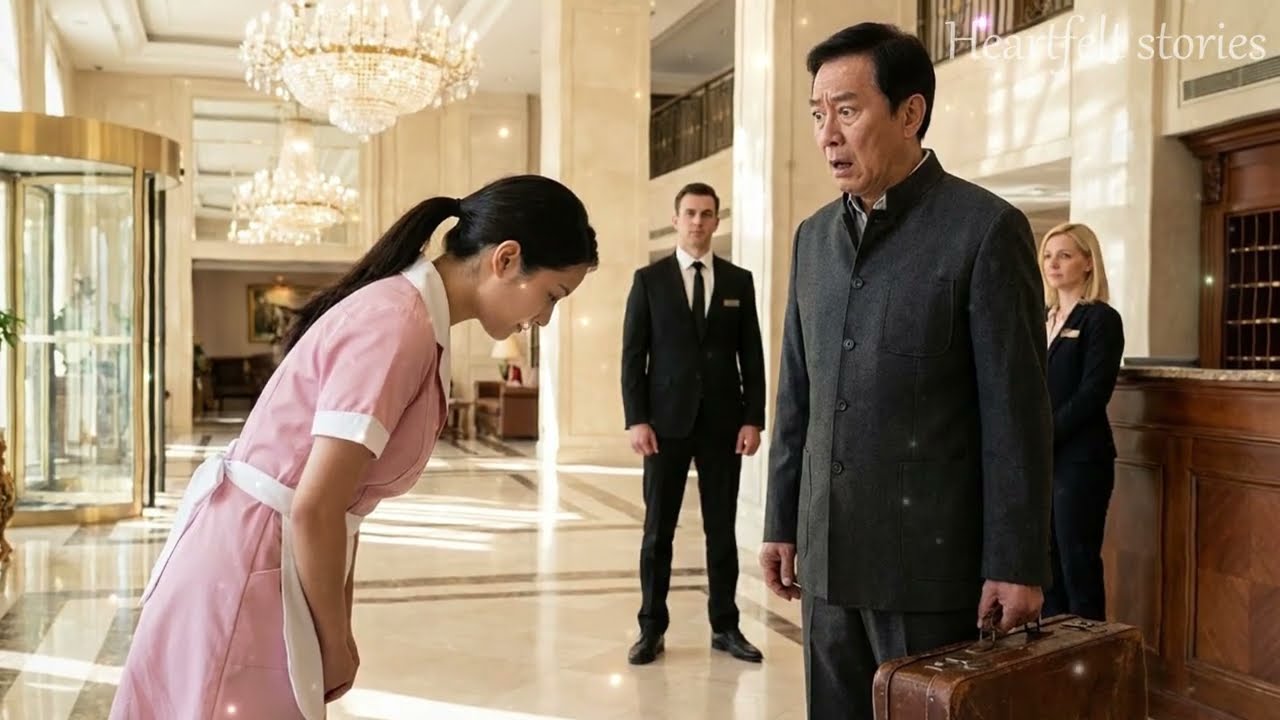
I closed my eyes for a second, breathed in the scent of flowers and polished stone, and prepared to speak. Then, like a bell cutting through a storm, a soft, polite voice in perfect Japanese reached me. Sumasan, it said. Excuse me. I turned sharply. A young woman emerged from the cafe, hair neatly pulled back, apron modest yet clean, eyes kind and steady despite obvious fatigue.
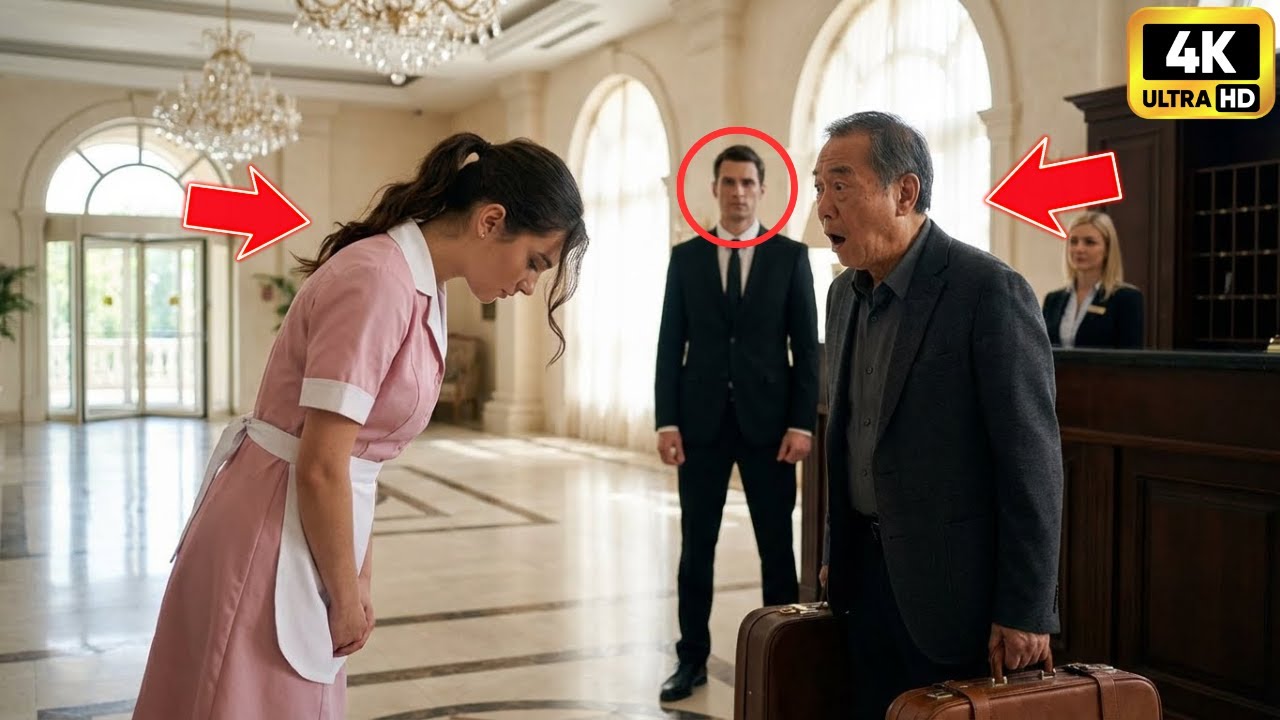
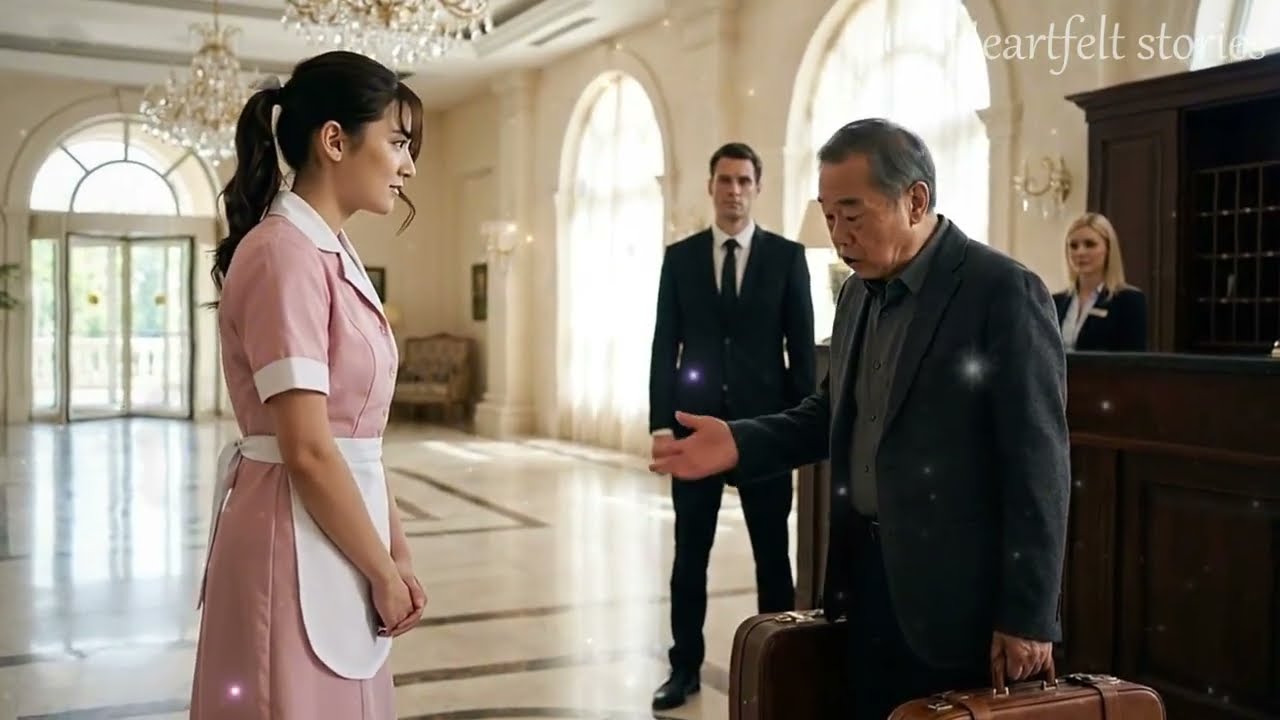
She walked toward me with a calm certainty, paused a few feet away and gave a slight bow. The gesture hit me harder than any words could have. Then she spoke again, fluent and natural. Sir, may I help you? The entire lobby seemed to pause. For a fleeting moment, I forgot my exhaustion. The line that had humiliated me, the manager’s condescending words.
All of it disappeared because this woman, a stranger, had recognized my struggle and chosen to respond with respect, empathy, and kindness. My voice caught rough with disbelief. “You You speak Japanese?” I asked. She smiled real and warm, not the practiced smile I had grown used to in luxury service settings. “Yes, sir.
I spent several years in Tokyo. I couldn’t help overhearing,” she said simply, focusing entirely on me while the lobby carried on around us as if frozen. “I felt something shift in me. Relief and a curiosity I hadn’t felt in weeks. Maybe the test wasn’t about what people deserved from me, but about what people could give when no one was watching. I stepped slightly closer.
“Can you help with my reservation?” I asked, still in Japanese, the words natural, grounding. She nodded full attention, and together we began untangling the confusion, her fingers flying across the keyboard with quiet authority. In a room filled with indifference, she had chosen to see me, to act, to care.
And in that small improbable moment, I realized something. Sometimes a single act of kindness could cut through the weight of isolation, betrayal, and exhaustion, creating ripples far larger than anyone could imagine. What would you do if you were in Richard’s shoes? Richard Carter’s hands trembled slightly as he watched Emily Thompson navigate the reservation system with calm precision.
The lobby around them was a swirl of motion. Guests moving past in their designer clothes, unaware that a quiet storm was unfolding at the front desk. For the first time in what felt like weeks, he could breathe. He wasn’t invisible here. Not because of wealth, not because of power, but because someone had seen him as a person. Not a problem.
Emily’s fingers flew across the keyboard, her dark eyes sharp and focused. Do you remember anything about the booking? she asked gently, switching to English for clarity. A date? Maybe a credit card number? An email address? Richard nodded, fumbling through his phone with exhaustion clouding his memory. The 18-hour journey and the betrayal from his nephew had left him scattered, his mind a fog of disbelief and fatigue.
“My assistant, Sarah Miller,” he murmured. “She may have made the reservation, or maybe under a pen name for privacy.” Emily’s eyes lit up with understanding, and she began typing again, her movements precise, deliberate. The air in the lobby seemed to hold his breath as seconds stretched, each keystroke echoing louder in Richard’s mind than the chatter of the crowd.
Then she paused, fingers hovering over the keys, and smiled faintly. Found it. Presidential suite, 14 nights starting today. Richard felt a jolt of relief. He could hardly believe it. She looked up at the manager, her voice soft but firm. This is a top floor suite, usually reserved for VIPs. The manager’s face drained of color.
His authoritative mass slipped as recognition dawn, fear mingling with embarrassment. The staff who had ignored Richard, the guests who had laughed at his quiet struggles, all seemed to freeze. Even the faint trickle of the fountain paused as if the room itself held its breath. Emily glanced at Richard with a soft smile, the warmth in her eyes unassuming but undeniable.
“Would you like help with your luggage?” she asked in Japanese, switching back to his native language. The bellhops appeared, reaching eagerly for his worn suitcase. The same ones who had previously walked past him as if he were furniture. He shook his head quietly. “No, thank you. I’ll manage.” He turned back to Emily, truly seeing her for the first time.
She was young, probably in her mid20s, exhausted from long hours and double shifts. Yet, she carried herself with a dignity and strength he hadn’t expected. “How did you learn Japanese?” he asked softly. Her smile turned a touch wistful. “My father was in the military. We lived in Tokyo from ages 8 to 14. I went to school there, made friends, learned the language.
It was the happiest time of my life. When we moved back, I promised myself I’d go back someday. Maybe work as a translator, perhaps for an embassy or an international company. University is expensive, so I’m here saving what I can. Richard felt a pang in his chest. Here was a young woman working herself to exhaustion, not because of obligation, but because she chose to help.
She had seen someone struggling and decided it mattered, even when she had no reason to expect reward or recognition. And in that moment, he realized how rare genuine kindness had become in a world obsessed with appearance and status. “Emily Thompson,” he said slowly, asking her full name. She looked slightly confused, but nodded.
He turned toward the manager, switching to English, letting his voice carry across the marble floors. “My real name is Richard Carter. I own Carter Hospitality Group, parent company of Summit Pines Resort and Properties Worldwide.” The manager blinked, shock rippling through his features, while Rachel, the front desk clerk, grasped the edge of the counter to steady herself.
A collective gasp ran through the lobby. “I came here quietly,” Richard continued, his voice calm but firm. “Because I wanted to see how my hotels treat guests when no one important is watching.” “Now I know.” He let that sink in, observing the shame and fear spreading across the manager’s face. The realization that their actions had consequences beyond their immediate perception.
Turning back to Emily, he said, “Miss Thompson, you showed me kindness when everyone else ignored me. You helped me when it wasn’t your job, when you expected nothing in return. That is rare. That is valuable.” His voice cracked slightly under the weight of emotion. Emily began to speak, hesitant, but Richard held up a hand.
No, not anyone could have done this. Only you, Emily. Only you today. He turned sharply to the manager. You’re fired. Effective immediately. The words cut through the lobby. The authority in his tone unmistakably, “The desk clerk as well. I want the names of every staff member who walked past me, who ignored me, who treated me as if I didn’t matter.
I will review their employment personally.” The manager opened his mouth, but no words came. Rachel’s tears streaked down her cheeks. “But sir,” the manager began weakly. Richard’s voice softened, almost pitying, yet every word was precise. You suggested I try a motel because I looked poor, because my English was not perfect.
Because you decided in 30 seconds that I was not worth your time. How many other guests have you treated this way? How many have walked through these doors and been judged not by their humanity but by their appearance? Silence met his questions punctuated only by the faint echoes of luxury around them. Turning to Emily, Richard continued, “I am creating a new position, guest relations cultural liaison.
Your job will be to ensure that every guest, regardless of appearance, language, or background, is treated with respect. salary is $90,000 per year plus benefits. I will also pay for your university education, any program you choose. Emily’s mouth fell open. Why? She whispered through tears. Richard looked at her calm now, the exhaustion in his own bones overshadowed by a new sense of purpose.
Because you proved goodness still exists. You helped because it was right. One sentence in Japanese changed everything. Today you gave me back something I thought I’d lost. Hope. He reached out and took her hand. Around them, the lobby remained still, frozen as if the world itself was holding its breath. Richard stepped back, voice ringing across the marble expanse.
Starting today, Summit Pines’s properties will have a new policy. Every property in every country will judge guests by respect, not by appearance. Staff will be trained in cultural sensitivity. Anyone who fails to treat another human being with dignity will be removed immediately. This is not a request. This is the law. Slowly, the first clap rang out, hesitant, then another until the entire lobby erupted in applause.
Emily’s tears continued to fall as she realized the magnitude of what had just happened. And Richard felt a strange warmth in his chest, a mix of vindication and relief, the first real smile on his face in weeks. Come, Dia,” he said softly in Japanese. “Help me to my room. I am tired and have many calls to make, but first I want to hear about Tokyo. I want to know your dreams.
I want to know everything.” She nodded, taking his worn suitcase, ignoring the flurry of bellhops, and walk beside him to the elevator. As the doors closed, Richard cast a final glance over the lobby, the fired manager frozen in place, the guests whispering, the staff looking at each other in dawning understanding.
A small, quiet smile tugged at his lips. “Thank you,” he said to Emily. “For what?” she asked. “For seeing me,” he said. The elevator rose, carrying them toward the top floor in the presidential suite, toward a future rewritten by a simple act of kindness. What would you have done if you saw someone being ignored like Richard was? Would you have stepped in to help or walked past like everyone else? Richard Carter sank into the plush armchair of the presidential suite, the soft hum of the air conditioning, and the muted city lights of the valley below, wrapping him
in a rare cocoon of quiet. After 3 weeks of betrayal, 18 hours of travel, and a lobby full of judgment, the tension in his shoulders finally began to ease. Yet even in this solitude, his mind churned. He thought of his nephew, the clean surgical betrayal in the way it had stripped him bare, leaving him exposed in a world he had once mastered.
The anger and disappointment still lingered, but for the first time there was clarity. He glanced at Emily Thompson, who had placed his suitcase neatly beside the bed. She had stayed with him all the way up, her presence calm, steady, and quietly reassuring. Despite exhaustion etched into her features, her eyes were bright with curiosity and warmth.
He could see the same resilience in her he had seen at the front desk. The determination to do right, even when the world offered no reward. Emily, he said softly. I want to hear about Tokyo. Tell me everything. The school, your friends, your favorite memories. She smiled, a mixture of surprise and relief, and began recounting her childhood in Japan.
Her voice animated as the memories unfolded. Richard listened, captivated, feeling a strange weight lift with each story she told. There was something profoundly human about hearing someone share their past with pride and vulnerability. A reminder of what mattered beyond contracts, profit margins, and corporate takeovers. Hours slipped by unnoticed as they spoke.
The kind of conversation that made the outside world vanish. When she finally paused, Richard leaned back, absorbing the quiet luxury around him. The suite itself a stark contrast to the humiliation he had endured just hours ago. Yet the real luxury was not marble or chandeliers. It was this, the rare experience of being truly seen.
He rose, walking toward the floor to ceiling windows and allowed himself a moment of reflection. Summit Pines Resort, every property under Carter Hospitality Group, had been a test today. Not for the guests, but for him and for his staff. He had wanted to witness how ordinary people, including his employees, treated those they did not recognize.
Now he knew. Some had failed spectacularly, blinded by pride or judgment. While one remarkable individual, Emily, had proven that integrity and kindness could thrive even in the smallest gestures. Richard returned to the armchair and addressed Emily. You know, I could have remained invisible forever.
I could have let the neglect, the mockery, the indifference define how I felt about my own company and the people who work here. But you changed that with something so simple. A greeting in Japanese and your attention when it mattered. He paused, his voice catching slightly. That’s what real leadership looks like. Recognizing people, treating them as human beings first. Emily’s eyes glistened.
I just saw someone who needed help. I didn’t know who you were. That’s exactly it, Richard said softly, a smile tugging at the corners of his mouth. And that’s why it matters. You didn’t help me because of status or reward. You helped because it was right. And today, that changed everything.
He reached into his jacket pocket, pulling out a small tablet and opening a document he had prepared in the past days. It outlines sweeping changes across all properties, mandatory cultural sensitivity training, new policies ensuring guests were treated with dignity regardless of appearance or language, and strict consequences for those who failed to comply.
He looked at Emily. I want you to lead this initiative. You will be guest relations cultural liaison with full authority to train, supervise, and ensure these values are upheld. Your salary will be $90,000 a year plus benefits and I will fund your university education, any program you choose. You will be my partner in this effort.
Tears spilled down Emily’s face, her hands trembling slightly as she pressed them to her mouth. “Why me?” she whispered. Richard shook his head, his smile calm but full of conviction. Because you reminded me that kindness still exists. You reminded me why it matters. You reminded me that even when the world judges based on appearances, there are people who act with humanity.
Today, you gave me hope. They spoke late into the evening, planning the roll out of the new policies, discussing the training programs, and envisioning a culture in which every guest felt seen and respected. Outside the suite, the valley lights twinkled like distant stars, indifferent to the transformation unfolding within.
When it was finally time to rest, Richard and Emily stepped into the elevator, and he cast one last glance at the lobby below, the fired manager still stood frozen in place, the guests whispering among themselves, the staff exchanging looks of dawning comprehension. It had been a hard lesson, but one that was witnessed, felt, and now understood.
The ripple effects of today would be felt long after the lobby returned to its usual bustle. Richard turned to Emily, gratitude evident in his eyes. “For seeing me,” he said simply. “For what?” she asked, still uncertain. “For being the person who mattered,” he replied. “When I was invisible, you made me visible.
” The doors of the elevator closed, carrying them upward toward the presidential suite toward the top floor in the start of a new chapter. for the resort, for the staff, and for Richard himself. A single act of genuine kindness had rewritten everything. The world outside the suite would continue to move.
But within these walls, a quiet revolution of empathy and respect had begun. Richard sank into the chair, finally allowing himself a moment of relief. The tension, the humiliation, the betrayal, all of it had been transformed. He felt a rare sense of peace. The kind that came not from wealth or power, but from witnessing the quiet strength of human decency.
Emily’s presence, her courage to act when no one else did, had restored something he thought lost. Faith in people. Now the lobby, the staff, the guests, they would carry this lesson forward, consciously or not. Richard understood that change often began in small gestures. And today’s act of seeing and helping had become the catalyst for a much larger transformation.
He smiled quietly with real warmth, a smile he hadn’t felt in weeks. What would you have done if you were in this lobby? Would you have walked past Richard, ignoring him like most did, or stepped forward to help, even if it was just a word or gesture. Share your thoughts in the comments. If this story touched your heart, comment number 100 below.
And tell me, what country are you watching from? Don’t forget to share this story with someone who needs to hear it today and hit subscribe for more powerful stories that remind us what truly matters in