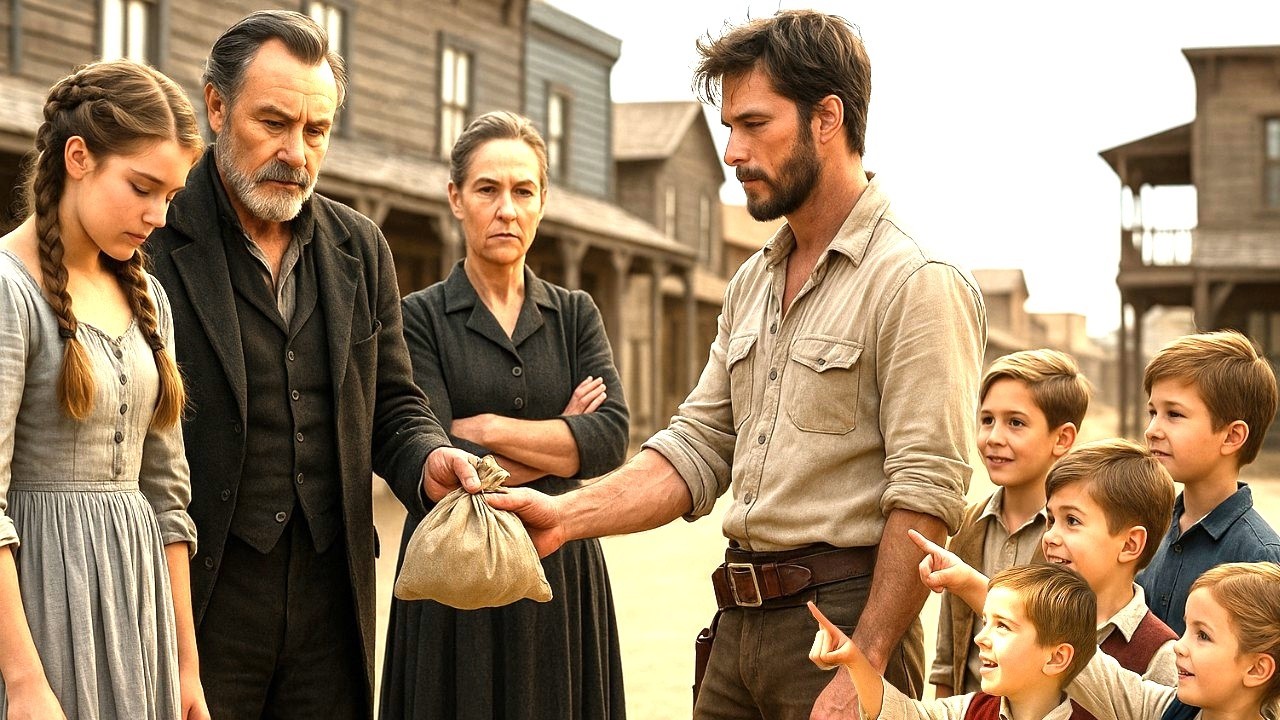
Ash Ridge, New Mexico Territory, spring of 1884. The spring wind carried dust through the streets of Ash Ridge, mingling with the smell of manure and scorched wood. It was the kind of dry day where nothing moved unless it had to. People gathered in the market square, drawn by the promise of ranching tools and something stranger. Her name was Kate Wynn, twenty-two, her blue dress faded at the seams, her hands clasped tight at her sides as if holding something within herself. Her father pushed her into the center of the square as if she were meat for display. “She can cook, sew, and keep silent,” he said.
“Anyone with money,” he added, “can take her home tonight.” The crowd didn’t laugh—not loud, at least—but the silence between the whispers was worse. Women looked away. Children peeked out from behind skirts. Kate stood there with the sun burning her skin and a deeper shame burning beneath it. “She is barren,” her father elaborated. “Tried for years; nothing took. But she has steady hands and good teeth, he figured, and that was worth something.” Kate didn’t plead. She had done that before, once when her husband had thrown her out, once after two years of trying, and once when her wedding dress had been snatched from her hands by the very hands that had held her. It hadn’t mattered then, so she stood silently. Near the back of the crowd, her mother stood, an old shawl clutched tight around her shoulders, her eyes fixed on the ground, her lips tight. She said nothing. Didn’t stop it. Just watched. And when the crowd parted, she drifted with them, her head bowed low, swallowed by the flow as if she hadn’t come to witness her daughter being sold, only to leave with everyone else.
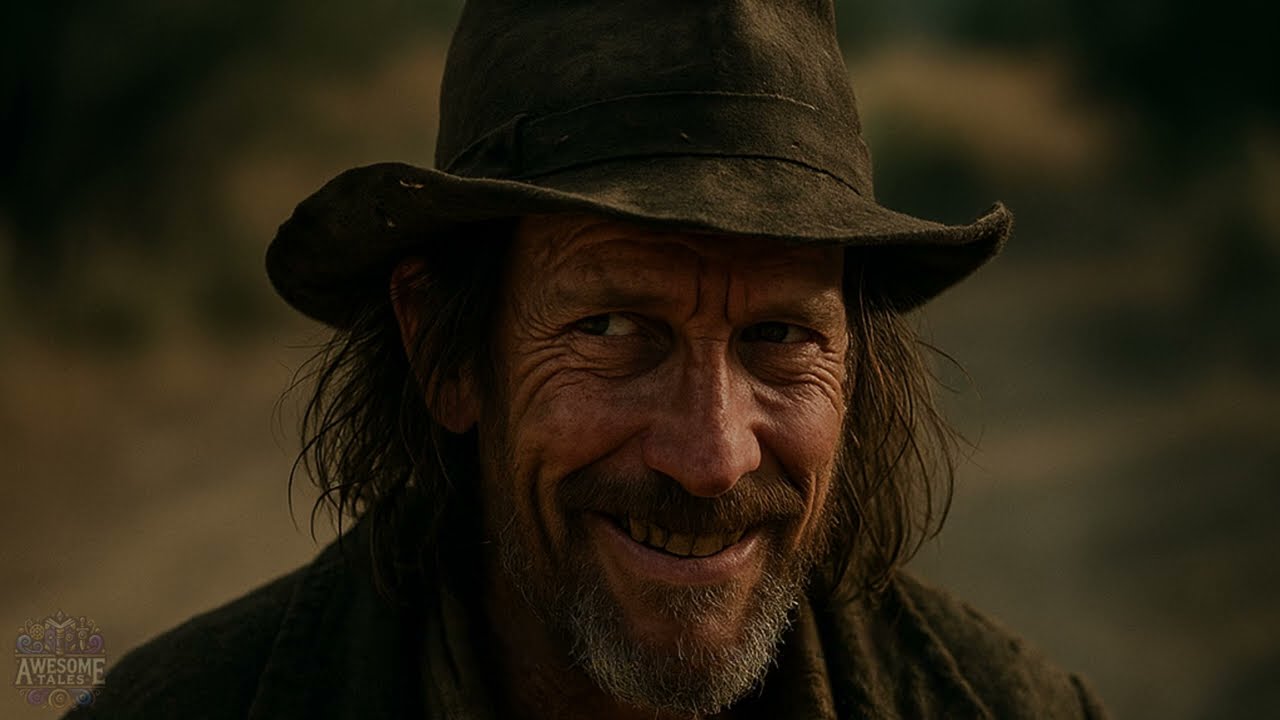
A man walked up. His broad-shouldered shirt was stiff with dust and trail-marks, and he wore a wide-brimmed hat that cast shadow over most of his face. His coat smelled of horse and pine. He didn’t ask her name. He didn’t look at her from head to toe like a buyer. He simply reached into his coat, pulled out a leather pouch, and dropped a coin on the table. No bargaining. No questions. Her father raised an eyebrow. “You sure about that? No refunds,” he said. The man didn’t flinch. Didn’t look at Kate. “She won’t be judged again,” he said, and turned and walked away. Kate didn’t move. The crowd had already begun to scatter. No one cared where she went now. Her father gave her one last shove. “Go on. You’re his now.” She bent down, picked up her satchel—just a pair of old shoes and a locket with her mother’s face inside—and followed the stranger into the dust.
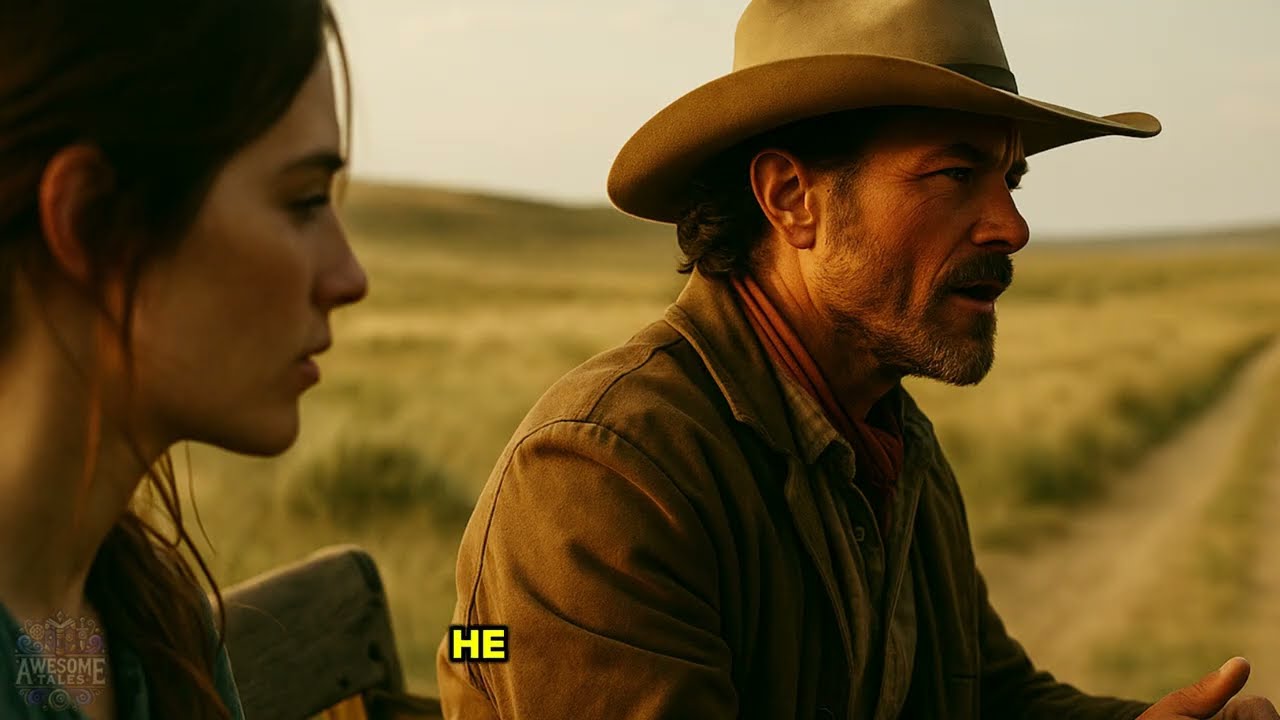
The wagon waited near the blacksmith, hitched to a pair of mules as silent as their master. Kate climbed onto the front seat, sitting beside the stranger without a word. She did not know his name was Bo Thatcher yet. Bo handed her a dented canteen. “Long ride,” he said. The water tasted of tin and old wind.
They rolled past the edge of Ash Ridge, where the prairie opened up like a blank page waiting to be written on. The sky stretched on forever. Fence posts leaned tiredly into the ground. There were no birds, only the wind in the grass and the occasional creak of leather. He said nothing more, and she didn’t ask. Kate studied his face when the brim of his hat was lifted just enough. He wasn’t old, but the sun had etched its history into his skin—thirty-five, maybe. His hands were loose on the reins, one scarred across the knuckles, the other wrapped with a ragged strip of cloth. No ring. “Why did you take me?” she asked, not expecting an answer. He didn’t look over. “Five children,” he said. “No mother. No time.” Her throat tightened. “So I’m a governess?” “No,” he said. “Just someone who ain’t cruel. That’ll be enough.”
By sundown, they arrived at a homestead tucked into the dry ridges of the land. The cabin leaned slightly to the west, as if listening for something that never came. A barn stood behind it. Weathered, grey chickens dashed across the yard, squawking as the wagon pulled in. He climbed down, tied the reins, and walked to the porch without asking if she would follow. She did. The porch boards creaked under her weight. The front door wasn’t a door but a heavy blanket nailed to the frame to keep the wind out. Five faces looked up—four boys, one girl, eyes wide and cheeks flushed. Each stood still in the dim light. They had lost their mother to fever two winters ago. Since then, the silence in that log cabin had been louder than any storm. “This is Kate,” Bo said. “She’s staying.”
The youngest, Samson, maybe five, walked straight to him and wrapped both arms around his leg. Bo bent down, picked him up with one arm, and opened a door to the other rooms upstairs. “Water’s still warm in the bucket,” he told Kate. She climbed the stairs slowly, her hand trailing the wall. The bedroom was small and plain—a washbasin, a narrow bed, a window looking out onto a wide, fenced field of dry grass. She set her satchel down and sat on the edge of the bed. She still hadn’t cried, but her hands trembled in her lap, and she stayed there, listening to the sounds of strangers in a house that wasn’t hers.
Morning brought the smell of smoke, old coffee, and something burning in a pan. The log cabin stirred—early footsteps on the creaking boards, the thump of boots by the door, quiet talk broken by the occasional cough. Kate moved carefully. She didn’t yet know who slept light, who spilled the sugar, or who liked their eggs hard or runny, if there were eggs at all. The children remained silent around her. Judah, the oldest, watched her with crossed arms and a face too old for his years. Levi whispered to Gideon, who kept glancing at her as if working out a problem in his head. Mira, the only girl, sat near the fire, clinging to a scrap of cloth she wouldn’t let go of. Samson, the youngest of the five, lingered nearby, silently mimicking her every move. She tried to cook beans into a mush. The bread wouldn’t rise. She spilled the coffee pot and the sugar tin, burning her hand. Then she tried to sew a ripped sock, pricking her finger twice. The needle rolled under the stove. She said nothing, just pressed her lips tight and swept the floor until her shoulders ached.
That afternoon, lifting the stew pot from the stove, her hand slipped. The cast-iron pot hit the floor. Stew splattered onto the floorboards. The sound startled the hens outside. Inside, the children froze. Kate stood still, her heart pounding, waiting for the yell, for the crack she had heard before. Then the front door opened. Bo walked in. He looked down at the mess, then at her. Without a word, he bent down, picked up the pot, scraped out the remainder, and wiped the floor with a rag. “Just stew,” he said, and that was all. He walked back out. Kate stood frozen for another minute, the rag still in her hand. The heat still rose in her throat, except this time there was no shame in it. It was something quieter. Something she didn’t yet have a name for.
That night, after the dishes were washed and the children had disappeared into their rooms, she sat on the porch, her hands in her lap. The night air was cool, the stars burning bright over the roof. She tried not to cry, but then she failed. She crept from room to room. Mira had kicked off her blanket. Levi mumbled in his sleep. Samson was curled with his hand in his mouth, the way children still believe someone will carry them through the night. Mira stirred and whimpered. Her forehead was too warm. Kate walked into the hall. Bo was already there. “She’s burning up,” she said. “I need willow bark and mint, if you have it.” He didn’t ask questions. He turned, and within minutes, she had everything. She boiled the herb water, mashed the wet cloth. She pressed the damp cloth to Mira’s face, holding the girl’s small body, and hummed. She didn’t stop. Not when the child shivered, not when the fever raged, not even when her own body slumped with exhaustion.
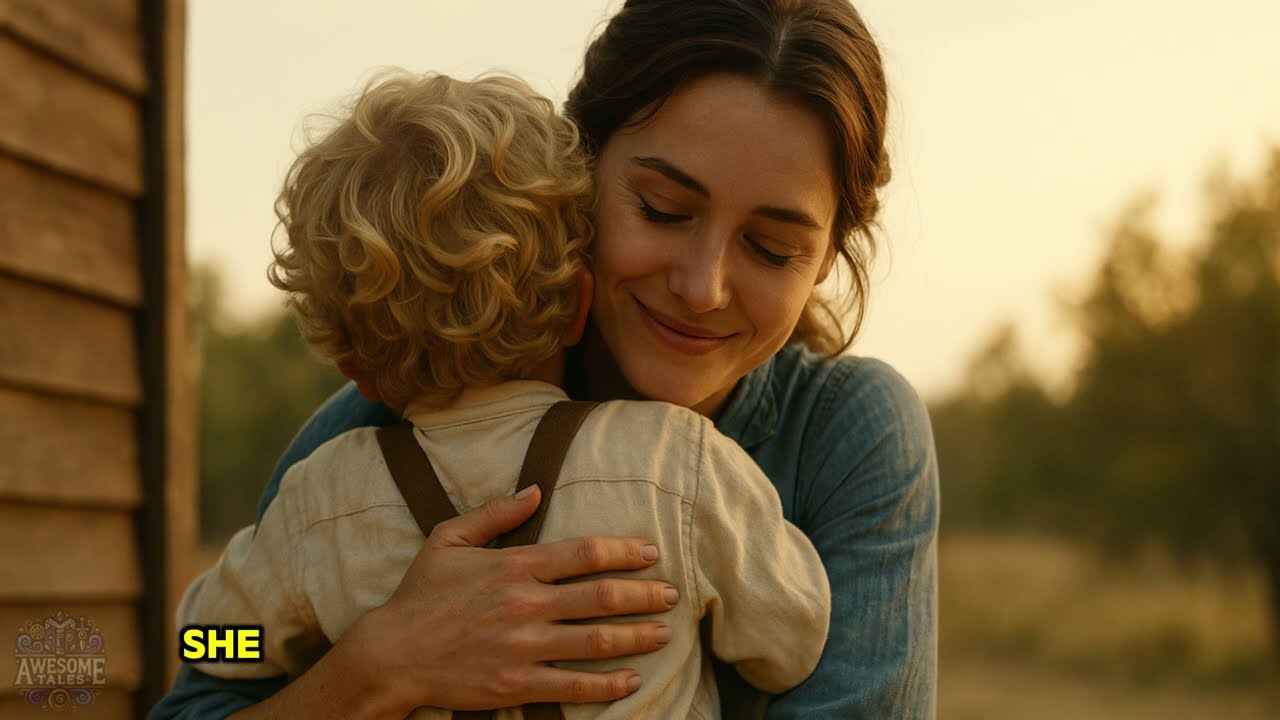
She stayed awake through the night until dawn. Mira opened her eyes and whispered hoarsely, “Pancakes.” Bo stood in the doorway. He hadn’t said a word, but the tension in his shoulders eased. His eyes remained fixed on Kate, as if he were seeing something he hadn’t expected—something strong. Something holy. Kate didn’t smile; she was too tired. But she didn’t flinch from his gaze, either. She just nodded and turned back to the girl, who was already drifting back to sleep in her arms.
The next morning, when Kate came downstairs, steam rose from a kettle that was already warm on the stove. Beside it lay a tin cup and a piece of paper folded once. Two words were scrawled in stiff, uneven handwriting: “Thank you.” No name. No signature. But none was needed. She held the paper a moment longer than intended, then she sat down, gripped the cup, and took a sip of the tea. It was bitter with pine, but it warmed her chest like something solid. Through the window, the prairie stretched out. The wind skimmed the wild grass. She watched it in silence. Something tired, tight, and long-closed-off inside her began to shift.
Later that day, she was washing pots behind the cabin when Samson wandered over. His hand was held high. “Sycamore,” he said, bright and sure. She turned. He wrapped his arms around her legs and grinned as if he had just named the moon. She didn’t correct him. She bent down, pulled him close, and for the first time in weeks, she smiled. Not because someone expected her to, but because she wanted to.
As spring settled into the bones of the land, the rhythm of the cabin began to change. Kate’s hands found their steadiness. The bread started to rise. The beans stayed whole. She sewed feed sacks into scarves—one for each of the children. They wore them without asking why. She taught letters by candlelight, helping Gideon write his name on a piece of kindling. Sang soft songs over cracked bowls of soup. Mira’s hair was braided into two neat ropes, tied with a blue ribbon salvaged from an old trunk. She learned what each child feared. Judah hated thunder. Levi lied when he was ashamed. Miriam went silent when she missed her mother.
None of them asked who she was. They watched what she did. They listened to how she stayed. The first time one of them said it, it came out like a breath. Levi handed her a spoon and mumbled, “Here, Ma.” The room went silent for a beat. He didn’t correct himself, and neither did she. The next day, Gideon said it. Then Mira. Then Samson, who had decided she belonged to him and that was that. She was Ma now. There was no ceremony. No announcement. Just the slow way of naming what already was.
That night, Bo sat on the porch with a piece of wood in his lap, carving under the lantern light. Kate walked past with a bundle of laundry in her arms. “Ever think about leaving?” he asked, his eyes still on his hands. She stopped. “I thought,” she said after a moment. He nodded once. “Why didn’t you?” Kate looked out at the dark field, where the swing she’d hung on the oak moved slowly in the wind. For the first time in her life, she said, “No one asked me to be anything I wasn’t.”
The town of Dustbend lay low on the horizon, the harsh sun bleaching the slatted windows and the sharp eyes. Kate hadn’t set foot in it since the day her father sold her like livestock. One afternoon, Bo hitched the wagon and stopped at the steps. “Need salt and nails,” he said. “Come if you want.” Kate climbed up without asking why. The road into town was quiet and wide open, dust rising behind the mules. Bo kept one hand on the reins, the other on his lap, his hat pulled low. His words were fewer than usual. In DustBend, he went into the general store. Kate waited on the porch, her arms crossed, her eyes scanning the street.
That’s when she heard it. “Well, well, if it ain’t the barren ghost,” the sharp voice echoed across the square. Kate turned. Her former mother-in-law stood near the dry-goods stall, fanning herself with a folded newspaper. Clinging to her side stood the young replacement wife—lace gloves, flushed cheeks, and a hand placed a little too deliberately on a yet-unrounded stomach. “Is that her?” the girl asked, loud enough for half the market to hear. “Oh, that’s her,” the older woman said slowly. “Pretty, but cursed. Couldn’t give us even a pup.” “I will,” the girl squeaked proudly. “A big, strapping boy. He’ll carry the family name. Unlike her—useless as a cracked jug.”
Kate didn’t reply. She stood still, her jaw tight, her hands clenched at her sides. She turned to leave when a shadow fell next to her. Bo had stepped out of the store, a sack of salt in one arm. His eyes blinked slowly. He only looked at the two women once, then turned to Kate. “She’s the one who gets Mira to sleep when her leg hurts,” he said. “The one who taught Samson not to throw rocks. The one who makes that house feel like it’s got a roof again.” Neither woman spoke. They didn’t need to. Bo nodded toward the wagon. “You ready?” Kate nodded back. They walked away together, leaving the words behind them like dust.
That night, Kate didn’t say anything about what had happened. She tucked the children in, pulling the blankets over bare shoulders, running a hand over Gideon’s hair as he slept. Afterward, she stepped out onto the porch alone, her shawl wrapped around her. Bo followed. He stood beside her, watching the stars scattered across the sky. “You didn’t have to say anything,” she said. He kept looking ahead. “I didn’t say it for them.”
The night air was thick, still, and almost as if the ground were holding its breath. The lantern inside the cabin flickered behind the curtain, and the world outside was dark and dry. Kate stepped out with a bucket in her hand. The sky stretched inky black above her, the stars dim behind a fragile curtain of heat. She walked toward the well, her bare feet silent on the dirt path. She didn’t see him at first. He was leaning against the fence post, half-sunk into shadow, his shoulders slumped, his hat tilted back. A bottle dangled from his fingers. Clay Vaughn, the trapper from the next ridge over, drunk again. “Well, now,” he called out, his voice slurring. “Look what the wind dragged in.” Kate froze. “Figured Bo kept you locked up tight,” Clay said, pushing off the post. “Guess not tight enough.” “It’s late, Clay,” she said. “Go home.” He staggered closer, his breath thick with whiskey. “I remember when they sold you,” he muttered. “Figured you’d end up somewhere quiet. Didn’t think Bo had that kind of taste.” Kate took a step back. “Don’t come closer.”
He grinned and kept walking. “Come on, now,” he said, his voice dropping low. “Just wanna look. After all that talk, you owe us at least a smile.” Then he reached out and grabbed her wrist—dirty, rough, unwashed—before she could scream, before she could turn away. The barn door slammed behind them—quick, steady bootfalls. Then Bo hit the trapper hard in the jaw. The man fell to the ground like a cut tree, groaning as he curled up. Dust rose around them. Bo stood over him, his chest heaving, his fist still clenched. Blood seeped from his knuckles. He didn’t look at Clay. He turned to Kate. “You alright?” She nodded, but her breath came in gasps. Her hands trembled. “I’m sorry,” she whispered, not even knowing why.
Bo walked over. He stripped the red bandana from his neck and gently took her hand, the one Clay had grabbed. He wrapped the cloth around her wrist, slowly and carefully. “No one touches you,” he said, his voice low and even. “Not unless I say so.” Then he looked at his own bleeding hand and shook his head. “Damn fool,” he muttered. Not to her. Not to Clay. But to the world.
Inside, Kate boiled water and cleaned his knuckles in silence. The room smelled of lye soap, copper, and smoke. “You didn’t have to do that,” she said. Bo didn’t flinch. “He put his hand on you. I don’t like fighting, but I don’t like someone scaring you.” She stopped pressing the cloth to his skin with a little more force. “I cried,” she said, her voice catching. “But not because I was scared.” Bo looked up. “Because no one has ever stood up for me like that before.” He didn’t answer, but something passed through his eyes—something warm and undefended, as if her words had sunk deep into him. When she was finished, he flexed his fingers once, and she wound the cloth neatly around them.
“I don’t want to live in a world,” he said quietly, “where a man like that thinks he can say those things to you. Or worse.” Kate smiled faintly. Her wrist still hurt, but her heart didn’t.
The morning was cold enough for breath to be visible. Kate was kneading biscuit dough in the kitchen when a scream broke the stillness—high-pitched, one of the children. She dropped the bowl—flour flying up into the air like snow—and ran barefoot out the door. Gideon lay near the woodpile, his face contorted in pain. His leg was twisted beneath him, and the old axe lay inches away, its blade streaked with red. Kate knelt beside him. He already had his hands pressed to his thigh. “Oh, Lord,” she whispered. Bo ran up, his face pale, but his hands steady. He picked the boy up without a word. “Boil water. Bandages. Now.”
Kate ran, her heart pounding so hard she couldn’t hear her own footsteps. She filled a pot and grabbed clean, thin cloth from the cupboard. When she returned, Bo had cleared the kitchen table and laid Gideon across it. His pants leg had been cut away. Blood oozed from a jagged gash along his thigh. Kate pressed the cloth down. The boy cried out, teeth clenched, his hands fisted. “I know, love,” she said, her voice thick. “I know it hurts. Just hold on.” She worked with shaking hands, her own tears falling onto the cloth as she wound the bandage tight, knotting it, then knotting it again. Red soaked through the fabric, but the bleeding slowed. Bo stood nearby, watching in silence.
Then Gideon blinked up at her, pale but alert. “Don’t cry, Ma,” he whispered. She pressed her lips together, inhaling the name like a prayer. “Ma,” he said again. “Ma makes the best biscuits.” Kate put a hand on his cheek and bowed her head, the last of her tears finally falling without shame. Afterward, when Gideon was resting with his leg propped up, and the others had gathered near the hearth, the children moved differently. Mira brought her a blanket. Samson curled up beside her. Levi handed her a carved wooden horse with a broken leg and said that she could fix anything, which meant she would stay.
Judah, the quietest of them, looked up and asked, “So you’re staying?” Kate didn’t answer with words. She just nodded. It was enough. They had called her Ma, but now, for the first time, she had said yes without speaking. Bo watched it all from the other side of the room, his hands on his knees, his eyes not on the fire but on her.
That night, after the house was gone silent, Bo still walked out onto the porch. Kate sat there, her arms crossed tight, the starlight unblinking. He stood beside her for a long time before speaking. “I ain’t good with words, you know.” “You said enough,” she replied. “When you put that coin down in Ash Ridge. I figured I was giving you a way out. That’s all. I never figured I had the right to keep you.” She turned to him slowly. “I thought you’d leave once you got your feet under you,” he continued. “And if that’s what you want, I won’t stop you. I won’t hold you to what started as a transaction.”
Kate looked at him, his posture tense, his voice even but tired, as if someone were braced for an answer that might choke him. “I used to think love meant being chosen at first sight,” she said. Then she paused. The wind gently swirled across the porch. “But I learned something better—being chosen again after someone has seen who you really are.” Bo didn’t answer right away. She walked closer and took his hands. “If you don’t send me away,” she said softly, “I won’t go.”
Summer arrived like judgment. No rain for seven weeks. The sky remained pale and cruel, the color of bone. The creek behind the barn shrank to a muddy thread, just enough for the mules. The ground cracked open. The wind became sharp. Corn curled brown on the stalk. The beans withered. The hens stopped laying. Bo said less each day. He worked longer, coming home with dirt in his eyes and nothing in his hands. The children stopped asking for seconds at supper. Kate heard their stomachs rumble through the walls at night.
And she still woke before dawn. She filled every tub and bucket with water from the deep well. She wrapped her hands in cloth and went out to the dying garden and dug. The ground fought her—dry as ash, hard as rock—but she broke it open, turned it over, made space where there was none. A few ranch hands offered to help. She refused. This was hers. Every morning, she watered. Every evening, she checked the leaves. When they slumped, she sang old lullabies her mother had never taught her. Then the log cabin went silent again until morning.
Bo didn’t return from the field. She found him slumped near the fence line, gasping for breath, his skin flushed with heat. He waved her off: “Just tired.” But she felt the fever burning him. That night, Bo lay on the bed, his breathing shallow. Kate wiped his forehead with cool cloths and spooned water to his lips. He mumbled in his dreams, twitching under the blanket. Then, near midnight, he turned to her in his sleep and whispered, “Don’t leave me. Don’t leave us again.” Kate leaned in close, her voice low and steady. “No,” she said. When she was needed.
By morning, the fever had broken. When Bo opened his eyes, she was still there, her hair loose, her face pale, her hands cracked and rough from digging the dirt. “You look terrible,” he rasped. She smiled. “You should see yourself.”
A few days later, the back door burst open. “Ma! Come quick!” Samson yelled. She followed him out to the garden, bracing herself for bad news. But tucked beneath a curled vine was a single, red tomato, clinging to the split stem. Imperfect. Alive. Bo walked up beside her. They stood in silence. “How?” he asked. Kate reached down and touched the vine, her hand trembling. “You taught me,” she said. “Not everything worth keeping comes easy.” Bo looked at her hands, blistered with dirt, her wrist cross-stitched with the red bandana. She never turned back without a word. He reached for them. He bent down and kissed her hands—slowly, carefully, as if she were something he owed an answer to. Kate didn’t pull away. She looked up at him, dust and sweat on her cheeks, and something soft in her chest opened up like spring. He raised his eyes to hers, and then, without permission or apology, he kissed her. Not like an affirmation. Not like a rescue. But like a man who had waited too long to speak what he felt. She kissed him back. There was no music. No audience. Just the hiss of the wind and the rustle of a garden that should have been dead and still was not.
That night, they sliced the tomato into six thin pieces, one for each child and one to share between them. They ate slowly, as if it were something sacred. And when the children were asleep, curled up under blankets on the floor, Bo reached for her hand. “I ain’t got much left,” he said. “The land’s tired. My bones are, too.” Kate turned to him. “Then I still have,” she said, “more than most. Because before you, I had a name no one wanted to speak. Now I have a garden that remembers my hands, children who call me home, and a man who let me stay without asking me to be anyone else.”
Bo touched her cheek with a thumb rough as fence-post bark. “You never needed rain,” he whispered, “to grow something beautiful.”
They came in the spring, not with dust on their boots like the others, but with polished carriages, clean hats, and hands that hadn’t held a shovel in years. The two men were government contractors. They carried papers, promises, and plans. “There will be a rail line,” one said, spreading a map on the kitchen table. “Cutting straight through this ridge. The elevation is perfect. The company is prepared to pay a high price for this land.” Kate stood near the stove, her arms crossed. Bo didn’t move from the doorway. “We don’t want to pressure you,” the other man added, “but think what this could mean for your children—a new house, a better school, real security.” Bo’s eyes never left the window. Outside, the swing hung crookedly on the distant oak. The garden rustled in the slight breeze, the soil still bearing the print of Kate’s hands. The carved bench sat under the pine, where they had drunk coffee and been silent together through the hard seasons. He didn’t look at either of the men, and he saw it all.
“No,” he said. The men blinked. “Sir, with all due respect—” Bo turned slowly, his arms crossed over his chest. “I ain’t selling.” “There’s room to negotiate—” “You can turn the train around,” Bo said. “Or go through someone else’s hill.” The younger man opened his mouth again, but the older one put a hand on his arm. They gathered their maps and left without another word.
That evening, as the sun set behind the ridge, Bo and Kate stood by the edge of the road, a wooden plank between them, and a hammer in their hands. The children watched from the porch. Bo held the sign straight, and Kate hammered the nails. When it was finished, it stood just outside the fence, visible to travelers as they passed, burned into the grain of the wood by careful hands. The words were:
NOT FOR SALE. Someone was finally allowed to stay here. That was enough.
The rumors spread through Dustbend the next morning. Some people laughed. Some people nodded quietly. No one knocked on the door after that. And the wind kept blowing as usual.
Time passed like the weather, slow and sure. The children grew up, their hands calloused, their voices deeper. One by one, they left to chase lives of their own. Some returned with children of their own, others sent letters and gifts wrapped in paper smelling faintly of train soot and strange towns. But the house was never empty. It filled in new ways with laughter, with footsteps too small for boots, and the smell of bread rising again in the oven. Kate’s garden spread wider each year, bowing with the wind and spilling over the pathway. Corn grew next to sunflowers. Mint tangled with onions. Everything flourished in places where it shouldn’t have, and every morning, Bo stood on the porch, his cup in his hand, his hat pushed back, watching her move between the rows as if she belonged there. He never interrupted. He only watched, as if witnessing a miracle. No words were needed.
One autumn afternoon, Bo walked the path with one of his grandsons, a boy no bigger than Samson had been when Kate arrived. The boy tugged at his grandfather’s sleeve. “Papa,” he said, “why don’t we call it Kate’s garden?” Bo paused beneath the garden arch. Above them, carved deep into the wood by a steady hand, were the words: She did not bear my blood, but she birthed the rest of my life. The boy looked up, blinking. “You mean she gave you a fresh start?” Bo smiled slowly and quietly. “She gave me everything.”
When Kate Wynn passed, they buried her beneath the old oak on the edge of the garden—the same tree where the wind chimes had once hung, the same tree where Bo had tied the swing for Mira when her legs were too weak to walk far, the same tree that had grown with them through drought and wind and long-forgotten winters. Bo carved her headstone himself. He didn’t let anyone else touch it. The stone was etched with a single line:
Here flourished all she was never given, and all she gave.
After that, Bo woke with the sun every morning and sat by the grave. Sometimes with a cup of coffee. Sometimes with a half-finished wood carving of a bird. Sometimes with just the silence. He never said much, but he didn’t have to. Until one day, he was gone, too. They buried him beside her beneath the whispering branches. The wind chime had long since rusted. The swing ropes had faded to grey. And the garden? It kept growing. Even when the frost came early. Even when the ground cracked again. Even when the rains forgot their way. It grew back—not in neat rows, but in the wild spirals of life. Mustard greens over the fence. Beans twining up the porch rail. Sunflowers taller than memory.
Long after the railroad curved around the hill. Long after the men with the maps forgot why they came. travelers still passed the fence line at the edge of the land where Bo and Kate had made their home, and slowed their wagons just enough to read the sign nailed there—the same sign Bo and Kate had put up together. It read: NOT FOR SALE.
Because sometimes, a place remembers the people who refused to leave. And sometimes, the dry hills bloom for those who chose love when no one else did.