They left him facing the runway. In Atlanta, Georgia, a 4-month-old German Shepherd puppy stood tied to the chain link by the service gate, eyes locked on the lights like a promise. The H highis flood lamps washed his white coat in aircraft amber, and he didn’t blink when the next jet screamed past.
He didn’t bark. He leaned into the leash until it pressed a quiet line in his neck, then rose on his toes as if the sky might lower itself to meet him. A blue folder hung from his mouth, damp at the corners, held as carefully as a boarding pass. I rolled to a stop and killed my engine, and the night got so still I could hear him shiver.
Another plane lifted, and he angled his head toward the thunder like he was counting departures. Dispatch had called it a minor noise complaint at the perimeter fence, the kind we usually clear in 5 minutes. I’d been doing nights out here long enough to know every rattle in the chain link, every loose panel, every fox that slipped through the grass.
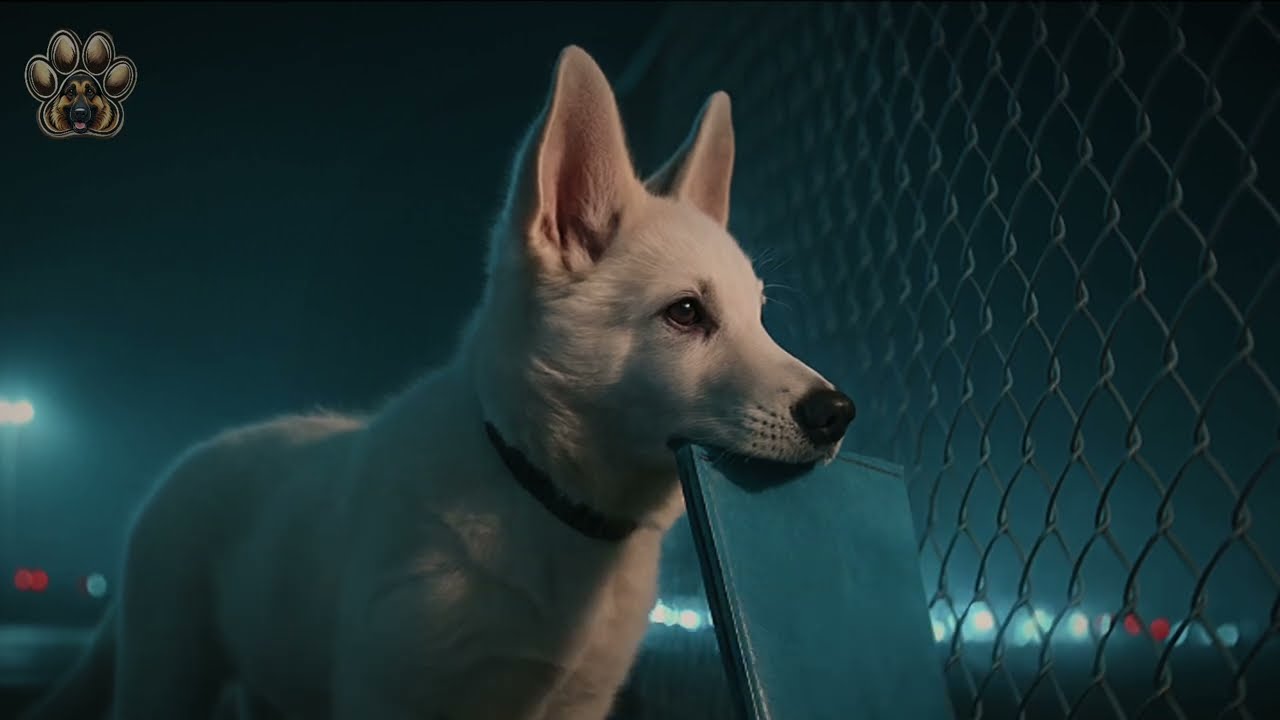
But this wasn’t fox movement. This was a small body bracing against concrete every time the runway lit up. Like each takeoff took a piece of him with it. I stepped out of the truck and the jet wash hit me in the chest, hot and oily, familiar. He flinched at the same blast, but he didn’t look away from the strip of burning light.
When the wheels left the ground, his whole frame rose with them, toes stretching, leash biting down, as if he could somehow hook his heart to that tail logo and not let it go. The folder slipped from his mouth, landed by his front paws, and he glanced down just long enough to nudge it back into place, careful like it mattered more than his own throat.
I walked closer, boots grinding over gravel, keeping my voice low so it didn’t compete with the engines. He heard me. I know he did. One ear twitched, one eye flashed in my direction. Then he chose the sky again, like I was just another sound that wasn’t hers. My flashlight swept up the fence and caught on the knot someone had yanked tight around the post.
Then farther out on a white tail with a red cross lifting into the dark. A medevac bird already climbing, already gone. It hit me then that nobody lost him out here. Someone had walked him to this exact spot, tied him facing the runway, and left him where the last thing he saw of her was metal and light.
Another aircraft lined up, engines spooling, a low growl rolling across the tarmac toward us. He inched forward until his chest met the bottom rail. Paws searching for a gap, nose pressing through cold steel as far as it would go. He wasn’t watching for escape. He was waiting for someone to come back out of the dark.
He almost snapped his own neck trying to follow the next one. The engines wound up, the runway strobed white, and he launched forward so hard the leash jerked him off his front paws. The strap bit into the soft place under his jaw, his back legs scrambled for grip, and for one ugly second, he just hung there between concrete and chain link.
He dragged in a ragged breath that sounded more like a choke than a gasp. But even then, he didn’t make a single noise. I heard myself swear under my breath and moved faster. boots sliding on the loose gravel. “Easy, buddy,” I said, palms out like I was walking up on a live wire. He flicked one eye at me, wild and glassy, then locked it straight back on the burning line of the runway like my voice was just another piece of wind.
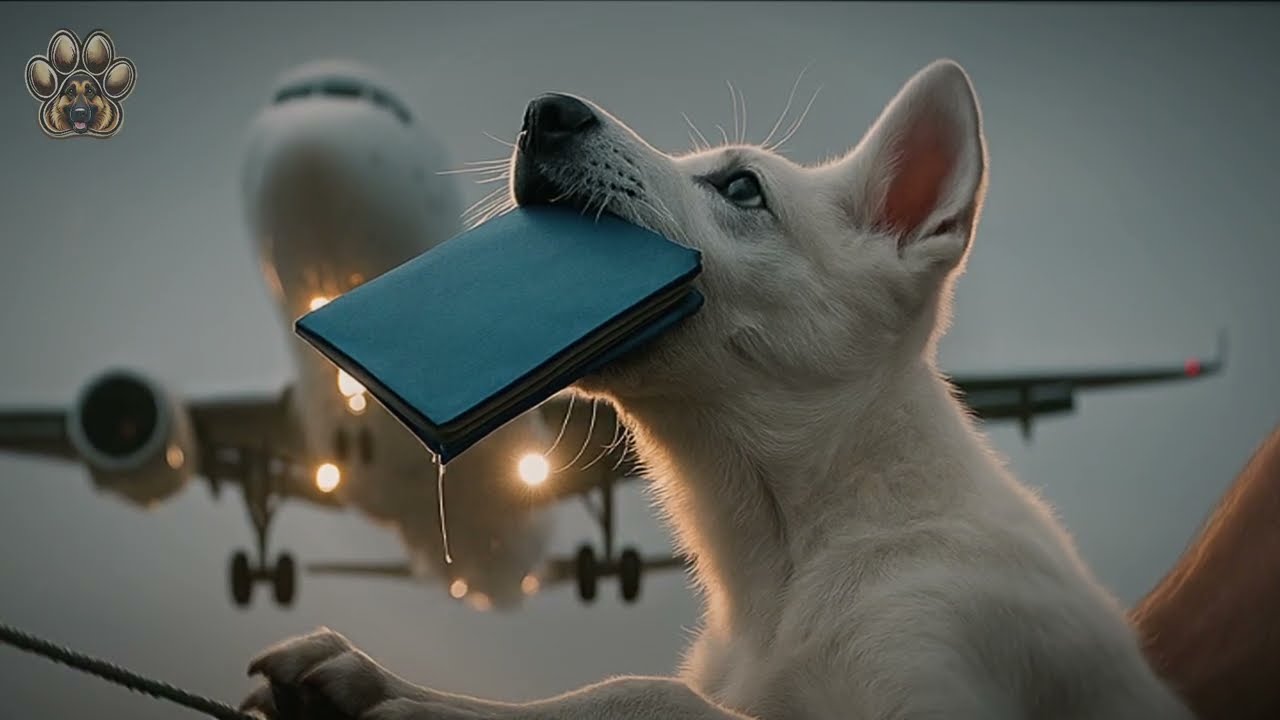
The muscles along his shoulders quivered, ready to throw his whole weight forward again if the lights told him to. On my radio, ground control crackled with routine clearances. Then a different voice cut in. lower clipped. Be advised, medevac outbound, priority departure, cardiac passenger on route from main terminal.
The words slid past like they were meant for someone else. But I saw his ears tip forward at the change in tone, as if he recognized that kind of urgency without knowing the language. I’d seen families sprint for those choppers before. I’d never seen who they left behind at the fence. The jet started its roll, a deep rising roar that made the fence hum.
He dropped back to the ground, snatched the blue folder off the concrete, and clenched it so tight the corners crumpled against his teeth. He planted his paws, braced his whole small body, and held on like like that folder was the one bag a rescued puppy wasn’t allowed to lose. From where I stood, I could finally read the edge of a sticker, half peeled, half soaked.
Pet documents, it said, the ink feathered from airport rain and jet fuel mist. I took another step in, close enough now that my flashlight washed over the knot in the leash and the raw line it had rubbed into his neck. He gave a tiny flinch at the light, then froze, jaw locked around the folder, eyes welded to the bright smear of engines at the far end of the strip.
Out by the access road, a patrol car rolled up slow to the gate, tires crunching, red and blue just barely touching the fence. My radio crackled again, this time from the unit in the cruiser. Hey, you’re at gate C, right? Heads up. Dispatch says that medevac passenger earlier tonight had a dog, white shepherd puppy. They never found it.
I looked at him at the way his teeth held paper like a promise. At the way his gaze clung to that climbing streak of light, and it finally clicked that he wasn’t praying for any plane at all. He was still waiting for the one that took his person up into the dark and never brought her back down.
If I didn’t cut that strap, he was going to break his own neck. If I did, he might pull free and run straight for the runway. Another jet rolled into position, nose light cutting through the haze while the engines climbed from a wine to a full body shake. He felt it before I did. His muscles bunched and he hurled himself forward so hard the leash snapped his head sideways and carved deeper into the sore band already circling his throat.
His paws skidded, nails scraping concrete, chest pinned against the strap, breathcatching in short, rough pulls that never turned into a sound. “Gate unit, close that lane,” I said into the radio, louder than I meant to. “If he gets loose, he’s going under someone’s wheels.” The patrol car eased up to seal the gap. Dark grill now a wall between us and the open pavement.
Most nights, my job out here was metal and timing. Tonight it was keeping one scared puppy from dying for a plane that was never going to stop. I went back to him slow knife tucked in my hand with the blade turned away. He shot me a quick wet glance then snapped his eyes back to the runway as the jet started its run.
The blue folder bounced against his paws and he tightened his jaw, lifting it just enough to keep the plastic edge from catching on the ground. Up close, I could see the fine shake in his legs. the bright red groove in his white fur where the strap had saun back and forth, each breath a shiver more than an inhale.
“Easy,” I said, letting my voice drop with every step. “Easy, buddy. I’ve got you.” My fingers slid between the nylon and his skin, feeling heat and the hard, fast punch of his heart, and for a beat, I just held on and breathed with him. Then I slid the blade in and cut clean through where the strap bit into the post.
He didn’t try to bolt into the dark. He went up instead, rearing on his back legs and slamming his front paws into the chain link, claws hooking the wire while he shoved his nose through the gap toward the roar. The folder never left his teeth. I wrapped an arm under his chest and hauled him back before he could climb higher, his whole body twisting, eyes still locked on the silver shape, tearing down the runway and lifting off.
pressed against me, he weighed almost nothing. All bone and heat and stubborn hope. As the jet climbed, he arched his neck after it, staring so hard at the row of glowing windows, it felt like he was searching everyone for a single missing person. “My flashlight swung with us, the beam sliding over the folder’s spine just long enough to catch a label.
” “My patient,” it read, a blurred human name after that pet and a smear of ink where his should have been. The office was quiet, but he was still listening to the sky, not to me. I carried him in against my chest, pushed the door open with my shoulder, and the hum of the runway followed us through the glass.
Anyway, the break room at night never looks like much. One flickering soda machine, an old couch, a radar screen casting green sweeps across the wall, and the dull vibration of engines coming through like a heartbeat you can’t quite locate. I set him down gently on the rubber mat by the door and closed us in.
He didn’t sniff the trash can. He didn’t nose the chair legs or circle for a spot. He walked straight past my boots to the narrow window that faced the field, planted himself there, and pressed his nose to the glass. Each time, a taxi light slid past. He tracked it, leaving faint fog circles that bloomed and faded with his breathing.
I picked up the blue folder from the table where I dropped it and flipped the wet cover open. Inside were vaccination records, airline style tags, a crumpled vet receipt, all curled from the moisture. On the main form, the letters had run, but not all the way. Color: white, breed shepherd, age 4 months. Under that, in a neater hand, a line that read, “Name Risco.
” “Risco,” I tried, soft, like I was testing the weight of it on my tongue. His ears twitched. For the first time since the fence, he turned fully away from the window and looked at me, eyes searching my face like he was checking who I’d stolen that word from. He took three slow steps in my direction, paws soundless on the tile, then pivoted and went right back to the glass as if he’d confirmed I wasn’t the one he was here for.
Farther down the page were numbers and a hospital logo. Emergency contact, same last name as the patient. In the notes section, someone had typed fast and clinical about a cardiac event, a medevac transfer, a clock that had suddenly started running faster than anybody wanted. On paper, he was just an abandoned puppy attached to a chart and a case number shoved into a folder and handed off between departments.
My phone vibrated across the table and made the coffee cups rattle. Unknown local number. I answered anyway, eyes still on the small shape by the window. Sir, a woman’s voice said, tired but precise. This is Atlanta General. We understand there is a dog at the airport tied to one of our emergency patients. I looked at Risco, nose flattened to the glass, staring out at a runway that didn’t know his name.
“Can you keep him with you for a couple of days?” she asked until we know if she makes it. I had no idea how you explain a couple of days to a dog who was still timing his world in takeoffs and landings. He trusted me once when he saw the lights in the mirror. I clipped a spare lead to his collar, tucked the blue folder under my arm, and walked Risco out to my truck.
He hopped into the back seat, turned sideways, and locked onto the rear window like the runway had just moved. Jet fuel off my jacket mixed with wet fur in the cab, and the quiet pressed harder than any engine. Each time a plane groaned overhead, he sprang up, paws on the rear deck, nose crushed to the glass as if he could claw a piece of sky and pull it back.
The belt checked him, his chest hit the back rest, and he swallowed air in rough bursts, but he never cried out. I heard myself telling him, “That’s not her flight. That one’s cargo.” Nothing you need to wait for, like whispering it might somehow make it true. Whatever promise he’d made at that fence didn’t include trusting the man who cut him loose.
By the time I took my exit, the roar of the airport had faded to a hum under the tires, and he finally lay down, not relaxed, just folded, eyes still angled toward the glow dying out behind us. I pulled into my driveway, opened the back door, and he hopped out to pivot away from the house, staring over the roof line toward the airport as if the whole neighborhood were a layover he hadn’t agreed to.
At the front step, he stalled, back paws on the concrete, front paws on the threshold, body strung tight between my hallway and the night until a long, quiet minute on the lead nudged him inside. He turned his back to me, sat facing the door, and fixed his eyes on the handle like it was a temporary jet bridge someone might lower any second.
Above the roofs, a plane dragged its sound across the sky. Uh, and that was when this brave pup let out a cracked whimper. A sound like hope trying not to believe itself. The only place that might understand him sounded almost exactly like the airport. The next morning, I loaded Risco back into the truck, folder on the seat beside me, and drove toward the low concrete building where I pulled volunteer shifts on my days off.
The shelter’s front doors kept sliding open and shut with that same tired gasp I knew from terminal entrances. Inside, metal doors clanged, phones rang, fans rattled in the ceiling, and dogs barked in sharp bursts that reminded me of radios keying on and off. He stepped in at my heel, ears pricricked, scanning every sound for the one engine he knew.
At the counter, they reached for a blank intake tag and asked almost casually, “Do you want to give him a name?” I set the blue folder down, opened it to the main page, and tapped it with a finger. “His name is Risco,” I said. He already had somebody write it down. They typed while I watched his reflection in the glass panel of the office door.
Status line, temporary hold, shelter puppy, owner hospitalized, outcome pending. In their system, he was a slot on a chart, waiting for either a reunion or a transfer. In his head, he was still on the perimeter road, listening for a specific set of wings. In the kennel run, he didn’t charge the gate or test every inch of concrete.
He walked to the back corner that faced the distant direction of the airport and sank down there, ribs lifting under his white coat with each slow inhale. Staff moved past with clipboards and the usual line floated by my shoulder. Dogs like him don’t stay long. Somebody said they meant people would want him.
What they didn’t get was that he wasn’t ready to want anyone back. That night, I came by after shift, long after the lobby closed. His food bowl was barely touched, water still clear, and he was sitting with his eyes fixed somewhere past the cinder block wall like he could see through to the runways. I slid down onto the cold floor outside his kennel and let my back rest against the bars.
For the first time in years, I stopped listening to the aircraft overhead and just sat there measuring the room by the sound of one dog breathing. He took the treat for the first time, not because he was hungry. He took it because a shadow passed the window. A few days blurred together like that. Me coming in at the same times, Risco staying in the same corner, food disappearing slowly enough to prove he was surviving.
Not fast enough to call it living. When I opened his run now, he didn’t glue himself to the back wall. He watched me head low, ears forward, like he was measuring how much of me he had to tolerate to keep his line on the sky. I’d sit on the floor inside the kennel and work on his paws one at a time. The skin between his toes was still pink and tender from the gravel, and the way he’d thrown himself at that fence, and the mark along his neck showed in a thin, raw groove.
He let me dab ointment along it, muscles tight, eyes not on my hands, but on the top edge of the gate, where the distant rumble rolled through. Up close, he looked less like some stoic statue and more like what he was. An injured puppy trying to pretend he hadn’t been scared out of his own body. Late one afternoon, a jet passed low enough that the whole building hummed.
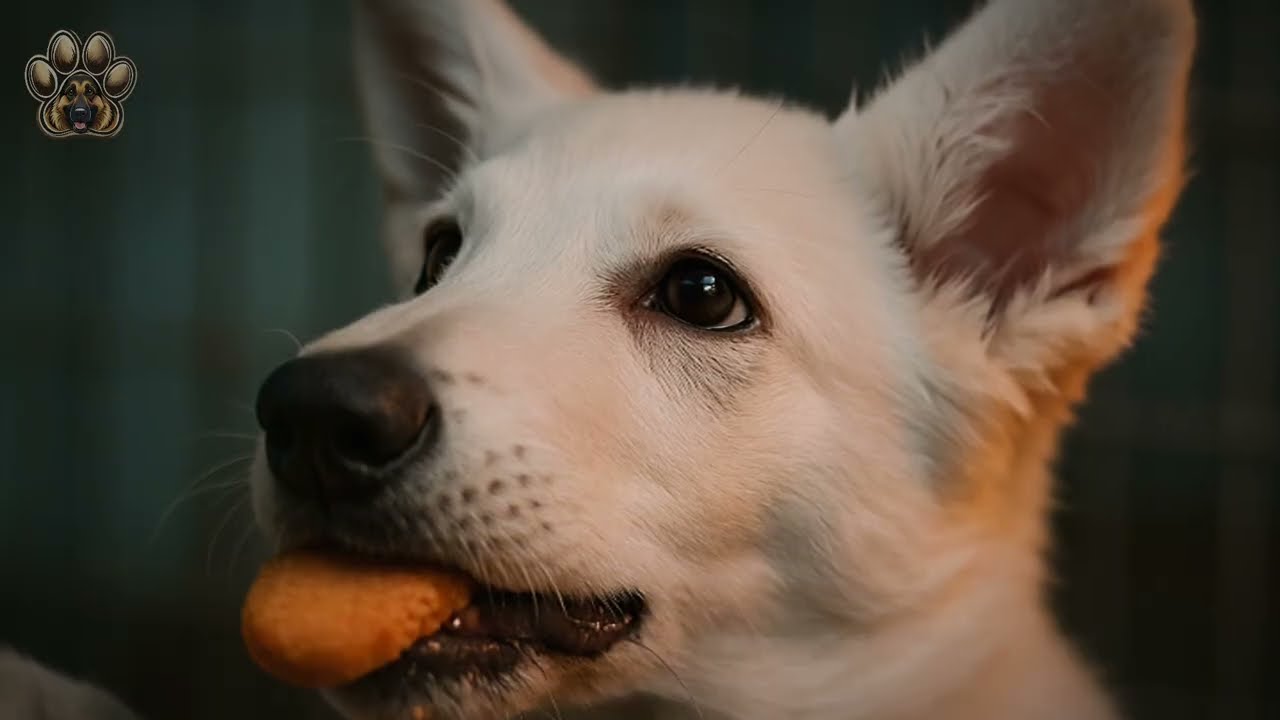
He started his usual move toward the far corner, then stopped halfway, turned, and took a single step in my direction instead. I had a biscuit in my palm. He sniffed, glanced sideways at the sound overhead, and then, like he was making a trade with the sky, leaned in, and took it.
Something I’d boarded up in myself a long time ago, shifted with that tiny decision. I’d promised I wouldn’t get attached again, not to another animal with one foot already somewhere else. But for that heartbeat, he’d chosen my hand over the wall. The call from the hospital came just before closing, the kind of voice that carries both bad and maybe in the same breath.
Her condition is unstable, the nurse said, but there’s still a chance. No one mentioned what would happen to him if that chance ran out. That night, a storm rolled in over Atlanta. Thunder stacking on top of the distant engines until the whole sky sounded like takeoff after takeoff. When the first crack shook the building, Rrisco didn’t bolt for the back of the run.
He pressed his side into the front panel right next to where I sat. And I realized the next storm might be the one that finally pushed him toward life or back into a kind of waiting that never brings anyone home. When the lights went out, we both remembered the runway. Thunder slammed the roof. The exit signs flickered.
And for one heartbeat, the whole shelter sounded like the tarmac when a storm shuts everything down at once. The siren panel beeped, fans spun down, and the hum of compressors died. But the engines out over Atlanta kept working somewhere in the dark. Rain hammered the metal like rolling wheels, and Risco snapped to his feet, eyes wide, head whipping from wall to wall as trying to pin the sound to one direction.
He lunged at the gate, claws skittering on damp concrete, then spun and clawed at the back corner as if he could scratch his way back to the fence line, he understood. I heard a bark break into a howl two kennels down. Another dog crashing its water bowl. Metal ringing sharp in the blackout. Risco’s breathing went ragged, too fast for his chest, and he started slamming his paws up the door, nails scraping steel, neck stretching the way it had under that strap.
He wasn’t thinking about pain or walls or me. He was hunting for the runway in the noise. I slid the latch and stepped into his kennel before I had time to tell myself it was a bad idea. If he bowled me over, I’d eat concrete. Instead of grabbing for his collar, I just sat down on the floor, back against the side panel, hands open on my knees.
For a second, he shot toward the far wall on instinct, the old pattern of bolting away from anything new. Then the thunder and the distant engines lined up in one long growl, and he froze halfway, turned, and staggered sideways until his shaking ribs pressed against my hip. His head stayed angled up, ears straining toward the sky, but his body leaned into me like this loyal puppy had finally picked a solid thing on a floor that wouldn’t stop moving.
“You know she’s not on any of these flights,” I said. Because it was easier to say it to a dog who couldn’t answer back. No planes bringing her back the way you’re waiting for. He didn’t understand the words, but he heard the break in them. His weight settled a little heavier, his nose bumping my shoulder as if to quiet me.
The storm moved off by inches. Thunder walking away across the city until the fans coughed back to life, and the emergency lights steadied. Most of the barking died down. Risco stayed right there next to me, not in the corner, not at the gate, just breathing in slow, uneven pulls that finally started to match mine.
My phone buzzed against my leg, screen lighting my palm with a hospital number I recognized now. “Can you come in tomorrow?” the voice asked when I answered. “We need to talk about what happens with the dog.” I looked at Risco, still pressed against my side, eyes fixed on nothing I could see, and felt the shape of another departure forming before anyone had even said the words.
He saw the fence again and ran like the world had narrowed to one strip of metal. That morning, they sat me down in the office off the kennels and set the blue folder on the desk. “She didn’t wake up,” the social worker said. “The tests say she won’t.” On the form, someone had already crossed out temporary hold and written placement needed beside his ID.
Like you could just redirect a German Shepherd puppy whose whole life had taken off without him. In the hall, Rrisco’s nails ticked a tight loop on the concrete. A tech cracked the rear door to haul in a crate, and a wave of hot air slid in, carrying the thick, unmistakable smell of jet fuel. Before the door could swing shut, he flashed past my boots, claws skidding on the floor, and squeezed through the gap like it had been waiting for him.
By the time I hit the parking lot, he was already down the service lane that points back toward the airport. Head low, ears back, he chased the distant engine hum like it was the only sound left on Earth. I ran after him, lungs burning, hoping the world would give us one more inch of luck. We caught him at the perimeter where the shelter property meets the airport fence.
Risco had found the same stretch of chain link that faces the runway headon like his body carried a map he couldn’t erase. He was on his back legs again, paws dug into the wire, whole frame shaking as another plane eased into place at the far end of the lights. I came up behind him and slid my arms under his ribs, lifting him off the fence before he could climb higher.
His claws scraped down the metal and then hung over my forearms as the engines roared and the jet began to roll. He leaned forward into the sound, neck stretched toward the line of windows as if he still believed one of them might hold her. She’s not on that one, I said right against his ear, trying to cut through the thunder.
For the first time, he tore his gaze away from the runway and looked straight at me. He hung there between my grip and the sky, and in that split second, I knew whichever way he turned next would decide which life he was willing to leave behind. Uh, I knew he’d chosen me the night he stopped counting takeoffs. The paperwork itself was nothing.
Screens, signatures, a scanned copy of that blue folder changing hands. Um, on one line I watched them move his status from placement needed to my name like you could summarize a whole new life in a checkbox. When I clipped his leash on outside and opened the truck door, he looked back once toward the direction of the airport, then jumped in without hesitation.
J, as if the route was finally allowed to change. This time, when a jet passed overhead on the way home, he stood to watch it through the rear glass, but he didn’t throw his weight at the window. He tracked the sound, then looked down at me in the mirror, eyes searching my face for what to do next. I didn’t have much, so I gave him the only thing I owned outright. Routine.
We built a new schedule like it was our own arrivals board. Early walk before the first bank of morning flights, kibble in the same bowl in the same corner, a chew toy that lived by the couch and nowhere else. Short training sessions where he learned wait and stay. and I learned how much of his world still tilted toward the sky.
Every time engines rumbled over the neighborhood, he’d trot to the window, check the clouds, and then more and more often circle back to wherever I was and lie down just close enough for his fur to touch my boot. One evening, a jet came in low and loud, rattling the picture frames on the wall. Risco jumped up, muscles tight, eyes flicking toward the glass out of habit.
Then he turned, walked over to me instead, and rested his head on my knee like a healing puppy choosing a gate that didn’t move. I laid a hand between his ears and felt for the first time that we were both standing on something that might hold. Later that night, my email pinged with a message from the social worker.
They’d found an envelope tucked in the back of the blue folder, a letter his owner had written just in case. They wanted to pass it on to whoever ended up keeping Risco. She knew he would wait even before anyone tied him to that fence. A week after the storm, I walked back into the shelter office and they handed me a plain white envelope clipped to that same blue folder.
My name was scrolled on the front in a shaky hand, the kind you see on hospital forms and goodbye notes. Inside was a single page folded twice that smelled faintly of antiseptic and whatever they use to wipe down airplane seats. She didn’t write much about herself. No dates, no diagnosis, just enough to explain that she knew her heart wasn’t something anyone could promise her.
She wrote about him, about the way he watched the window when she packed, how he paced when he heard luggage wheels, how they’d sat at the airport together before that last flight. If he ends up at the runway alone, she wrote, “Please don’t leave him there waiting for planes by himself.” On paper, he’d started as a foster puppy. Yeah.
temporary responsibility with an asterisk next to his name. In her letter, there were no asterisks. Whoever takes him home, the last paragraph said, “If you can take him to see the light sometimes, not to hurt him, to show him that waiting feels different when someone is standing beside you.” We signed the last of the adoption forms that afternoon. Real ink on real pages.
No more pending in any box next to his ID. Risco leaned against my leg while I wrote, not pulling, not pacing, just there, as if he decided the chair I sat in was the gate that mattered. When we were done, the clerk slid the papers into the folder and smiled like this was just another routine success story.
For us, it felt more like we just landed. That night, I drove him along the perimeter road, windows cracked so the sound of ATL could roll in. We stopped in a turnout where the planes rise up right in front of you, far enough to be safe, close enough that your chest still feels it.
Risco stood in the back of the truck, front paws on the edge, watching one jet line up, engines building, lights smearing across the dark. As it lifted off, he tracked it with his eyes the way he always had. Then he stepped down, walked over to where I was leaning against the side of the truck, and rested his head against my hip without making a sound.
He looked back once at the sky, then at me, and I realized he wasn’t just watching for someone to come back anymore. He was checking to make sure I wasn’t going anywhere. He doesn’t stand at the fence anymore. He sleeps by the door. On quiet nights, he still lifts his head when a jet drags its sound across Atlanta.
Ears pricking, eyes tracking some point only he remembers. But it isn’t that sharp, desperate stare at the runway. Now it’s softer, like a small salute to a moment when somebody he loved got lifted into the sky so people could try to save her. He listens, checks that the world is still moving, then sigh and lets his weight slide back down against the wood where my boots end.
I think about all the times I found him measuring his life in takeoffs and landings. how long he stood with his chest against cold metal, waiting for one person to step out of a plane that was never coming back. Every stray puppy at a fence like that is either going to go quiet for good or find a new voice through the people willing to sit on willing to sit on the concrete and shake with them until the noise in their head changes.
We can’t promise them the ones they lost, but we can stand where the waiting used to hurt and teach them that coming home can mean a different doorway. This little guy’s journey from abandonment to rehabilitation shows how important nonprofit rescue groups really are. They’re the reason he made it past the service gate, past the kennel, past the point where most dogs fade into numbers on a chart.
And the truth is, none of that works without the people on the other side of the screen. Caring for a rescued puppy is more than love. It’s responsibility. It’s pet care. It’s answering the call when a dog like Risco is tied to a fence and everyone else is looking at the plane. Every time you share a story like his, you shift the odds for the next dog standing nose towire in the dark.
You move them one step closer to a couch, to a food bowl with their name on it to a life where the loudest sound isn’t an engine, but a laugh in the kitchen. You help drag them from the edge of the runway back into the light of somebody’s porch. Join our Bravepaws family. Be their voice. Be their hope.