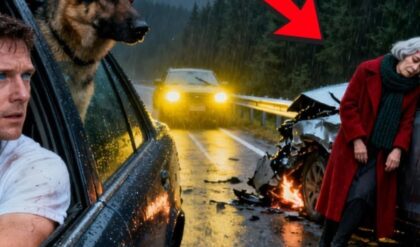
The moment I turned the key, the silence in the cab of my truck felt louder than the damn rain. It was over. I’d done it. I’d chosen to help a stranger over helping my own daughter, my own life. The thought was a physical weight, pressing down on my chest until my breath came short. I was a fool. A good fool, maybe, but a fool nonetheless.
I watched in the rearview mirror as the black BMW, now sitting steady on its donut spare, merged back onto Route 9 and disappeared into the gray mist. She was gone. Back to her important life, while I was left standing in the damp, cold silence, the smell of her expensive perfume lingering in the air, a cruel joke against the background of my own sweat and the grease under my nails.
The drive back to the trailer park was a blur of self-loathing. Every beat of the failing windshield wipers was a tick of the clock, counting down the minutes past the interview. 9:00 AM. 9:15. 9:30. I was supposed to be shaking hands, smiling, impressing someone. I was supposed to be securing a future where Sophie didn’t have to check the price tags on cereal boxes.
Instead, I was just a mechanic. A broke, single dad in a soggy, cheap suit, reeking of rainwater and failure.
My dad’s voice echoed in my head, the same one that had pushed me to pull over. “Son, you help folks when they need it. Doesn’t matter who they are.”
It was easier for him to say. He’d never been this close to the edge. He’d never had to look his own child in the eye and explain why they couldn’t afford the class field trip. He’d had a partner. I had Sarah’s picture on the dash and a mountain of her medical bills in a shoebox under my bed.
Pulling into our slot at the trailer park, the world looked gray. The rain had washed the color out of everything, leaving puddles that reflected the sky like cracked mirrors. Our little single-wide, tan with rust-colored trim, looked smaller than usual. Pathetic.
But it was ours. Paid for with busted knuckles and 16-hour days. The small patch of garden out front, where Sophie and I had planted tomatoes, was a burst of defiant green against the mud.
I sat there for a full minute, engine off, just trying to build the courage to go inside. How could I face her? My little girl, who had more faith in me than I had in myself. She’d been the one to help me press this stupid shirt last night. She’d picked out the tie.
I finally stepped out, my shoes squelching in the mud. The air was thick and heavy. I pushed the door open, the old hinges groaning in protest.
And there she was.
Sophie sat at the tiny kitchen table, a bowl of generic-brand cereal in front of her. Her braids, which she’d insisted on doing herself, were a little crooked. She was nine years old, but her eyes were ancient. The moment I walked in, her spoon froze halfway to her mouth. She didn’t smile. She didn’t have to ask. She just knew.
“How’d it go, Dad?” she asked, her voice careful, quiet. The way she always spoke when she wasn’t sure if she needed to brace for bad news.
I couldn’t hold the lie. I couldn’t even build one. I hung my damp jacket on the back of the chair, the one with the wobbly leg. The soggy tie felt like a noose. I sat down across from her, the Formica cold under my forearms.
“I missed it, Soph,” I whispered. The admission sucked the air from my lungs. “I stopped to help somebody. A woman, her car was… it was bad. By the time I got back on the road…”
I braced for the tears. For the disappointment. For the “why, Dad?”
Sophie just tilted her head, her gaze steady. She studied my face, looking for anger, or shame. Then, she gave a small, slow nod, as if my answer made perfect, logical sense.
“Mom always said you’d give away your last dollar to help a stranger,” she said, her voice flat, matter-of-fact. “Guess she was right.”
The words hit me harder than any anger could have. No judgment. No disappointment. Just… acceptance. To her, this wasn’t a catastrophic failure. It was just me being me. It was a validation of who her mother knew I was. And damn it, that hurt.
“You going to be okay about the job?” she asked, her voice softer now. She’d gotten so good at reading me since Sarah died. Too good. She could sense the tremors of my worry before I even spoke them.
I tried to force a smile. It felt cracked and brittle, but it came. “We’ll figure it out, peanut. We always do.”
She believed me. And that, right there, was the spark. Her belief was the kindling. Maybe, just maybe, I could believe it, too. We’d survived the hospital. We’d survived the funeral. We’d survived the endless, hollow nights of her asking why Mom wasn’t coming back. We’d get through this.
I leaned back, the chair creaking. I watched her finish her cereal, the sound of the spoon scraping the bowl a normal, beautiful sound in a world that felt like it was ending. For all my failures, I’d given her this: a world where her dad stopping to help someone wasn’t a tragedy, just a fact.
What I didn’t know, sitting there in my ruined suit, was that the woman in the BMW wasn’t just a stranger. She wasn’t gone from my story.
And at that very moment, she was making a phone call that was about to detonate the entire foundation of my small, broken life.
The next morning, I was elbow-deep in the guts of a Honda Civic, fighting a seized bolt on a water pump. This was my reality. Murphy’s Auto Repair. The smell of grease, burnt oil, and stale coffee. It was just another Tuesday. The radio crackled with a country song about losing a truck, a dog, and a woman. I could relate.
Then, she walked in.
I almost didn’t recognize her. The light from the open bay door silhouetted her, and for a second, I thought she was just a customer. But then she stepped into the fluorescent glow.
Gone were the soaked designer jeans. Gone was the helpless, rain-streaked expression. She wore a simple blue dress that probably cost more than my monthly trailer payment, and she moved with a quiet, sharp confidence that did not belong in Murphy’s. It was the woman from Route 9. Amy.
“Ryan,” she said. Her voice was warmer this time. Steadier.
I wiped my hands on a rag that was already past saving. I was suddenly, painfully aware of the oil stains on my work shirt, the ones that had been there for months. The grease under my nails that would never come out.
“Amy,” I replied, my voice rough. I couldn’t keep the suspicion out of my tone. “Car running okay? Or did you just come back to our little slice of paradise for the ambiance?”
Most people I helped on the road… you never saw them again. They were a taillight in the rearview mirror. Her showing up here? At my job? That was different. That was… weird.
She held out two cups of coffee. Not from the gas station. From the new place downtown, the one with the fancy logo that I couldn’t afford.
“Wanted to thank you properly,” she said, handing one to me.
I took it. The cup was warm. The first sip was strong, smooth. Not the bitter sludge I brewed at home. “Appreciate it,” I said, but the knot of suspicion didn’t loosen. “How’d you find me?”
“You mentioned you worked at Murphy’s,” she said, a little too quickly.
Had I? I didn’t remember. I remembered the rain, the ruined tire, the ticking clock.
She sat on the greasy metal bench outside the garage bay, not seeming to care about her expensive dress. I joined her, leaving a respectful distance. We both watched the traffic crawl past Plainfield’s two stoplights.
“I feel bad about yesterday,” she said finally, staring straight ahead. “You missed something important because of me.”
I took another sip of the coffee. It was too good for this conversation. “Nobody forced me to stop,” I said, the words tasting like gravel. “I made a choice. My dad taught me that helping people is the right thing, even if it costs you.”
She turned then, studying my profile. It was an intense look, like she was trying to x-ray my skull. “What if I told you Brooks Automotive might give you another chance?”
I laughed. It was a short, dry, ugly sound. “A nice fairy tale, Amy. But companies like Brooks don’t hand out second chances to guys in grease-stained shirts who don’t even show up. I live in the real world. That ship has sailed.”
Her smile was strange. It lingered, but there was something unsettled behind it, something that didn’t match the words. “What if it could work differently?”
I frowned. What was this? Some kind of test? A game? Before I could press her, the rumble of the 3:00 PM school bus cut through the afternoon. I saw it before I heard it, a big yellow rectangle of hope. I stood up, waving, as it rumbled past.
A small hand waved back frantically from a side window. Sophie. Her grin was bright enough to cut through the gray day.
My chest tightened with that familiar, painful, beautiful mix of pride and terror.
“That’s Sophie,” I said, my voice softening without my permission. “Light of my life. Reason I get up.”
Amy—if that was even her name—watched the bus until it disappeared. Her expression was unreadable. Hunger, maybe? Loneliness?
She stood up, smoothing her dress with an efficiency that screamed schedule and meetings. “If Brooks Automotive calls you for another interview,” she asked, her voice suddenly all business, “would you go?”
The question hung in the oily air. It wasn’t casual. It was a loaded weapon.
“Yeah,” I said slowly. “I’d go.”
Her shoulders relaxed, just a fraction. “Take care, Ryan Carter.”
And just like that, she was gone. Walking back to that black BMW, which I now saw was parked across the street, looking brand new.
I stood there with a cup of ridiculously good coffee, my heart pounding a weird, heavy rhythm. I didn’t know who she really was. But I knew one thing.
Whatever game this was, it wasn’t over.
The call came an hour later. My boss, Murphy, hollered across the garage, his voice a mix of confusion and annoyance. “Carter! Phone! Sounds… corporate.”
I picked up the receiver, wiping my hand on my jeans. “This is Ryan.”
“Mr. Carter, this is Janet Morrison from Human Resources at Brooks Automotive.” Her voice was polite, starched, and almost apologetic. “We’re calling about your missed interview yesterday. We understand you had significant car trouble, and we wanted to apologize for the miscommunication on our end.”
Car trouble? I almost laughed. My car trouble? “There must be a mistake…”
“No mistake, Mr. Carter,” she cut in, her voice smooth as silk. “These things happen. We value tenacity here, and we’d like to give you another opportunity. Can you come in tomorrow morning? Nine AM sharp?”
I stared at the wall, at the calendar of a 1950s pin-up girl holding a wrench. Amy. That woman hadn’t just brought me coffee. She’d spun a whole story. She’d lied for me. Why?
When life hands you a lifeline, you don’t ask why. You just grab on.
“Yes,” I said, my voice steadier than I felt. “Nine AM. I’ll be there.”
That night, Sophie was a tiny general. She supervised the ironing of my one good shirt. She debated which of my two ties looked “professional but not boring.”
“You nervous, Dad?” she asked, leaning on the counter as I polished my scuffed dress shoes until I could see my own tired face in them.
“A little,” I admitted. “But sometimes, being nervous just means you’re about to do something important.”
She grinned, a flash of her mother’s smile. “Mom always said courage isn’t about not being scared. It’s about doing the right thing, even when you are.”
Her words were a shield. I carried them with me all night.
The next morning, the sky was a clear, brilliant blue. A good omen. The headquarters of Brooks Automotive was a cathedral of glass and steel. I’d driven past it a hundred times, always feeling like a peasant outside a castle.
Walking into that marble lobby, I felt like I was breathing different air. Thinner. Richer. The receptionist greeted me by name, with a warmth that felt… flagged. Special treatment.
Janet Morrison appeared, clipboard in hand. She led me through a maze of quiet, plush cubicles. We stepped into a sleek conference room with a glass wall overlooking the entire city.
A man in a suit, Tom Stevens, stood to shake my hand.
But it was the third person in the room who made my stomach drop into my shoes.
She turned around from the window.
And my world tilted.
It was Amy. But it wasn’t. The blue dress was gone, replaced by a tailored power suit that looked like armor. Her hair was pulled back. Her eyes weren’t warm; they were sharp, calculating, and powerful.
This wasn’t Amy Johnson, the stranded motorist.
This was Amanda Brooks. The CEO of Brooks Automotive.
The woman whose name was on the building.
“Hello, Ryan,” she said, her voice calm, confident, and utterly devoid of the warmth from yesterday. “Thank you for coming in.”
I swallowed. My heart was a trapped bird against my ribs. My mind raced, replaying every word. Her “feeling bad.” The coffee. The lie about my car trouble.
It was a test. The whole thing was a sick, elaborate test.
“I think,” I said, my voice dangerously quiet, “we need to talk.”
Amanda didn’t flinch. But before she could speak, Tom started the formal questions. I forced myself to focus, to answer about my experience, my philosophies on team management, my diagnostic skills. But every word felt like ash in my mouth. I wasn’t being interviewed. I was being dissected.
Then, Tom asked the question. “Our records show you missed your first interview due to ‘car trouble.’ But Janet said you called it a ‘misunderstanding.’ Can you clarify what happened?”
The air went thin. This was it. The real interview.
I turned from Tom and looked straight at Amanda Brooks.
“I didn’t have car trouble,” I said, my voice clear and cold. “I stopped to help someone who needed it. Someone stranded on the side of Route 9 with a blown tire, who looked scared. I chose to help that person over being here on time.”
Amanda’s expression was a mask of corporate neutrality. But I saw her jaw tighten.
Her next question cut through the silence. “Do you regret that choice, Mr. Carter?”
I shook my head. “No. I don’t regret helping someone who needed me.” I leaned forward, just an inch. “But I do have a lot of questions about why that someone felt she had to lie to me. Twice.”
The silence that followed was so heavy it felt like it would break the glass. Janet cleared her throat. Tom looked at his clipboard like it held the secrets to the universe.
“Perhaps,” Janet said, her voice strained, “we should take a brief recess.”
Tom and Janet scrambled out of the room like it was on fire.
And then, it was just the two of us. Me, the mechanic in a cheap suit. And the billionaire who’d played me for a fool.
The room felt small, the air crackling. Amanda stood by the window, arms folded, a general on her own battlefield.
“You have every right to be angry,” she said quietly, her voice losing its CEO edge, replaced by something human.
“Do I?” I shot back, my own anger surprising me. “Because right now, I’m just confused. What was this, Ms. Brooks? Some kind of twisted ‘Undercover Boss’ episode? Did I pass? Do I get a prize?”
“I wanted to know,” she said, turning, her face bare, “who you were when you didn’t think it mattered. I spend my entire life surrounded by people who want something from me. Their kindness is… calculated. I needed to see if yours was real.”
“So you lied to me. At my job. In front of my boss.”
“I brought you coffee,” she said, a small, pained smile.
“And you lied to your HR department to get me here.”
“I… bent the truth,” she admitted. “To get you in the door.”
“Why?” I demanded. “Why go through all this for a mechanic from Plainfield?”
Before she could answer, the door flew open. Janet Morrison stood there, her face pale. “Amanda. Emergency at Plant 2. Line three is down. A major equipment failure. They… they can’t figure it out.”
Amanda’s face tightened. The vulnerable woman was gone, replaced instantly by the CEO. She was rattling off questions, grabbing her phone.
I didn’t even think. My body just reacted, the way it always did around broken machinery.
“What kind of failure?” I asked, already moving toward the door.
Amanda blinked, startled. “Ryan, this doesn’t concern you. You don’t work here.”
“Not yet,” I cut in, my voice hard. “But you wanted to know who I really am. You want to see real? Then let me show you.”
Twenty minutes later, I was in the passenger seat of her real car, a different, sleeker BMW, as she weaved through traffic like a woman possessed. My mind wasn’t on the interview. It was on the problem. Line three. Major equipment. Hydraulic? Belt? Sensor? My hands were already itching for a wrench.
Plant 2 was chaos. Alarms were flashing. Men in hard hats were shouting. And in the middle of it all, Line 3—the biggest, meanest assembly line I’d ever seen—was dead. Silent.
Tom Stevens, the guy from the interview, hurried over, his face slick with sweat. “We’re down, Amanda. Two hours. Every minute costs us thousands. Nobody can figure it out.”
I didn’t wait for an invitation. I crouched by the massive drive assembly. I could smell it. That faint, acrid scent. Burnt hydraulic fluid.
I listened. I put my hand on the steel housing. I felt the silence.
“Has anyone checked the secondary filter housing on the hydraulic reservoir?” I asked.
Tom frowned. “We changed all filters last month. Standard PM.”
“Primary filters, sure,” I said, sliding out. “But there’s a secondary housing behind the main panel. Most people forget it. Clogs up fast under heavy production. I’ve seen it a dozen times.”
I barked for a 3/8 wrench and a flashlight. I shrugged off my suit jacket, tossed my “professional” tie on it, and rolled up my sleeves. The crowd of engineers muttered. I saw Amanda, arms crossed, watching my every move.
I was on my back, crawling into the guts of a multi-million dollar machine, my only good shirt collecting oil and grime.
It was heaven.
Thirty minutes later, covered in grease, I slid back out. In my hand, I held the filter. It was black, choked, and solid with gunk.
“There’s your problem,” I said, holding it up like a trophy.
Tom’s eyes went wide. He screamed for a restart.
The plant held its breath. A supervisor hit the button.
With a deep, satisfying whir, the conveyor word back to life. Smooth. Steady.
The sound of applause rolled across the plant floor.
“How… how did you know?” Tom stammered.
“Because machines talk,” I said, wiping my hands on a rag. “You just have to know how to listen. Sometimes the answer isn’t complicated. It’s just hidden.”
Amanda stepped forward. Her suit was immaculate. I was a disaster. Her voice was low. “That was… impressive.”
I met her eyes. “That was just Tuesday afternoon. This is who I am, Ms. Brooks. No games. No tests. This.”
She studied me, and for the first time, the mask was gone. “I can see that,” she said. “The question is, do you want to do it here?”
The next morning, I was frying eggs when the knock came.
I opened the door, and my heart stopped.
Amanda Brooks was standing on the flimsy front steps of my trailer. In a tailored suit and heels. In the middle of the trailer park. My neighbors were already watching.
“Amanda,” I said, stepping outside, trying to block her view of my messy kitchen. “This is… a surprise.”
“I needed to see,” she said, her voice plain. “I needed to understand who you are. Before I ask you to trust me.”
I gestured to the rows of trailers, the kids’ bikes, our little garden. “This is it. Not much, but it’s home.”
“It’s honest,” she said.
The door swung open, and Sophie bounded out. She froze, her eyes going from me to the fancy lady to the very fancy car parked where it didn’t belong.
“Everything okay, Dad?” she asked, suspicion in her voice.
“Sophie,” I said, “this is Amanda. She’s… the lady whose tire I fixed.”
Amanda crouched down, getting on Sophie’s level. “He gave up something important to help me,” Amanda said gently.
Sophie looked at her, then at me. “That’s just what Dad does,” she said. Then, with the brutal honesty only a child has: “Are you going to give him the job?”
Amanda’s composure cracked. “That… depends on whether he wants it.”
“Of course he wants it,” Sophie said, rolling her eyes. “He wants to give me a better life. But he feels guilty about leaving Mr. Murphy.”
My face burned. Amanda looked… shaken.
“I hope you give him the job,” Sophie said, hugging me. “He deserves good things.”
The school bus pulled up. Sophie waved and was gone.
“She’s remarkable,” Amanda said.
“She’s the best thing I ever did,” I replied. “Now. Why are you really here?”
And she told me. About her father. About building the company from a two-bay garage, just like Murphy’s. About losing sight of what he was building. About a board that wanted to cut jobs.
“When my tire blew,” she said, “I was on my way to approve those layoffs. Then I met you. You reminded me of my father. This isn’t charity, Ryan. It’s about me trying to save this company’s soul. And I need someone who won’t let me forget what matters.”
She was offering me a job. A real job.
“I want you,” she said. “Not because of the tire. But because you see problems differently. You cut through the noise. I need that.”
I took a deep breath. “I have two conditions.”
She raised an eyebrow.
“First, I need two weeks. I’m not walking out on Murphy. I’ll train my replacement.”
She nodded. “Done.”
“Second,” I said, “before I sign anything… I want you to have dinner with me and Sophie. Here. At our table. My daughter deserves to know the person changing our lives. And you deserve to see who we really are.”
A real, genuine smile broke across her face. “I’d like that, Ryan. I’d like that very much.”
Six months later, I stood in that same glass conference room. Brooks Automotive had just landed the biggest contract in its history. Plant 2 was exceeding targets. Employee satisfaction was at an all-time high.
After the meeting, Amanda and I walked through the parking lot.
“Any regrets?” she asked.
“Just one,” I said. “I regret it took a flat tire for us to find each other.”
That evening, she showed up at our trailer. No suit. Just jeans and a sweater. She had a chocolate cake from a fancy bakery.
We ate at that same little table. Sophie, never shy, leaned forward.
“Amanda,” she asked, “do you ever miss being rich?”
Amanda choked on her coffee. “Sophie, I… I was never rich in the ways that matter. I had money, but I didn’t have… this. Friendship. Good cake.”
Sophie nodded. “Friendship is worth more than money.”
“Exactly,” Amanda said.
Later, after Sophie was in bed, Amanda and I sat on the steps.
“My dad always said,” I told her, “that regretting a kind act is like apologizing for being human. You just make the bet that the world is worth the effort.”
She looked up at the stars. “Your father was a wise man.”
“He was,” I said. “And he would have liked you.”
As her car’s taillights faded, I looked at our little home. It wasn’t small anymore. It was full. I’d stopped to fix a tire, and in the end, I’d helped fix something much, much bigger.