No maid lasted with the millionaire’s little daughter until a new maid did the impossible. “Another one just quit. She got locked in the art room with oil paints,” came the assistant’s voice over Michael Clark’s laptop speaker, biting into the tense moment. Michael’s eyes snapped open. He was 5 minutes behind in his conference.
The board meeting a crucial pitch for a merger. But now everything stopped. The words replayed in his head. He closed the laptop, signaling an abrupt end to the meeting, and walked out of the sleek glasswalled office without another word. Downstairs, the mansion was quiet, eerily so.
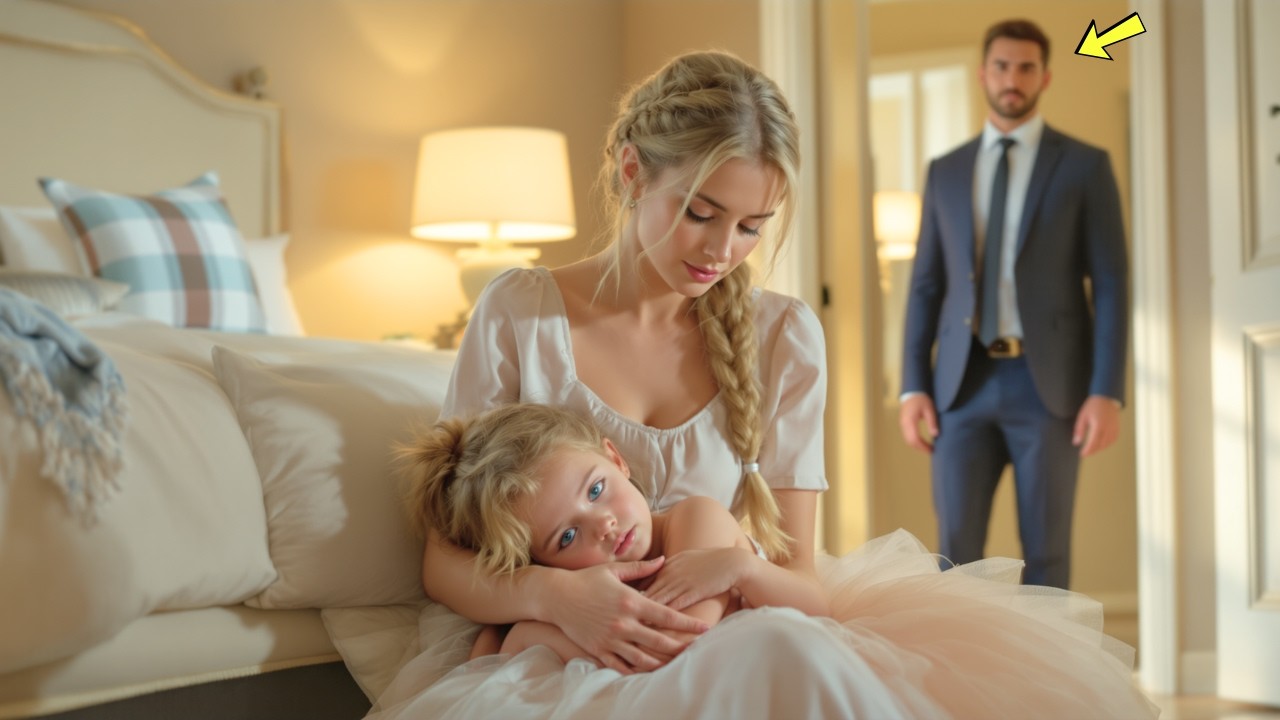
No laughter, no footsteps, just the faint hum of security monitors. Michael’s heart pounded as he climbed the stairs two at a time. He reached the door of Alice’s bedroom, imposing and grand, and pressed his ear against the cold wood. From inside came muffled sobs, the scraping of brush strokes, and then the clang of a wooden crate being tipped over. He kicked the door open.
The walls were smeared in red and black paint, streaks and splatters that turned his stomach cold. One canvas laid discarded on the floor. It was a child’s drawing, stick figures with a missing woman, a car, flames. Alice stood amidst the chaos, her small body trembling, hair matted, wearing a tutu splashed with paint. In one hand, she held a paintbrush like a weapon.
What? Alice? Michael managed. She lifted her head and screamed, voice raw. Bring back mommy. I don’t want anyone else. Michael dropped to his knees, scooping her into his arms. But she pushed him away, shaking. The smell of paint made his chest burn. He lowered his voice. Alice, sweetheart.
She ran past him, hurling the paintbrush at the door with force. She flung herself into her bed, hiding under the blankets, her body racked by silent sobs. Michael stood in the ruined room, tears he didn’t know he had forming. He thought she’d heal with time, that a few nice people, nannies, teachers, family, friends would soothe her. But 13 helpers had come and gone, each failing in less than a week.
Some even quit on the first day. Rumors of chaos, screaming, locked doors. He touched the paint smeared wall and closed his eyes. He was a successful tech CEO, a millionaire. He could control markets, calculate risk, manage crisis. But this, this was his greatest failure. In that quiet storm, he realized he was losing her.
Michael gently extracted a crayon from Alice’s grasp and placed it on her nightstand. He sat on the edge of the bed, his voice soft in the dark. “I know you just want mommy,” he said, voicebreaking. and I promise I will always try to bring her back to you in stories in your heart. But putting someone else here isn’t fair if she isn’t you.” Alice didn’t respond.
He continued, whispering to the dark. “If love were enough, she’d be here.” He pulled the blankets back and sat silently, waiting for her to calm down. In that stillness, he wondered if the right person could walk into their chaos, not to replace, but to understand.
He whispered, “I love you, Alice,” and stayed, wrapped in grief and hope, into the night. By late afternoon, the Clark mansion stood still once again, rooms cleaned, toys untouched, doors all closed. Only the faint echo of a child’s earlier cries lingered in the high ceiling hallways. Michael Clark sat across from the newest applicant at the kitchen island, his sleeves rolled up, a mug of coffee in his hand, his eyes tired but alert. She was different. That was his first impression.
Sienna Hayes was young, early 20s maybe. Blonde hair pulled into a neat braid, soft blue eyes, posture relaxed but confident. There was something in her voice when she said, “Good afternoon, Mr. Clark.” That caught him completely offguard. “Not what she said, but how she said it. Warm, gentle, familiar.” Michael blinked.

“You’re the 14th.” Sienna smiled politely. “That’s not the most encouraging welcome I’ve had in a job interview.” He looked her over again. “This is not a regular position. My daughter is difficult. I read the job description, she said evenly. And I’ve worked with children before. I also volunteered in paliotative care at Edenwood. Michael frowned.
You’ve done elderly care. Sometimes their stories are the ones children need the most, she replied simply. That answer stayed with him. He gave a tired sigh. You really want this job? She nodded. Yes. Then God help you,” he murmured, and signed the temporary contract. By early evening, she had been introduced to the household.
The housekeeper gave her a quick tour. A fresh uniform was laid out, and then she stood outside Alice’s door. Michael lingered by the stairs, waiting for the inevitable crash. The shouting, the rejection, like always, but none of it came. just a strange tense silence. Inside the room, Alice sat on her bed, clutching a faded picture frame. She did not look up when the door opened.
“Hello, Alice,” Sienna said softly. Alice froze. Her hands clenched the frame tighter. “That voice. It was not exactly the same, but close. Hauntingly close.” Sienna stepped forward slowly. “Your dad said I could come in just to say hi.” Alice’s lip quivered, her eyes filled wide with confusion and something else, grief, recognition. She opened her mouth, but no sound came. Then she began to cry.
Not the loud, angry tantrums of the past, but quiet, broken sobs. Her body trembled like something sacred had cracked open. Sienna knelt, unsure. I am sorry. Did I say something wrong? Alice shook her head violently, tears falling. Without a word, Sienna sat on the floor beside her, giving her space. “I know a lullaby,” she said after a long pause.
“Would it be okay if I sing it?” Alice did not answer, but she did not say no. So, Sienna began a soft tune, slow and melodic, an old English lullabi about stars and quiet wings. She had learned it years ago from a patient at Edenwood who said her daughter used to fall asleep to it. Sienna sang with care, each note warm, steady, laced with a tenderness that seemed to wrap the room like a blanket. When the song ended, she looked up and saw Alice watching her.
Not glaring, not frowning, just watching. With wet cheeks, the little girl whispered, “That was mommy’s song.” Sienna nodded slowly. It is a beautiful song. Alice hesitated, then inched closer, just a little. Sienna didn’t move. She just smiled. Alice’s fingers reached up, brushing against her own hair, then paused.
Then, cautiously, she leaned in, pressing her head into Sienna’s lap. Sienna’s breath caught. She carefully placed her hand on Alice’s golden curls. Michael, still at the top of the stairs, had stopped breathing. It was the first time Alice had let anyone touch her since the accident. After a long pause, a tiny voice whispered from under the blankets.
“Can you stay?” Alice asked. “Just one night?” Sienna’s heart cracked. She nodded, brushing Alice’s hair gently. “As long as you want, Little Star.” By the third morning, the Clark household was noticeably lighter. The staff whispered about it, barely believing it themselves. How Alice had come down for breakfast without being carried. How she asked for toast instead of throwing it. How she had let Sienna braid her hair.
Michael saw it, too. His daughter was still fragile, still quiet. But something had shifted. A small crack had opened in the grief locked walls she had built, and light was starting to pour in, and Sienna was at the center of it. They read books together in the sun room.
Alice curled under Sienna’s arm with her thumb in her mouth and a picture book open in her lap. They made cookies in the kitchen, flour on their faces. Sienna helping her crack eggs while Alice giggled at the mess. They even had a routine now. Tea with honey after nap time, a walk in the garden, lullabies before bed.
Michael watched all of this unfold like a man seeing color for the first time. His daughter was smiling again, laughing again, something he feared he would never see. But he remained cautious, observant, curious. Late one afternoon, after Alice had gone down for her nap, Michael lingered in the hallway, pretending to read the day’s report. Instead, he waited for Sienna to come out of the girl’s room. When she did, he spoke.
“You are good with her.” Sienna blinked, surprised. Thank you. He stepped forward. Better than anyone we have hired. Her voice softened. She is not difficult. She is just grieving loudly. Michael tilted his head. And you know how to quiet grief. Sienna hesitated. She leaned against the wall, fingers laced in front of her apron.
I lost my little brother when I was 17, she said quietly. Medical negligence. A preventable accident. Michael stilled. Sienna continued. He was only five. I was babysitting that day. It never leaves you that kind of guilt, that kind of pain. He swallowed, not knowing what to say. I saw Ellis’s eyes the moment I walked in, she whispered. I recognized that storm.
It used to live in me. Michael looked at her carefully. So why come here? I thought maybe,” she said gently, “if I could help her, some piece of me might heal, too.” That answer stayed with him. That night, Michael passed by the playroom on his way to his study and stopped cold. The door was half open.
Inside, the overhead light was dimmed, and the room was quiet, except for the faint scratch of crayons against the wall. Alice was kneeling, a box of markers beside her. She had drawn a picture, not just any picture. A tall woman with blonde hair, a soft smile, a long dress. Her mother, Michael, felt the air punch from his chest.
Then slowly he saw Alice take a cloth and gently, with slow, thoughtful movements begin to wipe it away. She paused halfway, then looked up at the space where the drawing had been. “I miss you, Mommy,” she whispered. “But I am not mad anymore.” Michael stepped back before she saw him. In the hallway, he leaned against the wall, one hand over his mouth. His daughter was healing.
Not from him, not from therapists, from her, from Sienna. And somehow that did not make him angry. It made him grateful. The kitchen smelled like vanilla, cinnamon, and melting chocolate. It was all too much. Alice stood on a stool in front of the counter, sleeves rolled up, face dusted with flour.
Sienna tied a tiny apron around her waist, blue with sunflowers. Michael, for once, was not in a suit. He wore jeans and an old t-shirt, but even that could not save him from the bright pink apron Alice insisted he wear. It had a cartoon unicorn and a slogan that read, “Baking is magical.” “I look ridiculous.” Michael muttered.
“You look magical,” Alice giggled, then pointed to a black scorch mark on the corner of the apron. “Oops, Daddy, you burned your unicorn.” Sienna burst out laughing. Michael held up his hands in mock surrender. In my defense, I was told to watch the cookies, not that the oven was already on fire. No one told you to turn it to broil, Sienna teased. Alice clutched her belly from laughter, collapsing on the stool, tears running down her cheeks.
Michael looked at her, really looked, and for the first time in what felt like forever, he laughed, too. A real laugh, loud, free, uncontrolled. The kitchen echoed with the sound of it. Three voices tumbling over each other like sunlight streaming through windows that had been shut for far too long. When the cookies cooled, they moved to the living room.
Sienna brought out soft cloth, buttons, and thread. Today, she announced, we are making friendship dolls. Alice gasped. With eyes that blink. No. Sienna smiled. But with hearts that glow. They work together. Alice choosing buttons. Sienna sewing. Michael awkwardly trying to stuff a doll’s arm with cotton while Alice critiqued his technique.
You are not a very good sewer, Daddy. I am a CEO, not a seamstress, Michael replied mock. Serious. What is a CEO? Someone who makes important decisions. Alice grinned. like deciding how to sew arms badly. Sienna nearly fell off the couch laughing. When they finished, Alice held up her doll. It had blonde yarn for hair, a yellow dress made from leftover kitchen towels, and a big red smile stitched across its face. “I will name her Sunny,” Alice declared.
“Because she brings the sunshine,” Michael blinked. That is a nice name. Alice turned to Sienna, eyes sparkling. That is your name now. Okay. Sunny. Sienna’s hands froze mid thread. Her lips parted slightly. You bring the sun. Alice continued seriously. The sun came back when you did. Sienna’s throat tightened. I I would be honored.
Michael watched the exchange. something heavy stirring in his chest. Later that afternoon, Alice sat on the floor with crayons, her tongue peeking from the corner of her mouth as she concentrated. Michael was pretending to read the paper. Sienna was tidying the table. “Done,” Alice declared. She held up a picture, three figures holding hands.
Michael recognized himself, tall with a tie and messy hair. Next to him, Alice wearing her sunflower apron. And on the other side, a woman with blonde hair and a yellow dress labeled Sunny. Above their heads, a big red heart. Sienna crouched beside her. “Is this your family?” Alice nodded. “I hope mommy sees it from heaven,” she whispered.
“And I hope she continues in her way.” Michael looked up, his heart clenching. Alice traced her finger over the sunny figure. If mommy sees you, I think I think she will not be sad about me anymore. The room went still. Sienna touched Alice’s cheek softly. Your mommy would be so proud of you.
Michael turned away, pretending to straighten the cushions. He did not speak, but his hands trembled. And in the silence, the sunlight spilled over all three of them. together. Oh. The house had fallen into a calm silence. Alice was finally asleep. Her arms wrapped tightly around the sunny doll. Her breath came slow and steady. Her golden hair fanned across the pillow like a halo.
Michael gently pulled the door shut, then turned to find Sienna in the hallway, tucking a stray curl behind her ear. “Would you?” he started, then cleared his throat, looking unusually awkward. Would you stay for dinner? I cooked. Well, he did something, but it is edible. Probably. Sienna smiled. Sure.
Downstairs, the dining room was dimly lit with the soft glow of pendant lights. The usual sterile, polished energy of the space had shifted, replaced with something warm, inviting. There was no formal table setting, no wine glasses or business talk, just two bowls of soup, a loaf of crusty bread, and a picture of lemonade. Sienna sat across from him, quietly unfolding her napkin. Michael studied her for a moment before speaking.
My wife, Clare, he began slowly, used to say silence was a sign of comfort. that if two people could sit together without needing to fill the air, it meant they were safe. Sienna looked up surprised. “I have not talked about her in a long time,” he added. “You do not have to,” Sienna said softly. “I want to,” he replied.
Clare was extraordinary. “She had a laugh that could change the mood of a room. She was the one who taught Alice to draw, to love stories. I used to read the same fairy tale book to both of them just to hear them giggle at the same parts every time. He paused, eyes distant.
The day she died, I remember thinking, “How does the world keep moving? How do traffic lights still change? Why does the sun rise? Everything inside me had stopped.” Sienna’s eyes shimmerred, but she said nothing. “Tonight,” he continued, “was the first time I said her name without feeling like I might break. The room was quiet again.” Then, without a word, Michael stood and walked to a nearby cabinet.
He returned with a small wrapped parcel, thin, rectangular. He placed it gently in front of Sienna. She looked at it, then at him. “Open it!” Carefully, she unwrapped the brown paper. Inside was an old worn book, The Golden Orchard of Dreams, a rare illustrated edition of Fairy Tales with a faded blue cover and silver lettering.
Sienna gasped. I found it through an independent book seller, Michael said quietly. Clare used to read it to Alice every night. We lost it in the accident. I thought maybe you could read it to her again. Sienna pressed her lips together, blinking fast. “I know it is just a book,” he added. “But it is not just a book,” Sienna said, her voice breaking.
“It is love,” she looked down, brushing her fingers over the cover like it was sacred. “You do not know what to say,” she whispered. Michael leaned forward slightly. “Say you will stay?” Sienna froze. “I’m Michael,” she said gently. I cannot forget who I am. I work for you. I take care of Alice. That is all.
That is not all, he said firmly. He looked her straight in the eye. You are the one who brought my daughter back to life. And without realizing it, you brought me back, too. His voice trembled just slightly. You are not just a maid, Sienna. Not to Alice. Not to me. Sienna’s breath caught. For a moment, neither of them moved.
Then, as if the moment itself knew it had reached the edge of something tender, the kitchen clock ticked softly in the background, and the lights above them flickered ever so gently. No kiss, no grand gesture, just a look and something beginning. It started with a glance. A well-dressed woman standing by her luxury SUV at the school parking lot noticed something that made her pause.
Sienna in a simple sundress gently helping Alice into the backseat of Michael Clark’s black town car. The little girl giggled and waved, calling out, “Bye, Miss Harper.” as they drove off. The woman blinked. Her eyes narrowed. Then she pulled out her phone. By the next afternoon, whispers began to spread across the private group chat of the school’s elite parents.
The topic, boundaries. I heard she’s living at his house,” one message read. “Is she even certified to care for a grieving child?” Another chimed in. I would never let someone like that be around my kid. A third added, “By the end of the week, it had a name.” The Clark situation. Michael was called in for an unscheduled meeting with the school board.
The principal, clearly uncomfortable, cleared her throat before speaking. “H Mr. Clark,” she began gently. “Several parents have expressed concern about Miss Bennett’s presence in Alice’s life. They feel the dynamic may be emotionally confusing. “She is the only one who has helped my daughter begin to heal,” Michael said coldly. Yes, but some feel the line between caretaker and replacement figure is becoming blurred. Michael’s jaw clenched. Do you think Alice is confused? He asked sharply.
The principal hesitated. It’s not our place to say. But the pressure from other parents is mounting. And as you know, the reputation of the school depends on the comfort of the community. That evening, Michael returned home to find a letter on the doorstep. It was unsigned, but the elegant handwriting gave it away.
It was from one of the school’s more prominent mothers. With all due respect, we hope you will consider what is best for Alice’s emotional development. Attaching too deeply to a temporary caregiver can cause lasting psychological confusion. She has already lost one mother. It is not fair to risk her losing another.
The words felt like a punch to the gut, but worse still was the change in Alice. She had begun to withdraw again. Her laughter faded, her joy dimmed. One night, while Michael was tucking her in, she looked up and asked quietly, “Daddy, am I allowed to love two mommies, or will they take Sunny away, too?” Michael froze. His throat tightened, and he had no answer. Then came the article.
A small local gossip blog picked up the whispers and posted a headline that felt like poison. Billionaires made or something more. The photo showed Michael walking beside Sienna and Alice. The angle suggestive the caption cruel. That night, Sienna sat alone at the kitchen table, the article open on her phone. Her face was pale, her hands trembling slightly. Michael stormed in.
Do not read that garbage, he snapped. My lawyers will shut it down by morning. Sienna did not respond. Her voice when it came was a whisper. It’s not about me, Michael. It’s about Alice. People are going to start saying things at school, at the store. She’s just a little girl. She doesn’t deserve this. We’ll sue.
Michael growled. We’ll release a statement. That will only make it worse. He stepped forward, frustration and helplessness tightening his chest. Then tell me what to do. I will do anything. But Sienna said nothing. That night, long after the house had gone still, Michael went to check on Alice. She was curled up in bed, clutching the sunny doll to her chest.
On her nightstand, beneath one of her crayon drawings, was an envelope. It had his name written on it. He opened it slowly, already fearing the worst. Michael, I came into your home to offer care to Alice and maybe selfishly to myself and never expected to love her as much as I do. But love, when it causes harm, is no longer love.
I cannot be the reason she is whispered about, stared at, questioned. I cannot be the shadow over her name. Please tell her I am sorry. Tell her I wanted to stay. But I was not strong enough. Sienna. Michael stood there for a long time, the letter trembling in his hands. The silence in the house was different now. This time it felt cold.
The house felt hollow again. Alice no longer burst into giggles at the breakfast table. Her laughter, once so vibrant in the halls, was now replaced by silence or outbursts that echoed through the walls like ghosts. Michael noticed it all. Every slam of a door, every untouched meal, every morning, she refused to get dressed for school.
She had not spoken Sienna’s name since the day she left, but she had not said much of anything else either. Michael tried. He offered to read her favorite story, but she shook her head. He tried baking the cookies they used to make together. She took one bite, then pushed the tray away. One night, as rain tapped gently on the windows, Michael walked past her room and noticed the light off, the bed empty. Panic surged.
He searched the house, calling her name until he noticed the slightly open door of the hallway closet. He knelt. Inside, curled up with her knees to her chest, was Alice. In her small hands, clutched tightly, was a pale yellow scarf. Sienna’s, she was whispering to it, eyes glassy, voice trembling. Sienna smells like mommy.
Michael’s breath caught. He sat down beside her, silently, not saying a word. He simply rested a hand on her back. That night, he sat alone in his study and reread the letters Sienna had left. Not once, not twice, but six times. He had once built companies, handled billion-dollar negotiations without blinking.
But here he was, helpless in the face of a 5-year-old’s grief and a woman’s quiet goodbye. The next morning, he made a decision. Not based on logic, not out of pride, but because he had finally learned to listen, not with his ears, but with his heart. At the next school meeting, Michael requested to speak.
The room was packed with polished parents and expensive suits. He stood before them. No script, no lawyer, just himself. My name is Michael Clark, he began, his voice steady but raw. Most of you know me as a CEO, a widowerower, a father,” he paused, eyes locking with a few familiar faces.
“What you may not know,” he continued, “is that in the last year, I have watched my daughter lose more than I could ever explain. And in that same year, I saw 13 different caretakers walk out of her life until one didn’t.” He stepped closer. Sienna Bennett didn’t just take care of Alice. She listened. She healed. She brought music and laughter back into our home.
And for that, I owe her more than I can put into words. A few heads turned uncomfortably. Michael did not care. I do not care what any of you whisper behind your hands. If kindness, patience, and love are threatening to you, then yes, I am guilty of letting my daughter love someone again. and if letting her do that makes me a bad parent, then I’ll wear that title proudly. A long silence followed.
He nodded once, then walked out without waiting for a response. That afternoon, he did one more thing. He contacted a trusted journalist, a quiet, ethical woman who once wrote a tribute article about his late wife, and gave her permission to publish a short personal statement. It was titled Gratitude, Not Gossip.
In it, Michael wrote, “There was no scandal, no scheme, just a father trying to do better and a woman brave enough to care when it was easier to walk away. She did not take advantage of me. She saved my daughter and maybe she began to save me, too.” The post went viral overnight, but Michael did not read the comments.
He was already in his car driving toward the edge of town to the address where Sienna’s letter had been postmarked. He had no plan, only hope. One month later, the Clark estate was transformed. Soft lights twinkled from every corner of the garden. The tall hedges shimmerred with fairy lights and candles floated gently in crystal bowls across the reflecting pool.
A string quartet played low in the background, and the air carried the scent of jasmine and freshly baked pastries. But the most beautiful thing wasn’t the decor. It was the atmosphere. It was a night not about wealth, nor social standing, nor business connections. It was a night about remembrance.
Michael had planned the event himself, a fundraiser for the foundation he had recently launched, named in quiet tribute to the woman who once held his heart, remembering her. The charity was created to support children grieving the loss of a parent to give them hope, resources, and a place to heal. People had come not just to give, but to feel something real. Celebrities stood beside school teachers. Wealthy donors chatted with single moms.
Children who had been touched by loss played near the garden’s edge, their laughter floating softly into the night air. No cameras, no interviews, just people connected by something deeper than status. Toward the end of the evening, after the speeches, after the tears and toasts, Michael stepped onto the small stage set beneath an oak tree.
His black suit was neatly pressed, but his expression was gentler than most had ever seen. He stood quietly for a moment, holding the microphone in both hands. There’s one more person I need to thank tonight, he said. The murmurss in the crowd faded. Michael scanned the faces before him. You all know the story of how this foundation began. You know who we named it for.
But what you don’t know is that I wouldn’t have had the strength to do any of this without someone who came into my life when I had no hope left. He paused, his voice catching slightly before continuing. She didn’t just care for my daughter. She gave her laughter back. She reminded me what family means. And she did it without asking for anything in return. A hush fell over the garden.
Michael turned toward the curtain just off the stage and extended his hand. From the shadows, Sienna stepped into the light. She wore a pale blue dress that moved gently with the breeze, and her hair, golden as ever, was curled softly around her shoulders. Her eyes sparkled with unshed tears, but there was strength in her smile, a strength Michael had always seen in her, even when she doubted it herself.
For a heartbeat, no one moved. Then a tiny voice rang out, clear and full of joy. My Sienna’s back, Alice. She zipped through the crowd on her tiny pink scooter. A bouquet of sunflowers gripped tightly in her hands. The guests laughed as she made her way up the stage steps and threw herself into Sienna’s arms.
Michael knelt beside them, slipping his hand into Sienna’s. Not as an employer, not as a grieving widowerower, but as a man who had chosen love again completely and without fear, he turned to the crowd. I never believed in second chances, he said.
But this woman, this family we’ve built, made me believe again. The applause that followed was not loud or showy. It was warm. It was healing. One year later, beneath the same oak tree, a smaller gathering was held. There were no reporters, no elaborate floral arrangements, just a garden, a handful of close friends, and a group of children who had once lived in shelters, now dressed in tiny suits and dresses, thanks to the Remembering Her Scholarship Fund. Michael and Sienna stood hand in hand.
Alice, now six and bold as ever, wore a white dress with a crown of daisies in her hair. She held a small satin pillow with the rings and a basket of petals looped over her arm. She marched down the aisle proudly, tossing petals with one hand and balancing the pillow with the other. At the altar, she raised her parents’ hands high like a tiny referee announcing a tie-breaking win.
I now pronounce you best family ever, she declared, earning a round of laughter. The vows were short, but meaningful. Honest words about grief, healing, and choosing love again, not out of need, but from courage. When the officient gave them permission to kiss, Alice clapped the loudest. Later, she ran to the photographer and shouted, “Take a picture. This is the best day.
” In the framed photo that would later sit in the Clark family hallway, Alice stood proudly between Michael and Sienna, her hands clutching theirs. Above it, written in elegant gold lettering, “Some families are born. Ours was healed. If this story touched your heart, if it reminded you that healing can come from the most unexpected places and that love, real honest love, does not always arrive perfect, but always arrives when it is meant to.
Then do not forget to like, share, and subscribe to Soulring Stories because here we believe that every heartbroken silence can one day turn into laughter again. See you in the next story.