The world often measures heroism in grand, sweeping gestures—in human acts of extraordinary bravery against fire or flood. Yet, sometimes, the deepest compassion surfaces in the smallest of moments, orchestrated by a protagonist who cannot speak a human word. This is the story of Rusty, a magnificent Golden Retriever whose unwavering persistence and profound empathy turned a mundane suburban sidewalk into a stage for a breathtaking rescue, saving a tiny, helpless kitten from the suffocating darkness of a storm drain.
It was a typically overcast afternoon, the kind where the grey light washes out the color of the world and encourages passersby to hurry home. The air was heavy with the scent of damp concrete and approaching rain. Sarah, a dedicated volunteer with HopeNest Rescue, was driving nearby, handling routine errands, when she noticed an anomaly: a dog behaving not just curiously, but frantically, near a large, municipal storm drain.
This dog, a handsome Golden Retriever with a coat the color of autumn leaves, was Rusty. He wasn’t barking wildly, which might have suggested aggression or play. Instead, he was engaged in an intensely focused, ritualistic dance. He would nudge the heavy metal grate with his nose, let out a soft, almost painful whine, look sharply up at the few people walking by, and then immediately look back down at the drain, repeating the sequence with escalating urgency. It was a silent, powerful plea—a call for help issued with every fiber of his being.
Sarah, whose years in animal rescue had trained her to recognize distress signals far beyond simple barks, immediately pulled over. She saw the desperation in Rusty’s amber eyes. “He wasn’t playing,” she later recounted, her voice still filled with awe. “He was working. He was communicating a crisis, and he was choosing me as his partner.”
As Sarah approached, Rusty redoubled his efforts, his tail wagging briefly but tensely, an expression of hope mingled with profound anxiety. Following his gaze, Sarah knelt down and pressed her ear close to the cold, rusted grate. Faint, almost inaudible, was the sound—a tiny, insistent, and utterly terrified mew.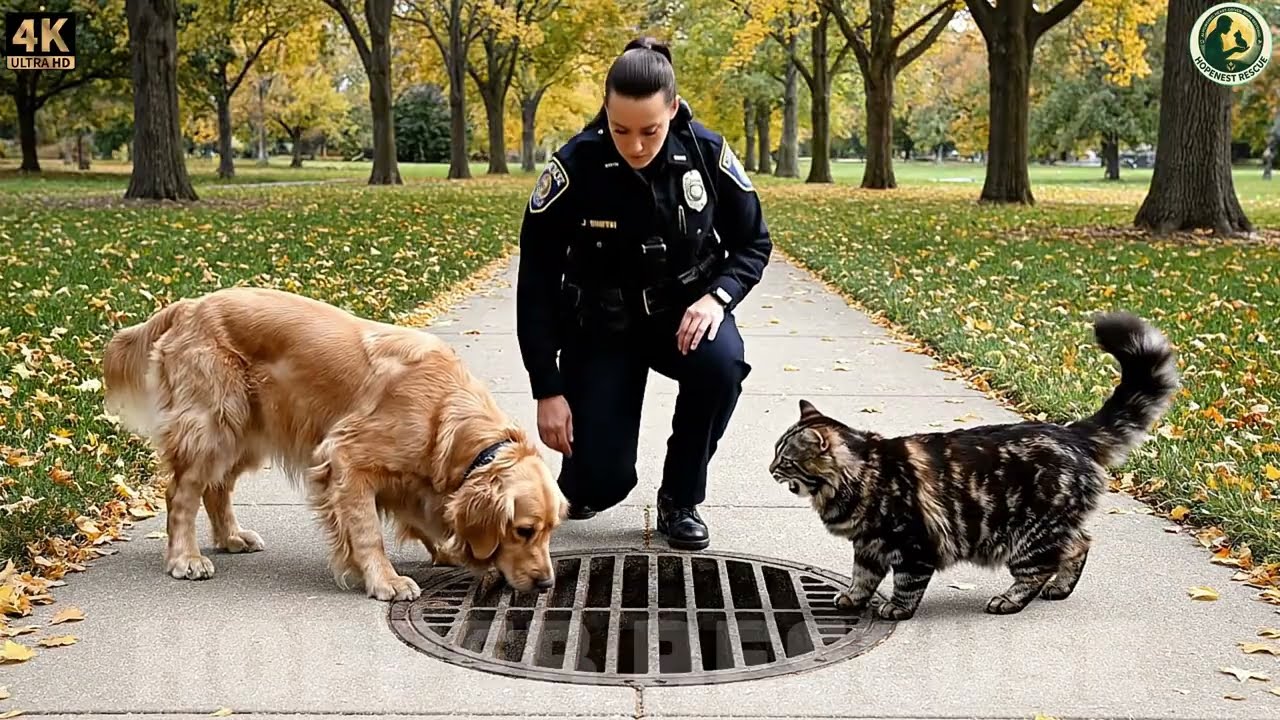
A kitten. Trapped.
The scene instantly transformed from a strange roadside curiosity into a heart-stopping emergency. The storm drain, an unforgiving channel of urban runoff, was deep. Through the narrow slats of the cover, Sarah could just make out a small, pale shape huddled against the slimy concrete wall, barely clinging to a dry patch just inches above the water line. The kitten, which looked no more than a few weeks old, was clearly exhausted, chilled, and far too weak to climb.
The crisis wasn’t just the entrapment; it was the element of time. The sky promised rain, and even a mild shower could rapidly turn the drain into a lethal torrent. Every second the kitten, which they later named ‘Pip’ for its tiny size, remained exposed to the elements and the psychological trauma of isolation, its chances of survival dwindled.
The initial challenge was the grate itself. Heavy, bolted down, and designed to withstand the weight of traffic, it was immovable without specialized equipment. Sarah contacted the HopeNest team immediately, and while waiting for backup and tools, she focused on Pip, trying to offer comfort. She lay flat on the pavement, speaking softly, her voice attempting to penetrate the dark, hollow space. All the while, Rusty remained her shadow, his nose pressed as close to the grate as possible, emitting soft, comforting sounds—a constant reminder to Pip that he was not forgotten. It was a magnificent, unsolicited act of interspecies guardianship.
When the rest of the HopeNest team arrived, the rescue shifted into high gear. They realized that physically prying the grate open was not feasible without potentially injuring the rescuers or delaying the operation significantly. The space between the bars was just wide enough for a slender arm, but the depth was prohibitive.
The plan they formulated was born of ingenuity and necessity. They lowered a small, flexible cage trap, baited with the most tempting, aromatic cat food they had. This technique, however, relies on the animal having enough strength and curiosity to enter. Pip was too weak and too traumatized to move.
The team then switched tactics, utilizing a specialized reaching pole equipped with a gentle, modified snare loop, a standard tool in careful animal retrieval. The maneuver required surgeon-like precision. Sarah slowly threaded the pole through the grate, navigating the dark, slippery space. Rusty watched, frozen, his whine now a continuous, low vibration of anxiety.
It took what felt like an eternity, the camera capturing the tense, breathless silence of the rescuers. Finally, Sarah managed to guide the soft loop around Pip’s tiny body. With the gentlest possible tension, and a silent prayer, she began to lift the little creature upward, inch by painstaking inch. The moment Pip cleared the grate and was brought into the light was met not with cheers, but with a collective gasp of relief.
Pip was minuscule, covered in grime and reeking of sewer water, but alive. Sarah immediately wrapped the trembling kitten in a warm, clean towel. The contrast was immediate and overwhelming: the sterile cold of the concrete was replaced by the warm, beating heart of compassion.
The first animal to meet Pip’s gaze was, of course, Rusty. Sarah held the kitten down low, allowing the heroic dog to gently approach. Rusty’s intense vigilance melted into tender curiosity. He lowered his massive head, gave Pip a single, soft sniff, and then licked the top of the towel with a gentle, confirming gesture. The energy of the scene shifted entirely, from tension and fear to profound peace. Rusty’s mission was complete; his desperate plea had been answered.
Pip was rushed to a veterinarian, where the prognosis was cautiously optimistic. Dehydrated, severely underweight, and suffering from a respiratory infection brought on by the damp, cold environment, the kitten was nevertheless a fighter. His survival was a testament to the speed of the HopeNest team and, more importantly, the extraordinary communication skills and pure heart of Rusty.
The story of the “Plea of the Paw” resonated across the community, sparking conversations about the depth of animal intelligence and the moral responsibility humans share for the creatures around them. Rusty’s actions weren’t merely instinctual; they demonstrated a complex awareness of another creature’s plight and the ability to intentionally seek specific help from a specific source.
HopeNest Rescue used the viral video of the event not just to celebrate a successful outcome, but to remind everyone of the hidden tragedies occurring constantly in every neighborhood. They highlighted the tireless work required to save lives like Pip’s and the crucial role that observant, kind citizens—and indeed, other animals—play in the rescue chain.
Pip’s recovery was slow but steady. He spent weeks in the loving care of a foster volunteer, growing stronger and more confident with every passing day. The video footage that captured his harrowing entrapment and liberation became a powerful symbol: a reminder that the bonds of empathy transcend species barriers. It showed that kindness doesn’t require a human voice—it requires only a willingness to look closely, listen intently, and act decisively when a loyal companion, or any desperate soul, asks for help. The Hero Dog’s plea was heard, and a life was saved, proving that the greatest lessons in kindness often come on four paws.