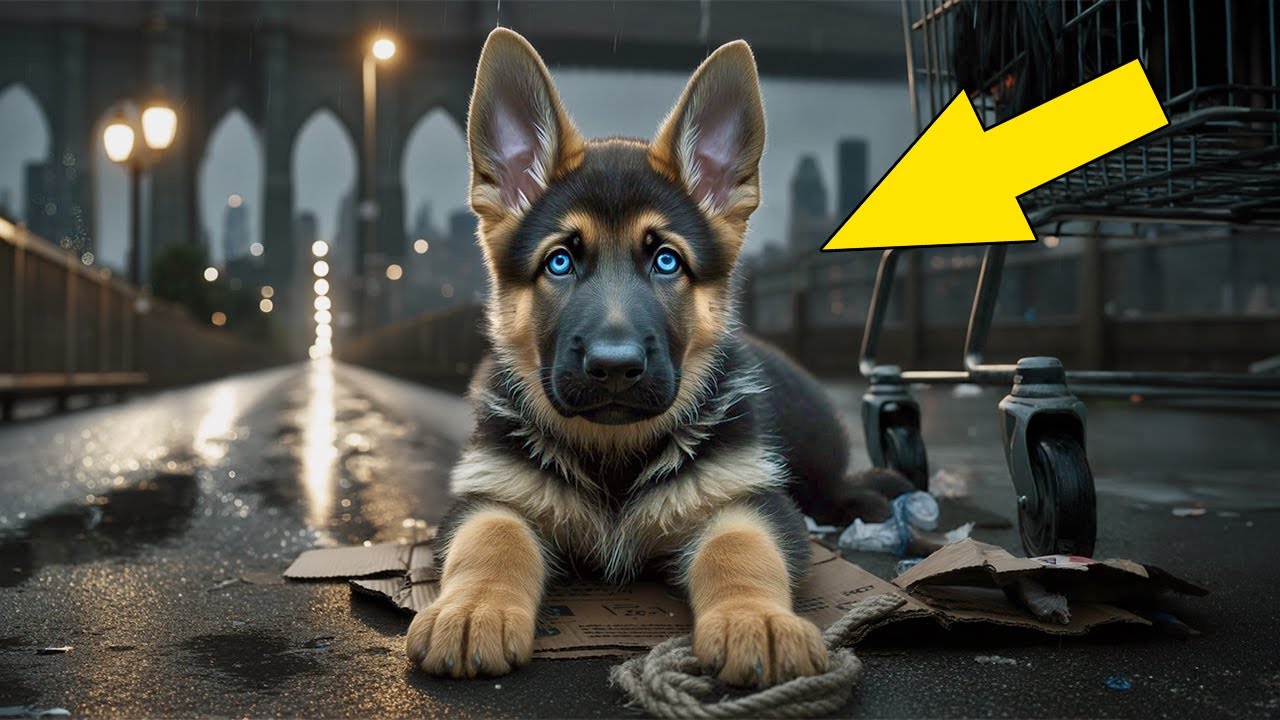
She didn’t bark. She didn’t run. She just stared at me through the darkness with those impossible ice blue eyes. Amber was crouched beneath the southeast side of the Brooklyn Bridge between two soaked slabs of cardboard and a pile of crumpled coats.
A thin rope was knotted loosely around her front leg, tied to a cracked shopping cart, half buried in trash. She couldn’t have been more than seven or eight months old. Thin, matted, soaked from the freezing drizzle that had been falling since sundown. But she didn’t look scared. She looked like she was waiting. The man beside her wasn’t moving. His chest barely rose under a torn army jacket.
I’d passed him three nights in a row, handing off granola bars, gloves, whatever I had left from the shelter van. But tonight, when I leaned closer, I saw it in an instant. The glaze in his eyes, the gray in his lips. I called it in. Quiet, fast. You learn to speak in soft tones when you’re this close to the edge.
I’m Jamie, 39, former FDNY paramedic. Now I work nights at a mobile shelter service that patrols underpasses, alleys, anywhere the city forgets. This part of Brooklyn is loud from above, dead silent below. You can hear your own pulse if you stand still enough. The medics arrived 6 minutes later.
They did everything they could, but the man was gone before I made the call. They took the body, logged it, bagged it, gone like a shadow that never fully arrived, and she stayed. Amber didn’t make a sound as they zipped him up, didn’t whimper, just watched. Just watched, breathing shallow, body low, eyes locked on the place where he’d been. I knelt slowly. “Hey,” I said.
“You don’t have to stay here.” She didn’t move, just lowered her head an inch. I reached forward slow and touched the rope. No resistance, just wet fur and the sharp edge of bone under her shoulder. When I slipped the knot free, she trembled once. Then she took a single step and collapsed against my leg. We sat there like that for a while.
Me with my back against the cold steel of the bridge pylon, her curled half over my boot, water dripping from both of us like we’d been forgotten. I carried her to the van. She didn’t resist, didn’t even lift her head. just let out a breath that sounded like she’d been holding it for days. The van was half loaded with sleeping bags and socks, hand warmers, plastic containers of soup.
I cleared space in the back, laid down an old thermal blanket and set her on top. She curled into a tight spiral and shivered until she slept. Back at the drop-in center, I wrapped her in towels and set her by the radiator. The place isn’t fancy, just two rooms, folding cotss, coffee that tastes like burnt rain. But it’s warm.
I stayed up watching her. Every time a horn blared outside or the pipes knocked, she twitched. But she didn’t bolt. She didn’t growl. Just kept those pale eyes halfopen, scanning shadows. I’d seen that look before. Years ago, after a failed resuscitation, a little girl, 7 years old, pulled from a fire. She lived, but barely.
When I visited her in the burn unit weeks later, she looked at me the same way, like someone who’d been touched by death and hadn’t quite come back. That night, I gave her a name, Amber. Not just for the color I expected her eyes to be, but for what she was, flickering, faint, but not out. The next morning, I took her to the shelter clinic.
No microchip, no tag, no collar, just a faint scar near her ribs and paws that looked worn down by miles of asphalt. The vet said she was underweight, dehydrated, but had strong lungs and a slow, calm heart. Whatever she’s been through, he said she didn’t give up. I nodded. Yeah, I saw that. They asked if I wanted to file for intake. Technically, I was supposed to, but I said, “No, not yet.
She’s with me for now.” We walked the East River path that night. She stayed close, not pressed against me, just near like a shadow. I kept the leash loose, but she never pulled, never tried to wander, just watched. People, cars, lights, everything.
And when we passed under the bridge again, she stopped, just for a moment, looked up at the spot we’d met, then kept walking like she knew we weren’t going back. Amber didn’t make a sound for three full days. Not a whine, not a bark, just soft steps behind me wherever I went, her nails barely clicking on the lenolium floors of the shelter. At night, she’d curl up at the end of the cot like a sentry.
I’d wake up and find her staring at the wall, eyes open, ears twitching like she was listening for someone who never came. She ate, but only if I stayed nearby. Drank in small sips like every gulp needed permission. I gave her space. She took it slowly, one inch at a time. The others started asking questions. Where’d she come from? Did she follow you? What’s with those eyes? I told them the truth. Found her under the bridge. She stayed.
That’s all it took for some of the regulars to start calling her ghost. Said she didn’t blink. Said she moved like a whisper. Said she looked like something pulled out of someone’s dream and dropped in the middle of Brooklyn. I didn’t correct them. But I never called her that. She was Amber and she was real. By the end of the week, she was following me on the nightly runs.
Not officially, of course. Um, volunteers aren’t supposed to bring animals into field zones. Liability insurance. But no one stopped me. Maybe because she never got in the way. Maybe because people just felt safer when she was around. That first night on patrol, we were in Dumbo, three blocks from the river. I was checking on a guy named Leo.

Ex-construction worker lost everything after his wife died. He usually camped in a tuckedway loading dock. Amber sniffed the air before we turned the corner. She stopped, growled low. One time, short, I froze. She stepped sideways, angled her body between me and the alley wall. I rounded slowly. There was someone else in Leo’s spot. Not him.
Younger, twitchy, eyes darting, rire of something synthetic and angry. I backed off. Amber didn’t move, just stared. The guy took one look at her, cursed under his breath, and disappeared into the night. We found Leo three blocks down, said he’d left for food, and someone had taken his stuff. When I told him what happened, he looked at Amber for a long time. She yours? I hesitated.
Not really. She just showed up. He nodded. That’s how the best ones come. After that, Amber had a reputation. People started recognizing her before they recognized me. She wasn’t aggressive, just present, solid, the kind of presence that makes a space feel safer without trying. Even the cops nodded when they saw her. One beat officer said, “She should get a vest.” I thought about it, but first I got her a tag.
Just her name and my phone number on the back. The guy at the hardware store asked if I wanted it engraved or printed. I said engraved. Permanent. Because something in me knew. She wasn’t temporary. That same week, I brought her into the back hallway of the shelter while I cleaned up the supply bins. One of the younger volunteers, Jaden, was sitting on the floor shaking.
He’d had a panic attack earlier, first time on night duty. saw someone overdose in front of him and froze. I was about to say something when Amber walked over and laid her head in his lap. He cried. Didn’t hide it. Didn’t apologize. Just wrapped his arms around her and let it all out. And she didn’t move. Just stayed. Later, he said, “I don’t know how she knew.
” I did because she’d seen it. Whatever it was, she recognized the fracture lines, the ones you can’t fake. I used to think broken people gave off a scent. Now I wonder if dogs like Amber are just wired to find it. That night I left the cot open. No command, no coaxing. She climbed up, circled once, and laid with her back against my ribs.
I hadn’t shared a bed with anyone in years, but her breathing matched mine. And for the first time in a long time, I slept. The first time she barked, it was barely a sound, just a single sharp warning that cut through the night like a snapped wire.
We were behind the old laundromat on York Street, passing out blankets. I was kneeling beside a woman who refused to come inside. Her eyes were hollow. She hadn’t said a word in two days. Amber stayed back as usual, watching, but then something shifted. A rusted gate creaked open near the alley entrance. Footsteps quick, heavy. I turned, hand instinctively reaching for the flashlight. Amber moved before I did.
She was between me and the figure in less than a second. Body low, shoulders square, eyes locked. Then that bark, not loud, not wild, but final. A boundary. The man froze. Young, just a kid. Hoodie pulled low. He stammered something and backed away. Hands up. I didn’t say a word. I didn’t need to. Amber had already decided the terms.
The woman beside me spoke. Just one whisper. She knew. Afterward, I sat with Amber on the curb. The city pressing down around us like a weight that never lets up. I rubbed behind her ear and looked into those ice blue eyes. You don’t miss much, do you? She blinked once. Slow, as if to say, not when it matters. The next morning, we stopped by the animal clinic again. Routine check.
She was healthier now. Co is brighter. But what struck the vet most wasn’t physical. She’s bonded to you, he said completely. I nodded. He smiled. Ever think about certifying her as a therapy dog? I hadn’t. Not because I didn’t think she could, but because I wasn’t sure I could. The idea of filling out forms, standing before a board, explaining myself to strangers, it felt like dredging everything I’d been trying to leave behind.
My old badge, my last call out, the night that ended it all. But later, while organizing meds at the shelter, I watched her. A man came in, new, silent, shaking. Didn’t want help. Wouldn’t take a meal. Sat in the corner with his head in his hands. Amber walked to him, didn’t touch him, didn’t push, just sat 3 feet away, and looked at him.
15 minutes passed. Then he shifted, lifted his head, looked at her, and whispered, “You’re not scared of me.” She didn’t move. And that’s when I realized maybe it wasn’t about me being ready. Maybe she already was. That night, I took her to the station yard. It was fenced, open, quiet, no trains this time of night. She ran for the first time since I’d found her. full stride, tongue out, legs long and fast.
And when she turned, she ran straight back to me like gravity had pulled her. I dropped to one knee. She stopped an inch from my chest, eyes shining like neon under the flood lights. You’re not going anywhere, are you? She leaned in and licked the side of my face. It was the first time I laughed in over a year.
Not a half smile, not a forced exhale, a real chest shaking full laugh. She barked once, soft this time. I swear it sounded like joy. We walked back through the quiet streets, her tag clinking gently against her collar. The buildings loomed high above us, lit windows like stars, trying to make sense of the dark.
When we passed the corner deli, the owner stepped out and said, “You two make a good team.” I smiled. “She does the work. I just carry the treats.” And as we turned the corner toward the bridge, Amber paused, looked up at it at the metal and stone that first held her pain, then looked at me, and for the first time, I saw something new in her eyes.
Not fear, not weariness, but trust. Rain was coming down in hard, slanted sheets when we got the call about the fire. Not a big one. A mattress blaze in a fifth floor walk up on Henry Street. Probably a candle, maybe a space heater. The fire department had it under control before we got there, but the building was still evacuating.
Our job was to help with blankets, water, whatever was needed. Amber stayed with me near the van. I kept her on the short leash. Too many people, too much noise, sirens, radios, everything echoing off the wet brick. Then I saw the kid, maybe 6 years old, standing barefoot on the sidewalk, shivering under a plastic poncho three sizes too big. His mom was crouched beside him, sobbing into her hands.
One of the EMTs said their apartment had filled with smoke before they got out. The boy hadn’t said a word since. I bent down, offered him a blanket. He didn’t take it, just stared ahead, unmoving. Then Amber stepped forward, slow, careful. She didn’t pull, just walked. The boy noticed her before his mother did. His eyes shifted, focused.
He reached out tentatively like she might vanish. Amber stopped an inch away and sat. The boy’s hand landed on her head, then his chin dropped to her shoulder, and that’s where he stayed for the next 10 minutes, silent, but breathing again. I watched Amber stay completely still, ears soft, body still but alert, like she knew any wrong move might break the moment.
The mother looked up, eyes red. She mouthed, “Thank you.” Amber didn’t look away. She was holding something fragile between them, something words couldn’t touch. After the scene cleared, I gave the boy the blanket and a stuffed animal from the back of the van.
He clutched both, but it was Amber he looked back at as they loaded into the temporary shelter bus. “She’s a helper?” I told him. He nodded. “Like you used to be?” he asked. I blinked. “Yeah,” I said. “Like I used to be.” Back at the shelter, Amber curled up in the corner near the boiler. She always chose that spot when it rained.
I sat across from her, knees pulled up to my chest. I remembered a night years ago. Different kind of storm. I’d lost a patient on the sidewalk in Midtown. CPR for 13 minutes. Didn’t come back. I got in the rig and couldn’t breathe. My partner said, “Some days you hold the line, some days the line holds you.” Tonight, Amber held the line. And I was starting to think she always would.
I pulled out the therapy dog application the vet had given me, crumpled, but still legible. Half of it was already filled out. I wrote her name again. this time slowly. Amber, they wanted a backstory for the animal. A brief paragraph. I stared at the blank space. What do you write for a dog who never asked for anything, but gave everything.
I wrote, “Found under the Brooklyn Bridge beside a man who never made it home, stayed behind, didn’t bark, didn’t run, just waited. She doesn’t perform tricks. She performs presents. And that’s more than enough.” I sealed the envelope and set it on the desk. I didn’t know if we’d pass. Didn’t know if she’d be certified, but I knew one thing. She already was.
Next day, I bought her a vest. It wasn’t regulation. Just a simple navy blue canvas with Velcro straps and a stitched patch I found online. In training, but still helping. When I clipped it on, she didn’t flinch, just stood taller. And when I looked into her eyes, they weren’t just pale anymore.
They were clear, focused, like she was finally seeing the world not as a place to hide from, but as a place to walk into with me. It started as a regular patrol, a loop through the Lower East Side, checking on the regulars, handing out clean socks and thermal gloves. Cold had crept in early this year, and even New York’s usual indifference felt sharper. People kept their heads down, eyes averted.
The kind of cold that made you forget kindness for survival. Amber was in her vest, head up, eyes scanning every shadow. We stopped by the underpass near Delansancy where Ricky usually stayed. But he wasn’t there. Just his blanket folded on top of a crate and and an empty coffee cup with 50 cents inside. I crouched to leave a granola bar.
And that’s when Amber moved fast. No sound, just motion. Straight toward the alley between the buildings across the street. I called after her, but she didn’t stop. I followed. Halfway in, I saw what she saw. Ricky was slumped beside a dumpster, face pale, lips blue, hands limp.
Amber was already beside him, licking at his fingers, pressing her body close. I dropped to my knees, checked his pulse. Thddy, barely there. I hit the radio on my shoulder. Need EMS. Eastside alley behind Delansancy underpass. Male, early 60s, possible hypothermia. Pulse weak, consciousness fading. I tore open the emergency pack and wrapped him in the foil blanket. Amber didn’t move.
She kept her body against his ribs, giving whatever heat she had left. And I swear when his eyes fluttered open for just a second, they locked on her first. “Is she mine?” he rasped. “No,” I said softly. “She’s everyone’s.” He smiled and passed out again. The ambulance came fast. “He’d make it. Low temp, but stable. They’d keep him overnight.
” One of the paramedics looked at Amber. She find him? I nodded. Before I did, he gave her a look like she was something rare. then to me, “You ever think she might be the best responder out here?” “Every day.” That night, as I dried Amber off back at the shelter, I looked at her paws, mudcaked red at the edges. She hadn’t hesitated, not once.
I rinsed them in warm water, dried them with an old towel, then wrapped her in the blanket she always chose, green fleece, a little torn at the corners. She didn’t sleep. She watched the door. I realized something then. Amber didn’t just react. She remembered. Places, faces, emotions.
She carried them like scars that never hardened. I’d seen that kind of memory in people, combat vets, ER nurses, firefighters, uh people who’d stood close to trauma long enough to inhale it. She carried it the same way. Later that week, the letter came. Official envelope, gold emblem, New York Therapy Dog Association approved.
Amber was now certified. There was a patch inside, new vest ID, a card with her name, a list of locations that had requested visits, children’s centers, clinics, even a retirement home in Queens. I didn’t cry when I opened it, but I ran my hand over her name over the embossed letters on the tag. Amber.
She was sitting beside me. I held the patch in my hand, and she looked at me like she already knew. “You ready to work?” I asked. She stood. Just stood. No bark, no tail wag, just stillness. But I felt it. Readiness, purpose, the quiet kind of strength that doesn’t need to announce itself.
And in that moment, I knew whatever she’d lost under that bridge, whatever was taken, she hadn’t lost herself. She’d found something better, something she could give. The first place we visited was a veteran’s housing unit on East 4th, tucked between two aging apartment blocks and a shuttered pawn shop.
The building had no sign, just a faded keypad and a door that buzzed once before letting you in. Inside it smelled like strong coffee and old lenolium. There were 32 residents, mostly men, mostly silent. Amber walked in like she belonged. No hesitation, no nervous glances. She stepped quietly across the common room floor, uh, pausing only when she reached the center. She sat, waited. The air shifted. At first, no one moved.
Then, a man in a navy sweatshirt leaned forward, reached out. His fingers brushed her fur, and she didn’t flinch. He looked up at me. “She doesn’t spook.” “Not anymore,” I said. “She been through it. She’s still walking through it.” He nodded like he understood something unspoken.
Then he patted her head once gently like it meant more than he could say. Over the next hour, Amber made her way through the room. She didn’t go to everyone, just a few. The ones with the eyes that didn’t lift. The ones whose hands trembled near their coffee cups. The ones who didn’t ask for anything. She just sat near them.
gave them something to anchor to. Later, one of the staff told me a resident who hadn’t spoken in two weeks asked if Amber would come back. She reached him. The woman said, “We’ve been trying for months. She walked in and did it in minutes.” I didn’t know how to explain it. Amber didn’t do tricks. She didn’t fetch or roll or dance. She didn’t jump into laps or perform for praise.
She was stillness, presence, a mirror that softened you without reflecting your damage. As we left the building, I looked down at her and said, “That was good work.” She didn’t react, just walked beside me, leash slack, eyes forward. But I knew she heard me. The next visit was a children’s center in the Bronx.
Group therapy for trauma impacted youth, ages 6 to 11. No dogs had lasted more than a day there. Too much movement, too many sudden noises. Amber walked in calm as ever. One boy, eight, maybe nine, threw a block across the room within the first two minutes. It shattered against the wall. No one flinched. No one yelled.
Amber walked over and sat down beside him. He didn’t look at her, just kept his arms wrapped around his knees. Then he said, “Not to her. Not to anyone. I saw someone leave and not come back.” Amber blinked once. That’s what she was doing under the bridge. I told the group leader after waiting and it clicked.
These kids, they weren’t acting out. They were waiting too for safety. For someone who wouldn’t leave, for something quiet and alive that didn’t demand anything back. Amber stayed an extra hour. That night, I sat in the shelter’s office scrolling through the forms we were supposed to submit. Progress reports, impact data, behavioral assessments. I didn’t know what to write.
How do you measure the way silence breaks? How do you track a heartbeat that steadies because of proximity? I typed one sentence. She finds the ones who stopped looking. The next morning, Amber woke me early. Something was wrong. She didn’t whine, but she paced. Her nails tapped the floor in a rhythm that made my chest tighten. I got dressed and followed her.
She led me to the door, then past it, back to the bridge. Same spot, same sound, same smell, and then I saw it. A bundle of fabric not moving. Amber sprinted ahead and I called after her, voice cracking. The closer I got, the more it came into focus. A shape slumped against the cold concrete, barely shielded from the wind. Amber was beside him already, pressed close.
I reached for my radio, called it in. Another life, right there on the edge, and her, steady as always, waiting, watching, holding the line. The man survived. He was barely responsive when they loaded him into the ambulance, but his pulse held. They said later it was likely a mix of cold malnutrition and fentinel laced into something he didn’t recognize.
He didn’t have ID, no name, no records, just a laminated bus card and a drawing tucked in his jacket. A child sketch of a dog that looked a lot like Amber done in blue crayon with the word stay scribbled underneath. Back at the shelter, Amber was quiet, not tired, focused. She paced once, checked each room, then lay down against the door as if guarding something invisible.
I sat across from her, a cup of burned coffee cooling in my hands, thinking how many people in the city go missing without ever leaving. I’d known that kind of disappearance, where your body shows up, but the rest of you doesn’t follow for a long time. Two nights later, Amber didn’t meet me at the van. I searched the whole block, then the shelter.
No one had seen her since breakfast. Panic started to rise low and tight in my throat. She’d never gone far, never without me. I called out, circled the block twice. Nothing. Then I spotted it. Her vest hanging over the back gate, untied, drooping. I ran down the alley, toward the river, toward the bridge. No sign. She was gone. I spent the rest of the night searching. No sleep. Checked every alley she’d ever paused in.
Every building stoop, every patch of ground under the overpass where the street lights didn’t quite reach. I asked around. Nothing. It was as if she’d vanished into the city’s seams. I called every shelter, every clinic, filed a lost report at animal care, left notes with every food pantry I knew. Blue-eyed shepherd mix named Amber, friendly answers to soft voice, therapy dog. I didn’t go home that night or the next.
Two days passed, then three. And then on the fourth morning, I got a text. Cash, is this your dog? Attached was a blurry photo. a German Shepherd curled behind a trash bin in Harlem, half covered in a plastic bag. But I knew her, even through grain, even through shadow. Those eyes. I called the number.
A woman answered. She ran a bodega on Malcolm X. Said the dog had been sitting out back for two nights. Wouldn’t let anyone near. Wouldn’t eat. Just waited. I didn’t wait for a train. I ran five blocks before I could even find a cab. When I got there, I saw her. She didn’t look up right away.
She was thinner, dirty, limping slightly on her left paw, but she was breathing. “Amber,” I whispered. She lifted her head slowly, then she stood. She didn’t run to me. She walked step by step, eyes locked on mine like she wasn’t quite sure I was real. I knelt down and opened my arms, and she collapsed into them.
No sound, no drama, just all of her weight leaning into my chest, like every muscle had been holding itself together too long. I held her and felt the hot sting behind my eyes. “You found your way back,” I said. But something about the way she smelled, the way she moved, told me she hadn’t been wandering. She’d gone looking back to the bridge, back to the place she was first left.
She went back to make sure no one else had been left behind. Even when I didn’t ask her to, especially then, I carried her home that night, not because she couldn’t walk, but because I needed to. She let me, chest pressed against mine, head tucked beneath my chin. Her heartbeat was slower than usual, steady, but tired, like a drum played too long without rest.
She didn’t tremble, didn’t whimper, just leaned into the movement as if my arms were the first safe thing she’d felt in days. Back at the shelter, I cleaned her wounds. Nothing deep, just scrapes, bruises, like one torn pad on her front paw. I soaked it gently, whispering her name like it might hold her together. Amber didn’t move, didn’t resist.
She rested her head on my knee, and closed her eyes. The vet came by the next morning. He checked her over, gave her antibiotics, cleared her lungs. No infection, no internal damage. She’s a little under, but she’ll bounce back, he said. Then he looked at me. Serious. But she ran herself down. She’s been holding on too hard. Probably hasn’t eaten properly since she left. I nodded.
I know. After he left, I sat on the floor beside her. She was curled in the green fleece blanket, her breath finally even. I thought about what she’d done, how she’d slipped the gate, shed her vest, and retraced the story of her own abandonment just to be sure no one else was left in that place again. She didn’t run away. She ran back.
That day, I canceled all outreach visits. I stayed with her, like watching the light shift across the shelter walls as she slept. I tried to do the paperwork, check messages, refill supply bins, but I couldn’t focus. My mind kept circling the same truth. Amber had gone back into the dark, not out of fear, but out of instinct. That’s what rescue does.
It returns to the broken places, even when no one asks. The next time she woke, she nudged her nose under my hand. I looked down. Her eyes, still blue, still sharp, had softened. “I missed you, too.” I said, “That night, I didn’t sleep.
I sat with her on the cot, one arm draped across her body, her warmth pressed into my side. I listened to the city hum through the windows, sirens in the distance, rain tapping at the sill. Life moving on, even when yours stands still. The next morning, I opened the envelope I’d left sealed for weeks. The invitation to speak at a panel for trauma response professionals, former medics, firefighters, crisis counselors.
They’d asked me to tell my story. I’d ignored it. I didn’t think I had one to tell. But now looking at Amber beside me, I realized I did. Not just a story about what I’d lost, a story about what I’d found. We went together. The panel was in a library auditorium near Midtown.
No stage, just a semicircle of chairs and 60 people looking for something they couldn’t name. I stood at the front. Amber sat quietly by my heel, vest clean, eyes alert. I took a deep breath. My name is Jamie. I used to run toward emergencies. Then I stopped. I lost myself. didn’t know how far gone I was until something found me. I looked down at her.
She didn’t knock on the door. She didn’t ask to come in. She just stayed. And every day since, she’s reminded me how healing starts. Not with fixing, with staying. Someone in the back wiped their eyes. Another leaned forward as if the words might slip away too fast. And Amber, she didn’t move. She just looked at them. And in that moment, I knew she wasn’t just my recovery.
She was the permission I didn’t know I needed to believe in life again. After the panel, they asked if Amber could stay a little longer. A few attendees wanted to meet her. One man, retired FDNY, older, shoulders curved like the city had finally caught up to him, knelt slowly in front of her. He didn’t speak, just held out his hand.
Amber stepped forward and pressed her head into his palm like she’d been waiting for him all along. He nodded once, stood, and left without a word. Another woman clutched a notebook to her chest and whispered, “My brother didn’t make it, but he loved dogs. She reminds me of him.
” Amber rested her paw on the woman’s foot. No noise, no command, just connection. They started calling her the quiet responder. And honestly, it fit. Back at the shelter, I hung her certification plaque on the wall near the exit door. It wasn’t big, just a wooden square with her name etched in brass, but everyone who saw it smiled.
Some nodded, others ran a finger across the edge and said, “She earned this.” And she had. Over the following weeks, Amber returned to her full strength. Her stride came back smooth and deliberate. Her focus even sharper. We resumed visits, rotating between the vet housing units, the children’s center, and most recently a new domestic violence shelter in Queens. That visit changed something in both of us.
One night, a woman who’d barely spoken since arriving sat down beside Amber and said, “You remind me of who I was before.” She didn’t cry. She just sat there. And Amber stayed beside her until her hand stopped shaking. That evening, after we left, I stood in the street staring at the glow of passing traffic.
Amber leaned into my hip, and I rested my hand on her back. “You give people a piece of themselves back,” I whispered. She looked up, blinked once, and then kept walking. Three days later, we were back under the Brooklyn Bridge. It wasn’t planned. Sometimes I took long walks when my head got too loud. Amber always matched my pace, never pulling, just near.
That morning was overcast, sky the color of wet cement. The air smelled like rust and salt. When we reached the spot where I first found her, Amber stopped. She stepped forward, sniffed the ground once, then circled the old pylon. She stood exactly where she’d been that night, soaked, waiting, watching. And then she turned and looked at me.
Not just a glance, a gaze, still present, like she wanted me to see it again, to remember. I walked over and sat beside her on the ground. No cushion, no jacket, just concrete under me and cold air on my face. “You came back here on purpose, didn’t you?” I said. Amber laid down slowly, head on her paws, her body angled toward the space where the man had once laid. Silent, broken, gone.
It hit me like a wave. She wasn’t revisiting pain. She was claiming it, not as hers, but as something she wouldn’t let define her. She returned not because she was stuck in the past. She returned because that was where her work had begun. It was never about the bridge. It was about what she chose to become after it. I sat beside her for nearly an hour. People passed above.
Trains thundered. Life moved on. But down there in that forgotten corner of Brooklyn, a dog reminded me that healing isn’t about erasing what happened. It’s about building something stronger on top of it. The night the storm rolled in, Amber was already at the door before I even heard thunder.
She stood perfectly still, ears forward, tail low, not tense, just focused. I opened the back entrance of the shelter, and she stepped out into the drizzle without hesitation, like she’d been waiting for this particular weather. It wasn’t a regular storm, not just rain or wind. It felt heavier, like the air itself was remembering something painful.
The kind of night where the city presses down on your chest and everything you’ve been pushing aside threatens to rise up all at once. We made our usual rounds, handing out ponchos, warming packs, dry socks. Most people were huddled under scaffolding or tucked into subway entrances. But something about Amber felt different. Her walk was slower, more deliberate. Her gaze lingered on doorways and corners we normally passed without pause. Then she stopped.
It was a narrow alley behind a shuttered barber shop just off Clinton Street, dark, blocked from the wind. And at the far end, hidden under a half-colapsed tarp, was movement. Amber stepped forward one careful paw at a time. I followed, calling out gently, “We’re from the night shelter. We’ve got warm clothes, water.” No answer.
Amber reached the tarp first. She didn’t bark, didn’t growl, she simply sat. That’s how I knew someone was there. Someone scared. Someone who didn’t want to be seen unless Amber saw them first. I pulled the tarp back slowly. She was maybe 19, soaked, shivering, eyes wide with a kind of panic that doesn’t come from the dark, but from whoever you’re hiding from. It’s okay, I said. We’re not here to move you.
She didn’t speak, just looked at Amber. looked hard, like trying to decide whether the dog was real or just a trick. Amber took one step forward and laid down. It worked. The girl reached out barely, and placed her fingers against Amber’s neck. She exhaled, then whispered, “Can I stay with her a little longer?” I nodded. We sat there a long time, the three of us, while the rain tapped rhythm against metal.
Later, when I walked the girl to the van, she asked Amber’s name. I told her. She smiled for the first time. Amber, like the light they put in windows when someone’s missing. I didn’t correct her. She wasn’t wrong. By the time we returned to the shelter, the rain had stopped, but everything still felt soaked inside and out. I dried Amber with a towel, brushing the street grime from her legs.
She leaned into me slightly, not because she was tired, but because she trusted me to be close. That night, I sat on my cot with her curled at my feet. The storm had passed, but I couldn’t sleep. I kept thinking about that alley, about the girl’s words. Amber hadn’t just found someone again. She’d helped her stay in her body in the moment in the city that almost swallowed her whole. When I finally drifted off, I dreamt of the bridge.
Only this time, Amber wasn’t alone beneath it. There were people, dozens, each one sitting quietly, heads bowed, eyes closed, but safe. And in the middle, Amber stood tall. Not barking, not guarding, just present. like a lighthouse, like a signal that someone still sees you, even when you think the world has stopped looking.
And somehow, even in the dream, I understood she wasn’t there to remember where she came from. She was there to show the way out. A few weeks later, Amber was invited to a youth recovery workshop uptown. Not the usual therapy group, this one was tougher. Kids fresh out of foster care, some on probation, most of them hardened by more than just neglect.
They didn’t trust anyone, especially adults, especially silence. They joked to fill space, teased each other like shields. When I brought Amber in, the energy in the room shifted, but not like I expected. At first, they ignored her. One kid muttered, “Cool dog. She bite.” Another laughed. “Bet she’s trained to narc.” I let them say what they needed to.
I didn’t correct them. I just let Amber do what she does. She walked through them, not begging for attention, not performing, just walking, breathing, being. She stopped beside a girl sitting cross-legged on a beat up mat in the corner. The girl looked maybe 15, maybe older, face unreadable, hood up.
She didn’t touch Amber. Didn’t look at her, but she didn’t move away either. A minute passed, then two. Then the girl whispered, “She been through it?” I nodded. “Yeah, more than once.” Still looks steady. She is. The girl glanced at me for the first time. You rescue her? No, I said we rescued each other. For the rest of the hour, Amber stayed by her side, didn’t move.
When the group wrapped up, the girl stood and finally stroked Amber’s head once, gentle, like she was touching something she wasn’t sure was real. “She’s not just a dog,” she said. I didn’t respond. I didn’t need to. Outside, while waiting for our ride, Amber sat next to me on the low stone ledge facing the city.
The skyline was still pale from the late morning haze, windows blinking under the rising sun. I looked down at her and asked, “Do you ever think about that first night?” She tilted her head like she was trying to decide whether to answer. I smiled. I do. There are things you don’t forget, not because they haunt you, but because they mark the moment everything changes. The moment someone stays.
The moment silence breaks. The moment a leash doesn’t just mean control. It means connection. Back at the shelter, we found a package by the door. No return address. Inside, a new vest, black canvas with deep orange trim. On the back, in clean white stitching, it said, “Amber, silent responder, night companion, bridge dog.” Below it, a simple line, “You showed me what staying looks like.
” Amber sniffed the vest, sat down beside it, waited. I put it on her slowly, careful not to rush, and fastened the last strap under her chest. She looked up at me, calm and ready. I brushed a hand along her back and whispered, “You know who sent that, don’t you?” She gave one soft exhale and turned toward the door. That night, we walked through Brooklyn Heights. No purpose, no plan, just movement, a rhythm between us.
Her leash was light in my hand, barely needed. We passed old stone buildings, iron railings wrapped in ivy, windows flickering with warm indoor light, and for once, I didn’t feel outside of it all. We turned toward the bridge again, not because we had to, but because it had become a part of us. At the base of the pylon, we stopped.
Amber sat. I sat beside her. We didn’t speak. We didn’t need to. The traffic above rumbled like distant thunder. The city lit up around us, not demanding anything, just existing. And I thought, this little girl’s journey from abandonment to rehabilitation shows how important nonprofit rescue groups really are. Caring for a rescued puppy is more than love. It’s responsibility. It’s pet care.
It’s walking into darkness because someone else is still stuck in it. It’s coming back again and again. Not to fix, not to save, but to stay. And that’s what Amber had done over and over. She stayed. Some dogs barked their way into the world. Amber didn’t. She watched, waited, and stayed until someone noticed.
She never asked for attention, never needed noise to matter. She just showed up again and again and again. Amber wasn’t just a rescue. She was the bridge. Not the one built of steel and stone overhead, but the one that forms between people and healing, between silence and safety, between being seen and being held. She didn’t save lives with sirens.
Uh she saved them with stillness. She didn’t chase the broken. She waited for them to come close enough to breathe again. And somehow in doing that, she reminded me how to breathe, too. I thought I was done. After my last emergency call, I packed away my uniforms, my badge, the part of me that believed the job could still be good.
I thought what I’d lost was permanent. I thought rescue was something I gave to others but didn’t get to keep for myself. Then came Amber. Blue eyes in the dark, a body curled beside someone who never woke up. A dog who didn’t leave when death came, who chose to stay instead.
That kind of loyalty doesn’t just mark you. It rewrites you. Amber gave people back their voices, not with commands or tricks, but by being silent enough that they could finally speak. She gave children a reason to sit still. Veterans a reason to remember. Survivors a reason to trust. And me, she gave me a reason to return. Not to the chaos, not to the past, but to present.
Because caring for a rescued puppy is more than love. It’s responsibility. It’s patience. It’s rebuilding trust, one soft look at a time. It’s choosing to stay. Even when leaving might be easier. Amber taught me that. Taught me that some dogs don’t follow. They lead quietly without asking.
And in a city that never stops moving, she became the still point, the reminder that not all heroes wear badges or carry hoses. Some just walk beside you when it gets dark. Some wait under bridges believing someone will come. Amber believed. She believed in people long after they’d stopped believing in themselves. And because of that, lives changed. mine changed.
So if her story touched you, if it reminded you of someone who held the line for you, or if it gave you hope that healing is still possible, please share it. Not for us, not for views, but because out there right now is another Amber waiting, watching, hoping someone will see her. And maybe because of this story, someone will. Join our Brave Paws family. Be their voice. Be their hope.