She was sitting so still people thought she was part of the ride. Her leash was looped once around the bench near the front plaza carousel. The one just outside the ticket gates at Six Flags Magic Mountain in Valencia. A white German Shepherd puppy, maybe 7 months old, tucked her legs beneath her like she’d been told to wait.
Above her floated a balloon shaped like a pink horse, bobbing gently in the California morning breeze. And dangling from her collar a bent scrap of cardboard, the corners soft from handling, the message written in thick fading marker, “Free! Take her! She’s good.” The balloon moved with each gust of wind. But she didn’t.
Kids ran by in clumps, laughing, dragging parents toward the entrance. A woman sat nearby, scrolling through her phone, glancing up at the puppy once, then away. No one stopped. No one questioned it. I did. I was halfway through my morning patrol around the entrance plaza, the area with snack carts and shaded benches where guests gather before the gates open.
I’d walked this route a hundred times. But this morning, I stopped hard. She wasn’t scared. That’s what hit me first. No trembling, no whining, no pacing, just stillness, like she’d been placed there on purpose, like she was trying her best to do what was asked of her. I stood a few feet away and looked at her.
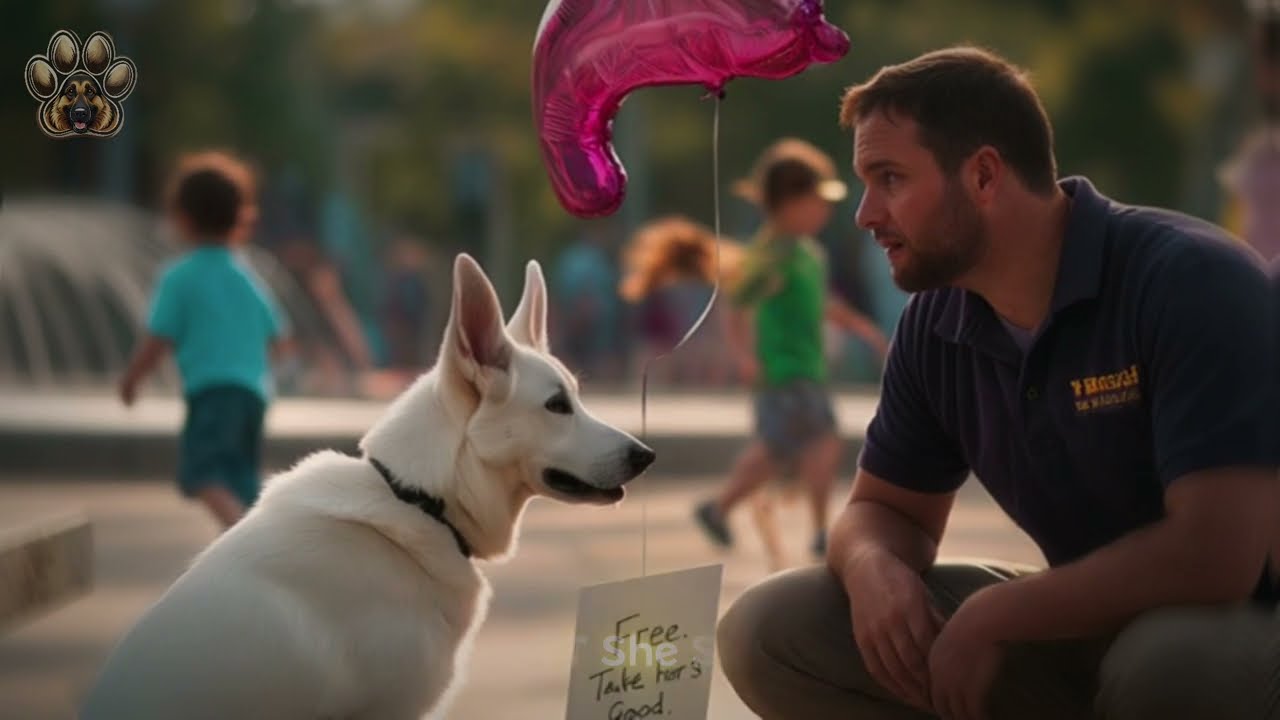
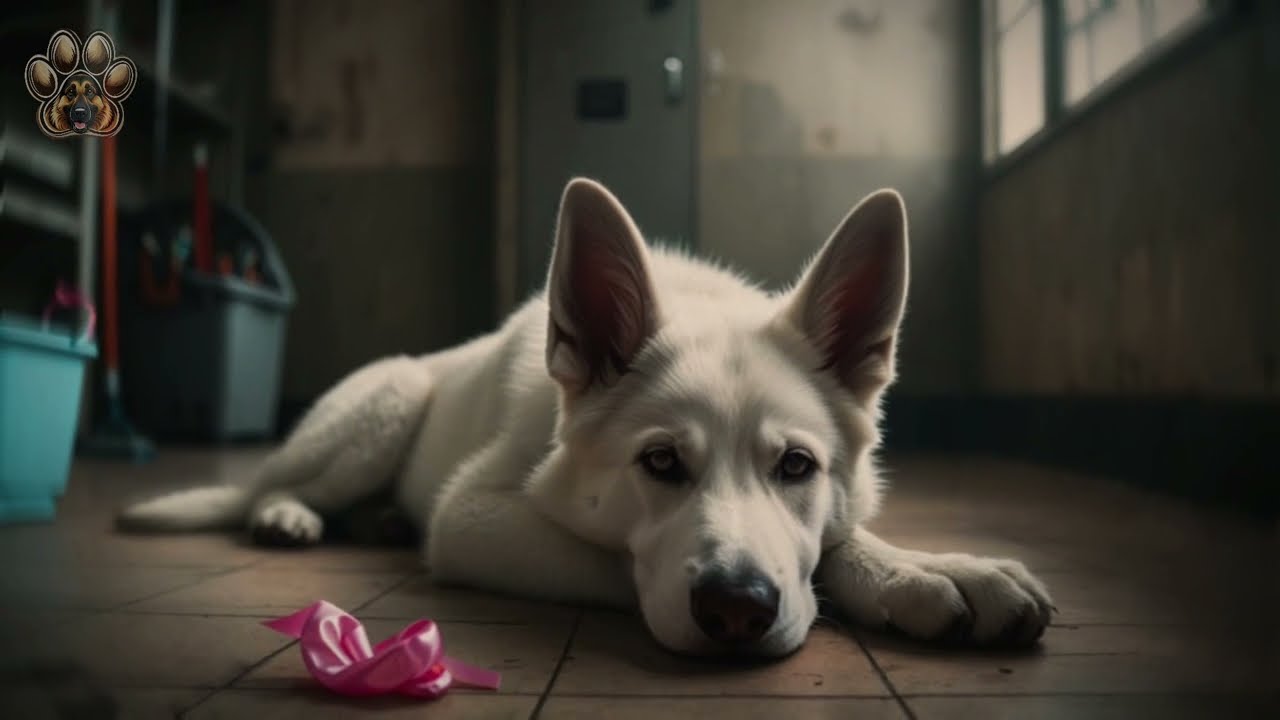
Really looked. White coat, a little dusty around the paws, ears relaxed, but low. Eyes, not panicked, but distant. She wasn’t hoping, she was waiting, and not in the way puppies wait. Wiggly, impatient, tail thumping. This was different. She looked like she thought someone was coming back, but she also looked like she knew they weren’t.
I squatted slowly, hands resting on my knees. “Hey girl,” I said, soft enough to blend with the carousel music. She didn’t move, not even her eyes. The balloon string tapped her ear. She didn’t flinch. I glanced at the sign again. “Free! Take her! She’s good. Not lost, not please help!” just discarded. People passed behind me.
Someone asked for directions to the lockers. Another group took selfies near the fountain. The whole world spun forward like nothing had happened. But here she was, tied to a bench with a balloon for company. I didn’t touch her. I didn’t speak again. I just sat on the edge of the bench and stayed. The music played. The sun warmed the pavement.
Somewhere behind me, a child cried over dropped popcorn. And still, she didn’t move. I wanted to believe she’d just gotten away from someone, that someone would come rushing back any second, apologizing, calling her name. But there was no name, no tags, just that sign, just that balloon.
She laid her head down on her front paws, eyes still open, and I sat there beside her, wondering how anyone could walk away from a puppy like this. I stayed with her longer than I should have. Guests kept flowing past us, the noise rising as the park filled. Laughter, stroller wheels, the distant whoosh of a ride testing its tracks.
But in this little pocket of space beside the carousel, it felt like none of that could touch her or me. She didn’t make a sound. No wine, no bark, just those quiet, steady eyes, like she was watching something only she could see. I finally reached for my radio. Dispatch, this is Kevin. Got something unusual near the front plaza bench.
Not a safety issue, just something I need to handle. A pause, then static. Copy that. All good. Yeah, I said. all good. But it wasn’t. I stood again slowly, giving her space. The leash was looped once, no knot. Easy to slip free if she really wanted to, but she didn’t. She stayed rooted like her leaving would disappoint someone. Like she still had a job to do.
I crouched beside her, hands on my thighs. You waiting for someone, girl? Nothing. I looked closer at her. She wasn’t starving. Her ribs weren’t showing, but her eyes, they told me everything. She’d already waited too long. The balloon shifted in the wind again, the pink horse turning in lazy circles above her.
It was tied neatly to her collar with a short ribbon, not something a child would do in play. It felt deliberate, like they wanted her to look cute. Wanted someone else to see her and feel what I was feeling now. She was a gift no one wanted to open. I reached into my pocket and found a crumpled protein bar, peeled it halfway, broke off a piece, and held it out in my palm.
Hungry? For a long moment, she didn’t react. Then, just a tiny twitch of her nose. Her head didn’t move, but she smelled it. I waited, let my hand rest on the ground beside the food. No pressure, no expectations. Still, she didn’t take it. But she looked at me. Really looked. And I swear there was a question behind those eyes.
Not who are you? But something softer. Are you different? I sat back on the bench again, not moving closer, just being there. People kept walking. A janitor pushed a trash cart by and glanced at me, then at her, said nothing, just nodded. I watched the balloon’s shadow crawl along the pavement.
I watched her chest rise and fall, and I realized I wasn’t ready to leave. Not yet. Not with her still sitting like that, waiting for someone who wasn’t coming. Eventually, I called the shelter. I leaned back on the bench and dialed the number we keep on file for found animals in the area. It rang six times before a tired voice answered.
Yeah, this is Kevin. I’m with park maintenance out at Six Flags Magic Mountain. I’ve got a situation. Someone left a German Shepherd puppy tied to a bench outside the entrance. No ID, no tags, just a balloon and a sign that says free. Take her. She’s good. The woman on the other end sighed before I’d even finished.
You’re the third call like that this week. I blinked. Excuse me. People are leaving animals in public spots. Parks, rest stops, even hospital drop offs. Shelters are full. We’re not taking in surreners right now unless it’s a medical emergency. This puppy’s been sitting here for God knows how long. She’s quiet, not moving.
She’s waiting. That’s all she’s doing. There was a pause. Can you hold on to her for a bit? I looked at her again. She hadn’t moved an inch. I don’t even know if she trusts me. She’s not the first, the woman said. But maybe she’ll choose you. But me shall choose you. Choose me. I hung up.
Didn’t leave a call back number. The bench creaked slightly as I shifted closer. Her ear flicked once, the first real movement I’d seen. Then her eyes tracked me. Not fearfully, just following. You’ve been through something, I said quietly. Haven’t you? The balloon had drifted slightly to one side, casting a strange little shadow across her back.
That ridiculous pink horse, bright and cheerful and wrong in every way. I reached slowly toward the leash. “Okay, if I take this off,” I asked. “No tricks. I just want to get you out of the sun.” She didn’t pull back. My fingers brushed the worn nylon. The knot came loose easily. I wrapped the leash around my hand, but didn’t tug. Just let it hang. Still nothing.
No attempt to bolt. No attempt to follow. She just sat. I stood and waited. Finally, after what felt like forever, she rose to her feet stiffly, like maybe she’d been in that same position for hours. She looked up at me once and then took a single step forward. That was all. One step, but it was enough. I led her slowly toward the back of the front plaza where we had a shaded staff area behind the fence thing in the gate.
She paused, sniffed the air, then walked in. No tail wag. No excitement, just quiet agreement. I filled a bowl with water from the breakroom sink and slid it toward her. She didn’t rush it, took a few tentative licks, then curled up in the corner of the room. I sat on the floor opposite her, resting my elbows on my knees. She watched me. I watched her.
No movement, no sound, just two souls in a maintenance shed behind a theme park trying to figure out what came next. I thought I was doing the right thing by giving her space, but silence has a weight, and it was pressing down on both of us. She lay curled in the corner of the staff room, her back to the wall, eyes half closed, but never really blinking.
That kind of stillness isn’t calm. It’s survival. I opened a drawer and found an old fleece towel. It smelled like oil and summer dust. I laid it near her. She didn’t move. Then I spotted something under her front paw. I crouched down, careful not to spook her. It was the ribbon from the balloon. It had come untied somewhere between the bench and here.
The balloon itself was gone now, probably floating above the park like a forgotten thought. But she was still holding the ribbon, gripping it gently like it was hers. I swallowed. They really left you with a souvenir, huh? Her eyes flicked toward me just for a second. That was the first time I felt it. The crack, the start of something. I sat again. Lower this time.
Closer. My daughter, she doesn’t speak either, I said quietly. Not with words. I didn’t know why I said it. It just came out. Maybe because the silence between us reminded me of home, of the living room that used to echo with giggles and music and now sat still, except for the click of Lily’s wheelchair or the buzz of the TV.
No one really watched. She’s nine, I went on. Cerebral pausy, non-verbal, but sharp, smarter than me. I looked at the puppy again. She hasn’t smiled in a long time. And there it was. Her ears moved. A tiny flick forward. Not much, but it was more than nothing. You’d like her? I said, “She’s got a good heart.
She just doesn’t let anyone near it anymore.” The puppy licked her paw once. “She used to laugh when we went on carousels,” I continued softer now. “Not anymore. She won’t go near them. We think something happened during a hospital trip. She locked down after that.” The puppy stood up slowly, stiffly walked three steps forward. I didn’t move.
She laid down again. This time, not in the corner, closer, just out of reach. And in that space between us, something shifted. Not trust. Not yet, but a question, a maybe. That night, I couldn’t stop thinking about her. I kept replaying that image, her sitting by the bench, that awful little sign hanging from her collar.
Free. Take her. She’s good. It wasn’t just a surrender. It was a dismissal, a verdict. Like someone had decided she was no longer worth the trouble. And suddenly, I was angry because this wasn’t some stray. This was a seven-month-old German Shepherd puppy who’d clearly been around people. Someone taught her to sit, to stay, to trust. And then someone broke that.
The next morning, she was still there in the shed, curled on the towel, awake, waiting. And for the first time when I walked in, her tail moved. Just once, a soft sweep against the floor. But it hit me like a thunderclap. I thought the tail wag meant we we were turning a corner. That maybe, just maybe, she decided I was one of the good ones.
But I was wrong. It happened the moment I opened the staff door to grab my tool belt. Just a second, half a second of letting the screen swing open. She bolted. No warning, no sound, just flash white movement and the leash trailing behind like a fuse. “Hey!” I shouted, scrambling after her. She ran low to the ground, weaving between the benches, dodging feet and strollers like she’d done it before, like she’d practiced escaping.
People turned, startled. A few kids pointed and laughed. They thought it was part of the show, but this wasn’t a game. I chased her through the front plaza, past the food carts, around the balloon stand, and there it was again. That balloon, the same kind, pink and horseshaped, tugging against its string in the morning breeze.
She stopped when she saw it. Just stopped. For a second, I caught up. She stood frozen, her eyes locked on that balloon. Not the one from before, just another one like it bobbing above a little girl’s hand. And in that moment, she looked so young. Not clever or skittish or trained, just lost. I moved slowly. “It’s okay, Dolly,” I said.
“I don’t know why I called her that. It just felt right, like she needed a name, like we both did.” She turned toward me, and then the girl holding the balloon screamed. A cart had tipped nearby. Ice spilled. A metal bin clattered to the ground, and someone shouted. Dolly spun and ran again fast through a narrow gap in the landscaping and toward the exit road. I felt it like a gut punch.
If she made it past that gate, she’d be on open asphalt. Park traffic. No one would see her until it was too late. I ran hard, harder than I had in years. My boots slammed against the pavement, lungs burning. Dolly, I yelled. Stop. She skidded to a halt just before the service road. Not because of my voice, but because of the sound. A horn.
A bus coming in fast for morning staff drop off. She froze. Inches from disaster. I reached her. Dropped to my knees. Didn’t grab. Didn’t shout. Just crouched and waited. She was trembling now. Not from fear, from confusion. From the fight between flight and something else. I opened my arms. Not a command, an invitation.
And then slowly she walked forward. One step, then two, and pressed herself into my chest. Her body went limp. Not relaxed, just given up. I wrapped the leash around my hand again and held her. Not tightly. Just enough. I got you, I whispered. I’m not letting go. And for the first time, I felt it. She didn’t want to run.
She just didn’t know what it meant to stay. Back in the staff room, Dolly wouldn’t look at me. She sat in the corner again, not curled up this time, upright, alert, breathing hard. The run had drained her, but something else had cracked open. I picked up the phone and called the shelter again. Same number, same woman. It’s Kevin, I said, trying to keep my voice level. She ran, almost got hit.
I got her back, but she’s done. She needs somewhere safe today. There was a pause on the other end. Then we still have no room. And if she’s healthy, we’re not authorized to prioritize intake. She almost died today. I said, “She’s not healthy. She’s emotionally shattered. You want me to wait until she stops breathing before you care? silence. “I’m sorry,” she said.
“We’re overloaded. The best I can do is put her on a list. A mobile vet might be available for a field checkup. I’ll text you the info.” I didn’t answer, just hung up. I looked over at Dolly. Her head was low, but her eyes tracked me now. I knelt down slowly. She didn’t flinch. “You’re not a number on a list,” I said.
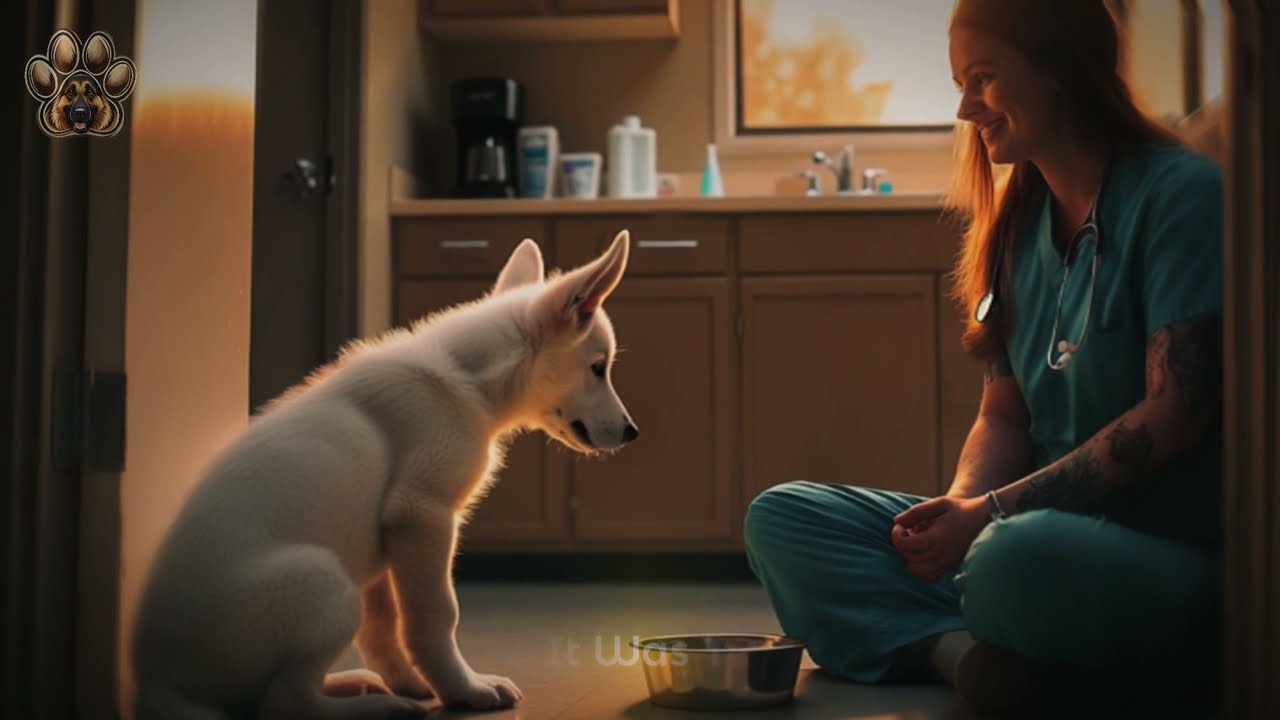
The vet arrived later that afternoon. A young woman named Dr. Hail. All tattoos and kindness. She sat cross-legged on the floor and waited for Dolly to come to her. It took 10 minutes, but she did. Dolly let her check her teeth, her joints, her belly, no major injuries, a little dehydrated, nails overgrown, scarring on her neck, not deep, but but old.
She’s been leashed tight for a long time, the vet murmured. Maybe tethered outside, maybe confined too much, too young. I felt sick. Behaviorally, I asked. Dr. Hail looked at her for a long moment. She’s waiting to be rejected. That’s why she didn’t run from danger. She doesn’t know where safety is.
That hit me harder than I expected. After she left, I drove home. Dolly sat in the passenger seat, curled into herself. I kept one hand on the wheel, one on the leash wrapped around my wrist. I didn’t say much. She didn’t either. My wife met me at the door. “You said it was temporary,” she said. Her eyes went to Dolly, then back to me. “Kevin, we have enough going on.
” “I know,” I said. She can’t stay. I know, I repeated, but I didn’t believe it. Dolly stepped inside hesitantly, pawing once at the welcome mat like it was a threshold she didn’t deserve to cross. And then Lily came around the corner. My daughter was in her chair, her favorite stuffed bare in her lap, her hair pulled back in a crooked ponytail.
She didn’t make a sound, just stared. Dolly froze, their eyes locked, long, still, quiet. Then Lily slowly lowered the bear. Dolly stepped forward, not fast, not playful, just steady, and rested her chin on Lily’s knee. My wife covered her mouth. I didn’t breathe. Lily reached out, one hand, shaky, unsure, and touched Dolly’s ear.
Not a tap, a touch, a choice, I whispered. I whispered, “I’ll sleep on the couch. She’ll stay in the laundry room just for a few days.” That please. My wife looked at them. Our daughter and a German Shepherd puppy with too many questions behind her eyes. She nodded. Once three days, she said, but I already knew this wasn’t temporary. Not anymore.
By the second night, Dolly no longer curled up in corners. She stayed close to Lily, always within a few feet like some invisible tether had formed between them. When Lily watched her cartoons in silence, Dolly lay beside the wheelchair, chin on the carpet, ears tilted toward the screen like she was trying to understand what made Lily stare so intently.
My wife didn’t say much, but I saw her watching, too. From the kitchen doorway, from behind her coffee mug, from the hallway mirror, watching the way our daughter’s eyes softened when the puppy was near. Watching the way Dolly never barked, never jumped, never intruded, just stayed. It was the staying that got to me. At work, I couldn’t concentrate.
The bench where I first found her was still there, of course. Same breeze, same carousel music playing on a loop. But every time I passed it, I saw her sitting there again. Not the new dolly, the old one. Still silent, waiting. I couldn’t shake it. I didn’t want to. That evening, I sat on the laundry room floor with Dolly, a bowl of water between us.
She drank slowly, eyes flicking to mine every few seconds. “You were meant to leave,” I said quietly. “Whoever dropped you off, they wanted it to be final, but you didn’t run. Not really.” She licked her lips and laid her head on my knee. I had a feeling she understood more than she let on. Lily came in without a sound.
She didn’t knock, didn’t wheel fast, just drifted in like a shadow. Dolly looked up, then Rose, walked over, and pressed her side gently to the foot plate of the chair. Lily reached down again, this time with both hands, and Dolly sat without command, without hesitation. That night, after Lily had gone to bed, I stood with my wife in the kitchen holding the lease papers from the shelter, the ones I’d printed just in case.
“You’re serious about this?” she asked. “I think they’re choosing each other,” I said. “And I think I need to choose that, too.” She didn’t answer right away, just looked past me into the living room where Dolly lay curled at the base of Lily’s chair. “She’s calmer with her,” she whispered. like Lily’s not strange to her like she recognizes something.
She recognizes being left behind, I said, and not being able to explain it. My wife reached over and touched my hand. Then let’s not let her feel that again. The next morning, I called the shelter. I’m keeping her, I said. The woman on the other end exhaled slowly. You’re the fifth person who said that this month. Maybe we’re finally getting something right. I told her. Dolly had a name now.
She had a crate, a bowl, a spot by the back door, but more than anything, she had a home. The change in Lily was so subtle at first, we almost missed it. It wasn’t big or dramatic. There were no miracle moments, no sudden words, just movement. A glance held a little longer. A hand that reached out without being prompted.
A softness around her eyes we hadn’t seen in years. Dolly didn’t demand anything from her. She didn’t push or beg. She just existed beside her, like that was her job now, to be near, to be still, to be ready if needed. I caught them once in the living room. Lily had wheeled over to where Dolly was lying, and without a word, without a sound, she dropped her stuffed bear beside her.
Dolly sniffed it gently, took it between her teeth and laid it across her own paws like it was treasure. I stood in the hallway, not daring to breathe. That night when I tucked Lily in, she held the corner of her blanket and looked up at me. Not just through me, at me. And for the first time in two years, she smiled. Not a big one, but it was real.
Dolly lay by the bed, curled tight, her nose tucked into her tail. I whispered, “Good girl.” The next day, I brought Dolly to our vet, this time for real. The clinic wasn’t fancy, but they knew shepherds well. The tech at the counter crouched down to greet her and Dolly stepped forward calmly. No flinching, no shrinking.
She’s come a long way in a week, the vet said after the exam. She’s lean but strong. She’s going to be a beauty when she fills out. She already was. I drove her back home and for the first time she stuck her nose out the window. Not all the way, just enough to feel the wind. Her ears fluttered and I swear I saw the corner of her mouth twitch.
At home, Lily was waiting by the door, not in her chair, on the floor, sitting with her back against the couch cushions, legs folded awkwardly, bare in her lap. Dolly trotted over and flopped down beside her like she’d been doing it her whole life. My wife looked at me and said, “You know she’s not going anywhere now.
” “I know,” I said. That evening, Lily reached for her communication tablet. Usually, she used it only at school, but this time she tapped out three words: slow and careful. She, my friend. I had to walk into the other room. The lump in my throat was too big. We’d taken in a broken German Shepherd puppy because no one else would because someone decided she wasn’t worth keeping, and she was giving us our daughter back.
One heartbeat at a time. A few days later, I found them in the backyard just sitting. Lily had maneuvered her chair onto the patch of grass near the fence where the light hit in long, warm bands in the late afternoon. Dolly was beside her, belly stretched to the dirt, her head resting against the wheel like it was made for her. Neither of them moved.
They didn’t need to. I stood by the sliding door, watching through the glass. Something about the stillness felt sacred, like if I opened the door too fast, I’d break it. That’s when I knew this wasn’t just about rescue. Dolly wasn’t our charity case. She wasn’t even our decision anymore. She had chosen Lily, and Lily had chosen her.
At dinner, Lily reached for her tablet again. Normally, we let her use it only when she seemed engaged. But tonight, she didn’t wait. She tapped slowly, deliberately. Can she stay? I looked at my wife. Her eyes were already glassy. I turned back to Lily. She’s yours, baby. For good. Lily didn’t smile this time. She just nodded once, like she already knew.
That night, we pulled out an old toy chest from the attic, a wooden box with a faded unicorn sticker on the lid. We filled it with dollies things, a brush, a rubber bone, her new collar, navy blue, with her name etched in brass. She watched us the whole time, head tilted, tails sweeping across the rug every time someone said her name.
At bedtime, Lily insisted Dolly sleep in her room. We’d started with the crate in the laundry room, then a dog bed in the hallway. But now, now Dolly curled up on a folded quilt right beside Lily’s bed, her nose tucked under the edge of the blanket. Sometime around midnight, I got up to check on them just to be sure.
Lily was asleep, her arm dangling loosely off the side of the bed. And Dolly, that white German Shepherd puppy who had once sat alone with a balloon and a cardboard sign, was lying with her head resting under Lily’s hand. It wasn’t chance. It wasn’t training. It was trust. I closed the door without a sound.
The next morning, I took Dolly with me back to the park, just for a short visit. I needed to see the bench again, the one by the carousel. It was still there, but the balloon stand was gone, and the bench looked smaller now, less like a scene and more like a memory. Dolly sniffed the pavement, then looked up at me with steady eyes. Not afraid, not questioning, just present.
You’re not that puppy anymore, I said softly. “And you never will be again.” She walked beside me the whole way back to the truck. No leash needed. It happened on a Tuesday. Lily was in the living room watching a nature show, and Dolly was beside her, curled up as always. Her new favorite spot was under the coffee table, just close enough to press her side to the wheels of Lily’s chair.
I was in the kitchen making lunch when I heard something. Not a bark, a thump. A chair leg scraped, then silence. I stepped around the corner. Lily’s eyes were wide. Her tablet was on the floor and Dolly was standing stiff D facing the front door, her ears high, her body like a drawn bow. Then the knock. Three hard wraps. I opened the door.
A man stood there, early 20s, holding the pink horse balloon. My stomach flipped. He didn’t say hello. Just looked past me into the house at Dolly. “She came back here?” he asked. I didn’t answer. He tilted his head. We tried leaving her twice. First time she followed us home. Second time we drove farther.
thought maybe a busy place would help. I stepped out and closed the door behind me. “She’s not going anywhere with you,” I said, my voice surprised even me. It wasn’t angry. It was final.” He smirked like this was still casual. “She’s just a dog, man.” “No,” I said. “She’s a soul and she chose to stay.” He held out the balloon.
“You want this?” Thought it’d be funny, you know, like a happy ending or whatever. I didn’t take it. He left. I stood there for a long time, staring at the road, at the parked cars, at the place where someone like him thought someone else would clean up his mess. Back inside, Dolly hadn’t moved. She was still standing guard beside Lily, tail low, ears tilted forward, waiting for permission to let go.
Lily looked up at me and without touching her tablet, she whispered, “Really?” whispered a single word. “Stay.” I nodded, tears already burning behind my eyes. “She’s staying.” I sank to the floor beside them. Dolly leaned against my chest, her breath warm and steady. That man thought he left behind something disposable.
But what he left behind was the beginning of everything. The next few weeks felt like watching spring arrive inside our house. Dolly wasn’t just part of the family now. She was the rhythm of it. She woke up before the sun and padded quietly to Lily’s door, waiting without sound until someone opened it. When Lily had physical therapy, Dolly laid near her mat, ears twitching to every strained breath.
When Lily cried in frustration, and sometimes she did, Dolly didn’t flinch. She stayed. And when Lily rested her head on the pillow in silence, Dolly rested her muzzle beside her hand. At school drop offs, the aids started sending notes home. Lily reached for another student today. She engaged in a group game. She smiled when asked about her dog. Smiled.
Sometimes I sat on the porch after dinner with a cup of coffee watching the two of them in the yard. Lily parked at the edge of the flower bed and Dolly beside her like they were keeping watch over a world only they could see. I’d get waves from neighbors, a thumbs up from a woman down the block who’d heard the story.
Someone even dropped a gift card in our mailbox with a note that read, “Not all heroes wear capes. Some have fur and broken hearts. One Saturday, I brought Dolly to the local shelter for final adoption paperwork and licensing. The woman behind the desk, same one I’d spoken to before, looked up and gasped. “You kept her?” “She kept us,” I said.
She came around the counter, knelt down, and scratched Dolly behind the ears. “She looks like a whole new dog.” “She is,” I said, “but she had to break a little to become this.” On the way home, I stopped by the same bench, the one near the carousel. I tied a new note to it, laminated this time. Waited at the bottom so it wouldn’t blow away. It read, “She wasn’t free.
She was priceless. Thank you for not loving her. Because we do.” As I walked away, Dolly didn’t even glance back. She didn’t need to anymore. Her leash hung loose at my side, but she never let it pull tight. Wherever I stepped, she followed. Wherever Lily sat, she rested. And wherever she once waited in silence, she would never wait alone again.
Some rescue stories are loud, full of sirens, shouting, rushing footsteps, but some are quiet. So quiet you might miss them if you’re not paying attention. Dolly’s story didn’t start with a cry for help. It started with silence, with stillness. With a white German Shepherd puppy tied to a bench, a balloon above her head, and a message that broke my heart. Free. Take her.
She’s good. She wasn’t free. She had already paid a price for being too gentle. for being left behind, for loving the wrong people first. But she never gave up. Not really. And in that stillness, she found us. She found Lily. And Lily, in her own silent way, reached back. Dolly didn’t just become part of our family.
She became part of our healing. She gave our daughter something we couldn’t, a bridge back to the world. Not with words, with presence, with patience, with love that asked for nothing in return. This little girl’s journey from abandonment to healing shows how important nonprofit rescue groups really are. Caring for a rescued puppy is more than love.
It’s responsibility. It’s pet care. And sometimes it’s the very thing that saves us. Join our Brave Paws family. Be their voice. Be their hope.