The courtroom drama surrounding rapper YNW Melly, born Jamell Demons, has captivated the public imagination since 2018, transforming a tragic night into a sprawling, high-stakes legal battle. Accused of the double murders of his friends, Christopher Thomas Jr. (YNW Juvy) and Anthony Williams (YNW SakChaser), Melly’s initial trial ended in a hung jury, setting the stage for a dramatic retrial. Yet, the entire landscape of this case—and the defendant’s future—was instantaneously and fundamentally altered on September 9, 2025, when Melly’s former co-defendant, Cortlen Henry, known as YNW Bortland, walked into the Broward County courtroom and took a plea deal that, by its very nature, obliterated the core of the defense’s strategy.
For years, the defense has rested its entire case on one central pillar: the fatal injuries sustained by Juvy and SakChaser were the result of a drive-by shooting. The narrative was simple, offering a clear path to reasonable doubt. However, Bortland’s eleventh-hour admission to accessory after the fact and witness tampering confirmed what forensic investigators had long argued: the crime was an inside job, and the alleged drive-by was a staged cover-up. This single act has thrust YNW Melly into what legal analysts are calling a “nightmare scenario” as he prepares to face a jury once more.
The Irrefutable Forensics of an Inside Job
Even before Bortland’s devastating plea, the forensic evidence had been steadily eroding the credibility of the drive-by claim. Investigators amassed a collection of evidence designed to prove that the shots that killed the two young men came from within the Jeep, not from an unknown assailant outside the vehicle.
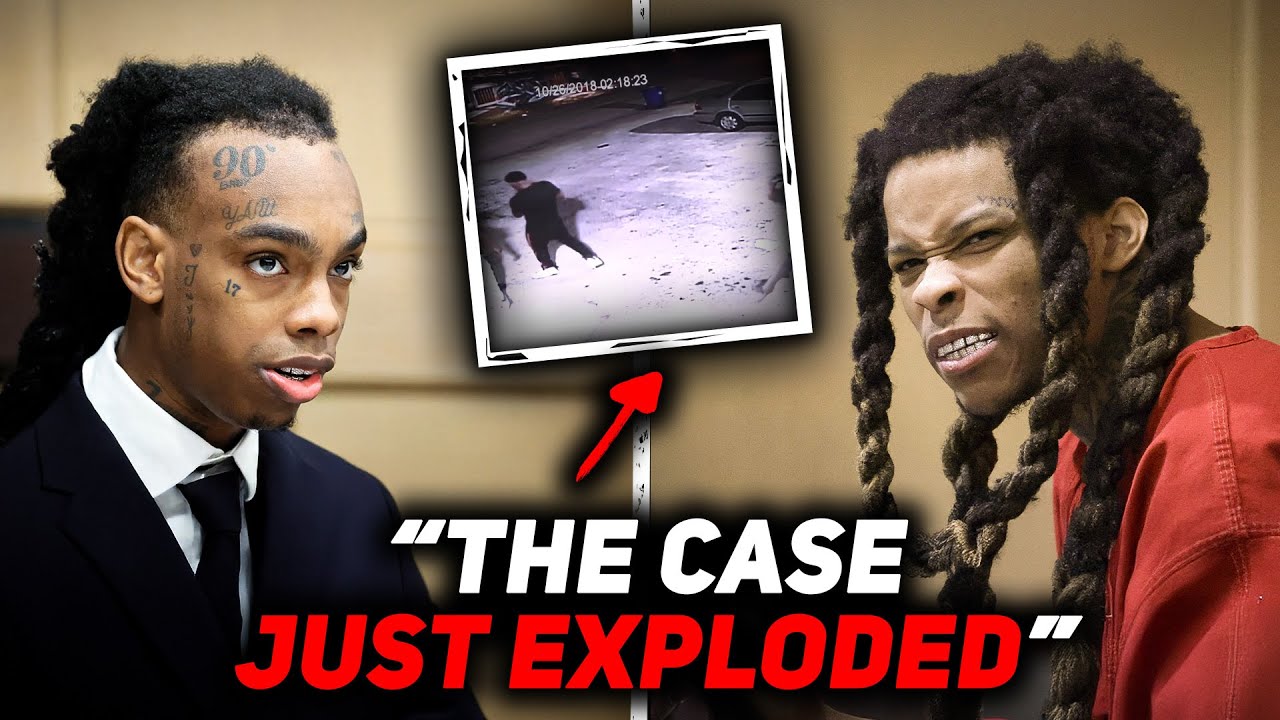
The most crucial piece of digital evidence that undermines the defense is the studio surveillance footage. The camera at New Era Recording Studios captured Melly, Bortland, Sakchaser, and Juvie leaving together. Prosecutors used this footage to show Melly sliding into the left rear seat of the Jeep—the exact position ballistic experts pinpointed as the source of the fatal shots. This placed Melly in the immediate vicinity of the crime scene just minutes before the tragedy.
The investigators’ physical evidence painted an even darker picture. Crime scene reconstruction specialist Sergeant Christopher Williams testified that forensic analysis showed zero signs of an external shooting. Not one mark, not one hole, nothing matched a drive-by. Instead, the evidence confirmed the driver’s side window was shattered from the inside, directly contradicting the defense’s core theory. Furthermore, eight shell casings from two different firearms were recovered inside the car.
Perhaps most damning was the testimony detailing the trajectory analysis. The bullet paths pointed straight to the seat Melly was seen entering, nowhere near an outside attacker. Moreover, the timing of the victims’ injuries suggested they were already deceased by the time the drive-by scene was staged. The calculated staging, combined with Melly’s DNA found on the left rear door handle of the Jeep, established a compelling, consistent narrative for the prosecution: this was a planned internal tragedy, followed by a theatrical cover-up.
YNW Bortland’s Stunning Pivot
The legal shockwave hit the court on September 9, 2025, just as jury selection was about to begin for Melly’s retrial. Bortland, facing the possibility of life or the highest penalty for his two first-degree tragedy counts, accepted a plea deal that granted him a remarkably lenient sentence: 10 years in Florida state prison followed by six years of probation.
The true significance of the deal, however, was not the sentence itself, but the compulsory admissions that accompanied it. By pleading guilty to accessory after the fact and witness tampering, Bortland was forced to acknowledge the central truth investigators had long fought to establish: the murder happened inside the car, and he assisted someone in covering it up afterward.

This admission was the tactical nuclear option that instantly vaporized the defense’s entire premise. With a former co-defendant legally acknowledging the staging, Melly’s lawyers can no longer argue the murders were a real drive-by. They are now cornered, forced to shift their strategy from “no crime happened here” to the immensely more challenging task of proving, “A crime happened, but YNW Melly was not the person who pulled the trigger.”
The deal also included a profer agreement, where Bortland was required to provide information to the authorities. This immediately sparked rampant rumors in the hip-hop community that Bortland had “snitched” on his friend, a grave violation of the so-called “street code.” Despite his lawyer, Fred Hadt, publicly insisting he “doesn’t represent snitches” and that the cooperation would be minimal, the underlying legal reality remains: Bortland’s cooperation, however limited, provided prosecutors with missing pieces of information and, critically, confirmed the crime’s foundational mechanics.
The Defense’s Desperate Pivot and the Prosecution’s Self-Inflicted Wounds
Melly’s defense team, under the new leadership of Carrie Hua and Drew Finland, inherited a scorched-earth legal landscape after the plea deal. Their original strategy, visible during the 2023 trial, involved pointing the finger directly at Bortland, noting that Bortland tested positive for fatal wound residue while Melly did not. They also highlighted the lack of attack residue on Melly’s hands and presented a single witness, Melly’s friend, who claimed Melly was asleep at the house when the events occurred. While these points may still be used to argue Melly wasn’t the shooter, they are far less powerful now that the crime’s location is undisputed.
Furthermore, the defense has consistently attacked the integrity of the police investigation, specifically targeting Detective Mark Moretti, who openly admitted to threatening witnesses with deportation and jail time. This tactic aims to create reasonable doubt by casting a shadow over the reliability of the testimony and the fairness of the overall process.
The prosecution, however, has also been plagued by scandal. In a stunning twist, lead prosecutor Christine Bradley was removed from the case after being accused of hiding evidence. This legal hiccup forced new prosecutors to step in, requiring them to swiftly master five years’ worth of intricate case details on an accelerated timeline.
The Unfolding Nightmare Scenario and the Road to 2027
As the retrial date approaches, now scheduled for January 2027, the stakes could not be higher. Melly still faces two counts of first-degree tragedy, and if convicted, the highest penalty remains a possibility under Florida law. The pressure is further amplified by a recent legal change: only eight jurors, rather than the previous requirement of all 12, are now needed to vote for execution.
The retrial has already been delayed due to pending appeals regarding the admissibility of key evidence. Prosecutors desperately want to use Melly’s own lyrics, specifically from songs like “Murder on My Mind,” and evidence of his alleged gang association (Sign Bloods) to argue motive and state of mind. The defense is fighting back hard, arguing that using artistic expression as criminal proof crosses a dangerous line, a debate the appeals court is currently wrestling with. The ruling on these matters will dramatically shape the evidence presented and the direction of the 2027 courtroom showdown.
Beyond the legal technicalities, the case remains profoundly human. For the families of Anthony Williams and Christopher Thomas Jr., they have been waiting seven years for accountability and closure. For Melly’s supporters, justice means ensuring that an innocent man—whose life and career were skyrocketing—is not wrongfully sentenced.
The YNW Melly case is no longer just about a rapper’s fate; it is a critical test of the American legal system’s integrity, particularly in how it handles forensic evidence, witness reliability, and the controversial use of art as a weapon in court. YNW Bortland’s plea deal has effectively closed the door on the defense’s most comfortable argument. When Melly steps back into that courtroom in 2027, the jury will not be deciding if a staged crime occurred, but who orchestrated and executed the tragedy inside that Jeep. The answers to that question will determine whether a young man lives or dies. The world is watching.