Sir, that boy lived with me at the orphanage. The maid’s trembling voice sliced through the golden silence of the mansion’s corridor. Her words hung in the air like a haunting echo, fragile, yet powerful enough to shatter the serenity that wealth had built. The billionaire Ethan Morera turned slowly, his gaze fixed on the old portrait hanging above the marble fireplace.
The boy in the painting, those wide, innocent eyes, that faint half smile, wasn’t just a stranger from the past. He was identical to the brother Ethan had lost more than three decades ago. A sharp ache bloomed in his chest, the kind that memory brings when it claws its way back to the surface. The maid, her name was Amara, a quiet black woman who had started working at the estate only two weeks earlier, stood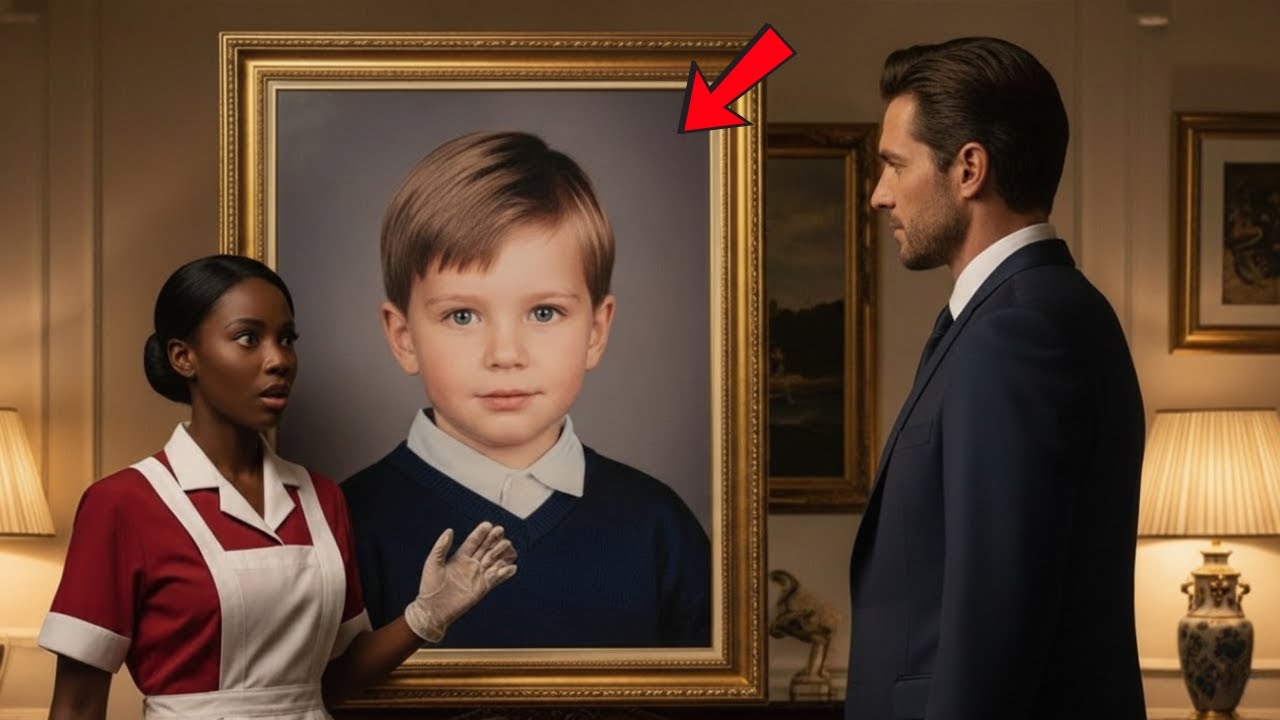 trembling, her hands clutching the edge of her apron as if holding herself together. “I knew him,” she whispered,
her voice cracking under the weight of remembrance. “We called him Daniel at the orphanage. He never spoke of his family, but he used to say he had an older brother, a brother who called him my little champion.” Ethan’s breath caught. The air seemed to thicken, time folding upon itself as the echoes of childhood laughter and a mother’s piano notes came rushing back.
For years he had buried the pain, pretending that success could fill the void left by his brother’s abduction. But now, as Amara’s words settled like dust over his heart, Ethan understood this wasn’t coincidence. The past had found him again in the voice of a woman who remembered what the world had chosen to forget.
Ethan’s gaze lingered on the portrait long after Amara’s words faded into silence. The boy’s painted eyes seemed to follow him, accusing, pleading, remembering. For 30 years, Ethan had lived with that same gaze etched into his soul. His younger brother, Leo, had vanished when he was only four years old, snatched away from a sunlit Sunday morning in the city park.
Ethan could still remember the scream, the one that tore through their mother’s throat when she realized her baby was gone. Their family had once been perfect. His father, a sharp-minded lawyer with a tender heart. his mother, a gentle music teacher, who filled the house with chop and the smell of jasmine tea.
And then Leo disappeared, and everything beautiful in their world went quiet. The search had lasted months. Police sirens, newspaper headlines, interviews that turned to whispers, then silence. The case went cold, the trail vanished, and with it their family’s warmth. His mother withered slowly, her hands still hovering over piano keys that no longer made a sound.
His father buried himself in work, his love for justice turning brittle and empty. And Ethan, only eight at the time, was left with a promise he had whispered to the wind, “I’ll find you, Leo. I swear I’ll bring you home.” But promises made in childhood have a cruel way of becoming ghosts. As years passed, Ethan built walls first with ambition, then with fortune.
He became a man whose name opened doors and silenced rooms. Yet inside him there was always that small, trembling voice of a boy calling for his brother. And now here he was, standing in the echoing hallway of his mansion, a monument to everything he’d achieved and everything he’d lost.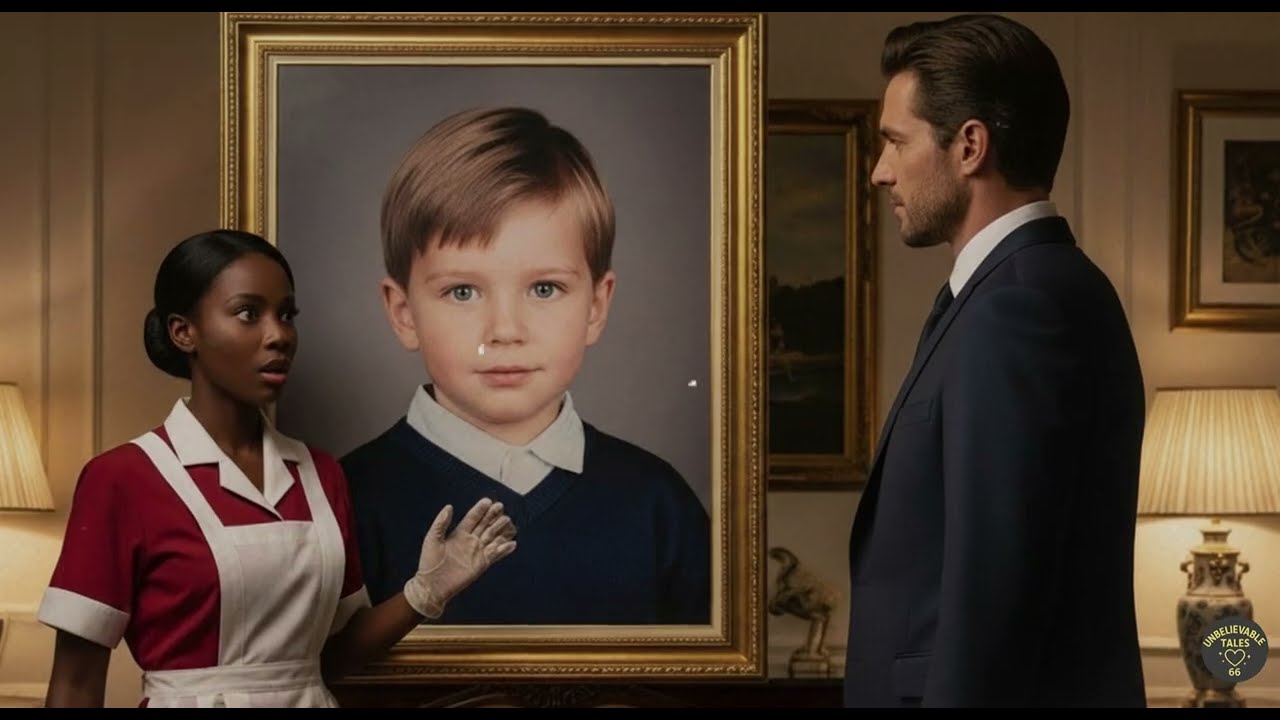
The golden chandeliers, the marble floors, the vast emptiness, they all mocked him with their perfection. No amount of wealth could erase the sound of a mother’s sobb or the weight of an empty chair at the family table. Amara watched him from the doorway. Her eyes filled with something Ethan hadn’t seen in years. Empathy that didn’t pity him.
She seemed to understand without words that his fortune was built not on triumph but on grief disguised as success. Some losses, she said softly, almost as if speaking to herself don’t fade with time. They just learn to wear suits. Ethan turned toward her, the corners of his mouth tightening as he exhaled.
Her words landed deeper than she could have known. For the first time in decades, the fortress around his heart cracked, and through it the faint echo of a piano note seemed to return, trembling and unfinished, like a memory waiting to be played again. The next morning, Ethan found Amara standing once again beneath the portrait.
Her dark hands clasped tightly before her apron, her eyes glistening with something between fear and faith. The winter light filtered through the tall windows, painting soft gold over her face as she spoke, her voice trembling like a confession long kept in the dark. Sir, the boy in that picture. She began quietly. I knew him by another name.
We called him Daniel. He lived with me in the Sicente orphanage until he was 14. Ethan froze midstep. The sound of his heartbeat filled the silence between them. “Daniel,” he echoed as if testing the word against memory. Amara nodded. “He used to say he was taken from a rich family, that his brother called him my little champion. No one believed him.
They said it was a dream a child made up to survive.” But I, her voice cracked. I believed him. Ethan’s throat tightened. The words, “My little champion” struck like lightning through the fog of years. That was what he used to call Leo every time they played soccer in the garden. His knees weakened, and he gripped the edge of a nearby chair as the walls around him seemed to blur into memory.
“What happened to him?” he whispered. Amara swallowed hard. He was brought to the orphanage at 6. They said his parents had died in a car accident, that he had no relatives, but he never stopped drawing that same house, that same piano. He said one day his brother would find him.
Her words landed like raindrops on a droughted heart. Ethan saw it all. The boy’s trembling hand holding a crayon, sketching a home he could barely remember, whispering a name no one believed in. He had been there so close, hidden in plain sight while the world moved on. Amara’s eyes filled with tears. Then one day, he disappeared. After a fight at the orphanage, he ran away.
We searched for him for weeks, but he was gone. Ethan’s breath came shallow, the ache in his chest now unbearable. He turned toward the portrait again, tracing the outline of the boy’s face with trembling fingers. “All these years,” he murmured. He was alive. He was waiting. Amara stepped closer, her voice breaking into a whisper. Sometimes, sir, the past doesn’t die.
It just hides until someone is brave enough to look. Ethan closed his eyes, and for the first time in decades, the weight of hope returned, fragile, trembling, but alive like a faint heartbeat beneath the dust of forgotten years. That night, Ethan didn’t sleep. The mansion, usually silent and orderly, felt haunted by echoes.
He could no longer ignore the laughter of a child, the clinking of piano keys, the rustle of his mother’s silk dress as she whispered Leo’s name into the dark. He wandered from room to room, searching not for comfort, but for traces of the boy who had once filled their home with joy. Every photograph, every shadow seemed to ask the same question.
Why didn’t you keep looking? By dawn, he made his decision. When Amara arrived that morning, she found Ethan standing by the grand staircase, coat in hand, determination etched deep into the lines of his face. “We’re going to Salvente,” he said simply. “If Daniel was there, I need to see it.
” They drove for hours through the countryside until the road narrowed into a winding path lined with jackaranda trees. The orphanage stood at the end, tired and gray, its walls cracked with time, but still holding the faint laughter of children long gone. An elderly nun answered the door, her name stitched on a faded tag. Sister Magdalena, when Ethan showed her the portrait, her face drained of color.
“My God,” she whispered. That’s Daniel. I remember him. Quiet boy, always drawing, always waiting by the gate at sunset. Her hands trembled as she reached for the picture. He used to tell us someone would come for him. We thought it was just a fantasy. Ethan’s voice was barely steady. Do you know how he came here? The nun hesitated.
He was brought by a woman claiming to be a state social worker. She had documents, birth certificate, death records for his parents. Everything looked official. She paused, shame flickering across her features. But the papers, they were false. We learned too late. A cold shiver coursed through Ethan. All the unanswered questions the dead ends the silence suddenly aligned into a cruel truth. Leo hadn’t vanished into nothing.
He had been hidden behind forged papers, lost to a system that never looked twice. Amara stood beside him, her eyes glistening. “He was here, Ethan. So close all these years,” he clenched his jaw, his voice breaking. “They took him from us, and the world just moved on,” Sister Magdalena placed a fragile hand on his. “Sometimes,” she said softly.
“Grace gives us one last chance to find what was stolen.” Ethan looked out the orphanage window where the morning light broke through the clouds. For the first time, he felt that chance stirring inside him a promise reborn. The search was no longer for closure. It was for redemption.
Sister Magdalena led them through a narrow hallway that smelled faintly of dust and old prayers. The floor creaked beneath their steps as sunlight slipped through cracked windows, illuminating faded murals painted by children long gone. When they reached her small office, she opened a drawer and carefully retrieved a worn leather folder.
“He left something behind,” she said, her voice trembling with reverence. “Inside the folder lay a single sheet of yellowed paper, creased fragile and trembling in her hands, as if it carried its own heartbeat.” Ethan reached for it with unsteady fingers. When he unfolded it, time seemed to stop. The drawing was simple, almost childlike, yet breathtakingly familiar.
A grand house with ivy climbing its walls, a piano by a sunlit window, and two boys holding hands in the garden. Beneath it, written in uneven, innocent letters, were the words, “My name is Leo Morera. One day, my brother will find me.” The room went silent. Ethan stared at the page as though it could breathe.
His throat tightened, his vision blurred. The air around him thickened with memories his mother’s laughter as she taught Leo to play piano. His father lifting them both into the air, promising the world could never break them. Yet it had. Amara pressed a trembling hand to her mouth, tears streaking her dark cheeks. “He drew your home,” she whispered.
He never forgot you. Ethan’s knees nearly gave way. He sank into a chair, holding the paper against his chest as if afraid it might vanish. He was alive, he murmured. He remembered. He kept waiting. For a moment, the three of them sat in silence, the billionaire, the maid, and the nun bound together by a child’s faith that had outlived the cruelty of the world.
Sister Magdalena wiped her eyes. He said he’d give this to the person who came asking for him. He believed his brother would find the way. Ethan looked up, his face pale but resolute. “Then that’s exactly what I’ll do,” he said, his voice breaking yet filled with fire. “I’ll find him no matter how long it takes.” He folded the drawing carefully as if it were sacred scripture and slipped it into his coat pocket.
The paper was light, yet it felt like carrying the weight of a promise finally awakened. As he stepped out into the sunlight, Ethan could almost hear a faint piano melody drifting through the wind, unfinished, waiting for its final note. That night, back in the mansion, Ethan placed the fragile drawing beside the old portrait of Leo.
The two images, one born of art, the other of memory, seemed to face each other across the decades, whispering the truth that the world had tried to bury. For hours he sat before them in silence, his mind echoing with the same thought he was here. He was alive, and I failed to find him. But grief, when met with love, can turn into purpose.
The next morning, Ethan began to act. He contacted private investigators, combed through public records, and reopened every file the police had long since closed. He called Amara into his study, spreading documents across the table, maps, adoption papers, death certificates, all riddled with discrepancies. “Every clue leads nowhere,” he muttered exhaustion, softening his voice.
Amara, standing beside him, studied one of the orphanages records. “Not nowhere,” she said gently. “Just not far enough yet.” Her quiet certainty gave him strength. Together they followed a trail of dates and names that stitched a faint map across the country. At last, a lead emerged, a hospital record from years ago bearing the name Daniel Lucas Morera, age 17, admitted after being found injured on a deserted row road.
Ethan’s pulse quickened. They drove for hours until the city lights faded into the quiet hills of Bo Horizonte. At the hospital, a weary old doctor met them in the archives room. When Ethan showed the photograph of Leo, the doctor’s eyes widened. “I remember that boy,” he said softly. “Quiet, talented, always drawing.
He had no memory of who he was.” After he recovered, he said he needed to visit an old orphanage in Sao Vicente. And then he disappeared. Ethan felt the world tilt beneath him. He went back. He whispered the words almost a prayer. He went back to find us. They returned to Sao Vicente before sunrise. The orphanage stood empty now, abandoned to Ivy and silence.
Inside, the air was heavy with the ghosts of laughter and loss. As they stepped into the crumbling dormatory, Amara froze, her gaze fixed on one wall, covered in faint scribbles. Ethan, she breathed. He turned. And there it was. Amid the faded marks, one sentence stood clear, etched in a child’s shaky hand.
I came back, but no one was waiting. The words hit Ethan like a blade made of sorrow. He pressed his palm against the wall, trembling. “He was here,” he whispered. “He came home and we weren’t.” Amara’s tears fell quietly. “But you are now,” she said. And as the first light of dawn poured through the broken windows, Ethan swore to the silence that this time, this time, he would not let his brother fade into history again.
For days after finding the message on the wall, Ethan couldn’t sleep. The words, “I came back,” but no one was waiting echoed in his head like a wound that refused to close. They followed him into every room of the mansion, into every heartbeat. Each time he looked at the empty chair beside the piano, he imagined Leo sitting there, small hands resting on the keys, waiting for a brother who never came.
But grief was no longer enough. Ethan turned it into motion. He hired a team of international investigators, scanning through decades of lost files and unmarked graves, tracing every Daniel, every orphan boy who had vanished from the system. For months, the search led only to dead ends until one evening, a call broke through the silence. Mr.
Morera, the lead investigator, said, “We’ve found a record.” A man named Lucas Daniel Morera admitted to a shelter in Minas 15 years ago. He was a street artist used to paint portraits of children. Locals called him the quiet painter. Ethan’s breath caught. The world seemed to slow around him where in a small mountain town Sarah Azul, he still lives there, they say.
Within hours, Ethan and Amara were on the road, their car cutting through the misty countryside like a pulse of destiny. As they arrived, the town was alive with color, a small market filled with laughter, the smell of roasted coffee, the hum of life. Then Amara stopped walking. Ethan,” she whispered, her voice trembling. “Look, beneath a striped canopy, a man sat at an easel painting a little girl’s portrait.
His clothes were simple, his beard short, his eyes focused and calm, but there was something unmistakable in his face, the curve of his jaw, the softness in his gaze. Ethan’s body froze. It’s him.” Amara approached first. Her voice barely a breath, Daniel. The man looked up, confusion flickering across his eyes before recognition began to surface like sunlight breaking through clouds.
“Amara,” he whispered. Then his gaze shifted to Ethan. The world seemed to stop. Ethan stepped forward, his voice cracking under the weight of 30 years Leo. The man’s hands trembled as Ethan pulled a folded drawing from his coat pocket. The same one from the orphanage now faded by time.
Do you remember this? When Leo’s eyes fell on it, something inside him broke open. Tears spilled down his face. I used to dream of this house. That piano. He pressed a shaking hand to his chest. And of you. Ethan’s voice trembled as he reached for him. You’re home now, little champion. And there, in the middle of the bustling square, two grown men fell into each other’s arms.
Brothers torn apart by fate, reunited by faith, and healed by a love that had refused to die. The crowd paused, watching in silence, as if witnessing a miracle that time itself had waited to deliver. The following morning, sunlight poured softly through the tall windows of the Morera mansion, bathing the once silent halls in a golden warmth they hadn’t felt in decades.
For years, those walls had echoed with absence. But now they held laughter, fragile at first, like something newly reborn. Leo moved slowly through the corridors, his fingers grazing the polished wood, pausing to study framed photographs of a childhood he could barely remember. Each face, each familiar corner seemed to unlock a memory long buried beneath the rubble of pain.
Amara followed quietly, watching as he stopped before the piano, his mother’s piano untouched for 30 years. The dust shimmerred in the sunlight as Leo lifted the cover and pressed a single key. The note trembled through the air, raw and beautiful, like a voice finding its way back after a lifetime of silence. Ethan stood in the doorway, his eyes moist.
“Do you remember this?” he asked softly. Leo smiled faintly. “Not with my mind,” he whispered, but my heart never forgot. Over the next few days, they tried to bridge the years that had been stolen from them. Nights stretched long and full of conversation, some words spoken, others shared through quiet glances.
Leo spoke of the orphanage, of the kind nuns of hunger and cold, of the ache of waiting. Ethan told him of the endless search, the guilt, and the vow that had kept him alive. Amara sat with them, her presence a gentle constant, the bridge between their broken past and their healing present.
One afternoon, as Ethan sorted through old family letters, he found an envelope, its paper yellowed and soft. His mother’s handwriting curved across the front. For my sons, if one day you are together again. With trembling hands he opened it. If fate ever brings Leo back, she had written, “Tell him the piano still waits.
Tell him that love never forgets.” Ethan passed the letter to his brother. Leo’s tears fell freely, glistening on the fragile paper. She knew he whispered. That night, the two brothers sat before the piano. Ethan played the opening notes of their mother’s favorite shopen nocturn, hesitant, imperfect. Then Leo joined in his touch, uncertain yet full of longing.
The melody rose and filled the mansion, weaving through the rafters out into the garden, carrying with it every word they had never been able to say. Amara stood by the doorway, tears glimmering beneath her smile. For the first time in 30 years, the house was no longer haunted by loss. It was alive again with memory forgiveness and the quiet sound of love finding its way home.
Days turned into weeks and for the first time in decades, the Morera mansion began to feel like a home again. Yet beneath the joy of reunion, Ethan sensed there was one final truth left unspoken, a missing piece in the story of how his brother had been taken. The question haunted him late into the night. Who had stolen Leo’s life and why? He found the answer one afternoon while sorting through a box of old police reports and orphanage documents.
There buried between faded papers was a name Terresa Var, the woman who had delivered Leo to the orphanage with false documents. His hands trembled as he read the notes scribbled in the margin. former nurse at private hospitals, dismissed under suspicion of child trafficking. Ethan’s chest tightened. For 30 years, justice had been buried beneath bureaucracy and indifference.
He could have pursued vengeance. The billionaire in him had the means, the power. But as he looked out across the garden, where Leo was sketching quietly in the afternoon sun, he felt a different conviction take root. Revenge wouldn’t heal them. Redemption might. That night, Ethan sat with Amara and Leo in the study, the soft crackle of the fireplace wrapping their silence in warmth.
“I found the woman who took you,” he said finally, his voice calm, but steady. Leo looked up his expression, neither angry nor afraid, just tired, as if the weight of knowing had already been carried too long. “What will you do?” Amara asked gently. Ethan gazed into the flames. “Nothing. The past has already punished her. What matters now is what we do with the time we still have.
From that decision was born something larger than any of them. Within months, Ethan established the Helena Foundation, named after their mother. Its mission to find missing children, support orphanages, and restore families torn apart by neglect and greed. Leo designed the logo himself. A simple, beautiful image of two boys holding hands before a piano, sunlight falling behind them.
At the foundation’s inauguration, the hall filled with reporters, social workers, and families who had once felt the same emptiness Ethan and Leo knew too well. Standing on the stage, Ethan’s voice trembled as he spoke. This story began with the promise. A brother who swore he would find the other and a woman whose heart kept that memory alive.
“Today we turn pain into purpose.” Leo stepped forward, placing a hand on Ethan’s shoulder. “Love found us,” he said softly, even after the world tried to take it away. In the front row, Amara wept quietly, her heart full. And as applause rose through the hall, Ethan looked toward the painting of two boys behind them, the same faces that had once been separated by time.
Now reunited in hope, they seemed to smile as if to say the music had finally found its ending. When the applause faded, and the crowd slowly dispersed, Ethan stood alone in the grand hall, his gaze resting on the portrait that had once started it all. The boy with the innocent eyes, the symbol of everything he had lost. And finally found again.
The same portrait now hung beside Leo’s newest painting. Two brothers standing before a piano, their hands clasped sunlight spilling across their faces. For the first time in his life, Ethan felt no emptiness, no echo of guilt, only peace. Leo joined him quietly. It’s strange, he said, smiling through tears.
After everything that was taken from us, it feels like the universe was just waiting for us to find our way back. Ethan nodded, his voice low. Maybe love doesn’t disappear, Leo. It just waits for the moment we’re ready to remember it. Behind them, Amara watched silently, her heart full. In her eyes, their reunion was not just the end of a story.
It was the beginning of healing for everyone who had ever lost someone and dared to keep believing. The piano in the corner gleamed under the soft light. When Ethan pressed its keys, the melody rose gentle, forgiving, eternal. The mansion, once a monument of silence, now sang with life again. Sometimes life breaks us apart, so that love can teach us what truly matters.
Not wealth, not power, but the courage to forgive, to search, and to believe that time cannot bury love that was meant to return. If this story touched your heart, tell us in the comments what part moved you most. Share it with someone who needs hope today. And don’t forget to subscribe because more stories of love, loss, and redemption are waiting to remind you that even in silence, the heart never stops remembering.