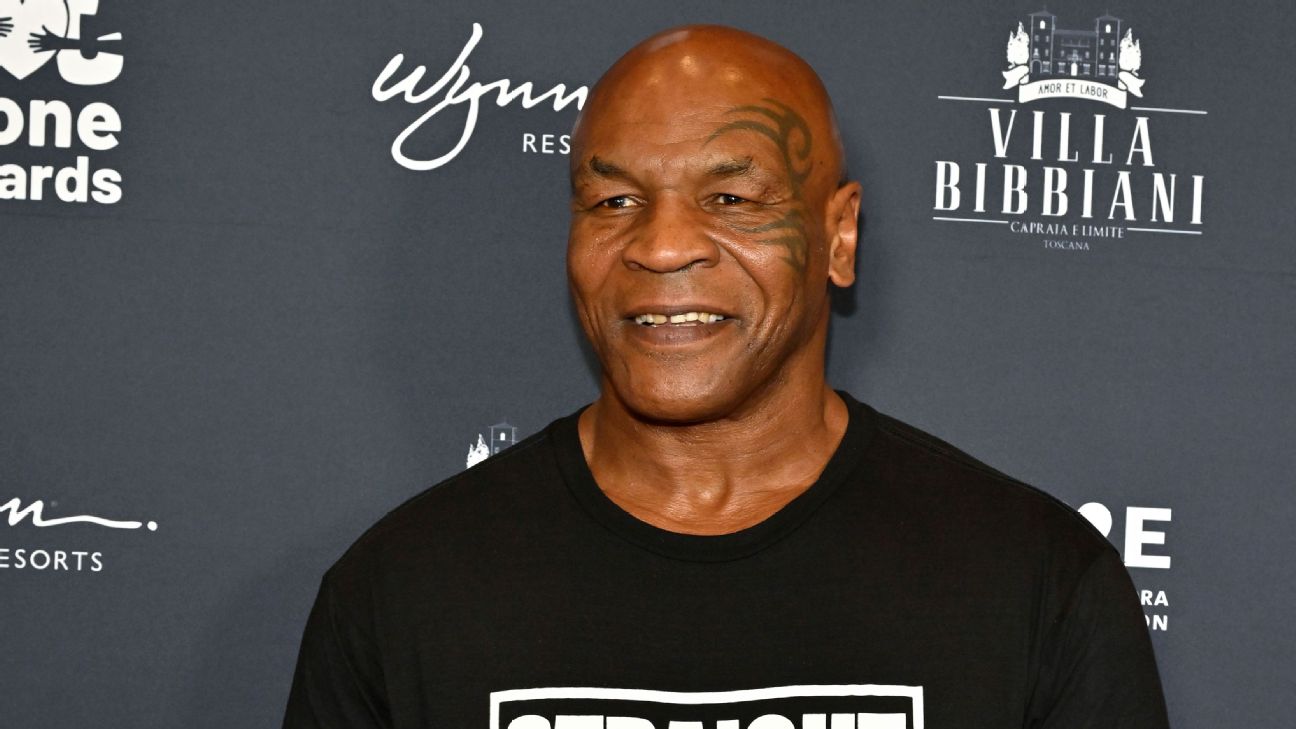
Mike Tyson stands as one of the most electrifying forces the sports world has ever witnessed—a man whose fists rewrote boxing history and whose name once echoed through arenas like thunder. The youngest heavyweight champion ever crowned, the phenomenon behind legendary nights like his 91-second demolition of Michael Spinks, Tyson wasn’t just a fighter; he was a spectacle, a storm, a once-in-a-century talent rising from the unforgiving streets of Brooklyn.
From a childhood buried under poverty, violence, and abandonment, he punched his way upward with a ferocity the world had never seen, transforming himself from a troubled kid with a lisp into a global icon feared by champions and adored by millions. But behind the roar of crowds lay a life carved by shadows, and today at 59, the man who once shocked the planet now faces a different battlefield: one filled with regrets, lingering traumas, fragile health, and the kind of pain that no opponent ever managed to knock out. His journey is not just a boxing story; it is a profound human tragedy followed by an even more profound, hard-won resurrection.

The Crucible of Brownsville: Where Fury Was Forged
It is heartbreaking how the world’s fiercest champions often rise from places that tried to break them long before the world ever knew their names. Mike Tyson entered this world on June 30th, 1966, in Brooklyn, born into a home splintered by absence. His biological father vanished early, and a brief stepfather left when Mike was only two. What remained was a weary mother, Lorna Tyson, fighting day and night to keep her children afloat as poverty and exhaustion pressed against her like an unending storm. They eventually landed in Brownsville, one of New York’s harshest neighborhoods, where even hope seemed reluctant to stay.
Inside their drafty apartment, young Mike learned what hunger, cold, and quiet humiliation felt like. His oversized glasses and soft lisp made him an easy target, pushed, mocked, and treated as if he were invisible. “People looked right through me,” he later said, remembering how shame settled into him long before confidence ever could. Loneliness wrapped around him so tightly it felt like a second skin.
His only gentleness came from above: pigeons, which he kept on the rooftop, building their coups from discarded planks and whispering secrets into their feathers. “They were the first things I ever loved,” he confessed. Then came the afternoon that shattered it all: a neighborhood boy seized Mike’s favorite pigeon and left the fragile creature lifeless on the ground. To others, it meant nothing; to Mike, it was everything. Heartbreak and humiliation surged through him, fracturing something deep inside. A fire awakened within him, forged not from anger alone, but from fear, pain, and the vow he carried for the rest of his life: he never wanted to feel powerless again.
That vow followed him into the streets. Trouble became familiar, leading to nearly 40 detentions by the time he was 13. A desperate, misguided act—snatching a woman’s purse—sent him to the Trion School for Boys in upstate New York. It was a colder, lonelier place. For nine long months, Mike sat closest to the door in the visitor’s room, hoping to see his mother. She never came.
The Prophecy and the Price of Iron
“And then within those bleak walls, fate finally intervened.” One afternoon, counselor and former boxer Bobby Stewart watched Mike hit a heavy bag with a raw power far beyond his age. Stewart saw the wounded fury and the desperate longing to be strong enough to survive. He introduced the 14-year-old Mike to Cus D’Amato, an aging trainer in the dim, dusty Catskill Boxing Club. After studying the boy in silence, Cus spoke the impossible: “I believe you can be the youngest heavyweight champion in the world.”
Those words hit Mike harder than any punch. Cus didn’t simply open his gym; he opened his home, becoming the father Mike had been denied since birth, making him his legal guardian. Under Cus’s care, Mike endured brutal training—4 a.m. runs through freezing mornings, 2,000 squats, 500 dips. Yet, in that pain, something extraordinary formed: a slow, fragile belief that he could become someone.
But every rise demands its sacrifice. In 1982, Mike’s mother, Lorna, passed away. Grief found him, and he cried not just because she was gone, but because she never got to witness the man he was becoming. With the loss of his biological mother and the guidance of Cus, Iron Mike was born in the furnace of that tiny Catskill gym.
Tyson stepped into the ring as a professional on March 6th, 1985, carrying a prophecy. He fought an almost inhuman schedule, winning his first 15 fights by knockout. On November 22nd, 1986, at only 20 years old, Tyson overwhelmed Trevor Berbick to seize the WBC heavyweight title, becoming the youngest heavyweight champion in history. By 21, winning a grueling 12-round battle against Tony Tucker, he became the undisputed heavyweight champion of the world, holding all three major belts. His career reached its zenith on June 27th, 1988, against Michael Spinks, where he earned a career-high $22 million purse and demolished Spinks in a stunning 91 seconds.
The Untethered Storm and the Cost of Lost Anchors
Even at the very top of the world, where the crowds roar loudest, shadows grow in silence. For Mike Tyson, that shadow began at age 19 when he lost Cus D’Amato in November 1985. Cus was the anchor who taught him discipline and emotional control. Three years later, his gentle, brilliant manager, Jimmy Jacobs, passed away. Tyson felt “the lights went out for the second time.” When his trainer Kevin Rooney was pushed from the team soon after, the last guardian of Cus’s principles disappeared.
Into that emptiness stepped Don King, glittering with promises and temptations that blurred Tyson’s sense of direction. “I was a kid with too much power and nobody to tell me no,” Tyson later reflected. His young marriage to actress Robin Givens collapsed publicly under emotional storms and scrutiny, culminating in a famous televised interview where Robin spoke about fear and emotional turmoil.

The loss of discipline led to the greatest upset in boxing history in 1990. Tyson entered Tokyo undertrained and unfocused, losing his undisputed title to Buster Douglas, a 42-to-1 underdog. In 1992, at age 25, his descent deepened when a conviction put him behind steel bars for three years. The cell door slamming shut sounded “like my whole life closing.” In prison, he was forced to confront the anger and success without purpose that defined his unguided life.
His return in 1995 lacked the spirit that once defined him, culminating in 1997 during the Holyfield rematch in the impulsive, shocking act of biting his opponent’s ear. The decline continued, leading to his final fight in 2005 against Kevin McBride, where Tyson whispered, “I don’t have it in my heart anymore.”
The fall was not only physical; it was financial. By 2003, despite earning an estimated $400 million, perhaps close to $700 million, Tyson filed for bankruptcy, buried under $23 million of debt. Extravagance drained his fortune: Bengal Tigers at $70,000 each, a gold bathtub, diamond watches, and massive entourages consuming money faster than fights earned it. “I trusted the wrong people and I didn’t trust myself enough to slow down,” he admitted.
The Deepest Scar and the Path to Peace
Some wounds in Mike Tyson’s life were never carved by fists; they were carved by love and fragile hope. The deepest, most shattering loss arrived after his financial ruin. Between 2003 and 2005, he was in a complicated relationship with Soul Zoitt, which produced their daughter, Exodus. “She made me gentle. I didn’t know I had that inside me,” Tyson said of her birth.
Then came May 26th, 2009, the day that split his life in two. Exodus, just four years old, became entangled in an exercise machine inside the home, an unimaginable accident. Tyson, in Las Vegas when the call found him, immediately flew to Phoenix, moving through the airport in a haze of dread. He arrived shortly after doctors delivered the news: Exodus was gone.
“Nothing prepares you for that. No pain on earth goes deeper. It changes you permanently.” This tragedy, his deepest wound, did not destroy him; instead, it forced him to confront his past with humility, to choose gentleness over chaos, and to finally understand the fragile responsibility of love. “Her memory made me want to live better, not harder, just better,” he said.
Rebuilding in Silence and the Wisdom of Age
Humbled and stripped of everything that once defined him, Tyson began a rebirth almost no one believed possible. He turned inward at age 40, choosing therapy, routine, and discipline. He returned to the principles Cus had whispered: “A fighter’s biggest battle is with himself.”
His resurgence began not in the ring, but on the stage, stepping onto Broadway in 2012 with Undisputed Truth. He spoke openly about loss, regret, and the emotional wounds success had never healed. Audiences saw a man courageous enough to confront his past without flinching. This honesty led to new horizons: film roles, business ventures, and his globally successful Hotboxin’ podcast. By the early 2020s, Tyson had rebuilt an estimated $25 to $30 million net worth—not through destruction, but through intentional reinvention and wisdom.
His anchor today is his family. He married Lakiha “Kiki” Spicer two weeks after Exodus’s passing in a quiet Las Vegas chapel, choosing to face the darkness as a pair. Their marriage, built not on perfection but on forgiveness and structure, remains the anchor of his stability. Their children, Milan and Morocco, are the heartbeat of his life. Tyson attends Milan’s tennis practices, leaning forward with quiet, unwavering pride.
Now at 59, Tyson stands in a chapter few could have predicted. The explosive force of his youth has been replaced by quiet resistance. He battles the truth of a body that demanded too much from the flesh that carried it. Sciatica flares, and his joints ache. In 2024, a violent gastric ulcer flare-up mid-flight served as a brutal reminder that time has its own power. His greatest victories now depend on protecting what he has left.
His home in Las Vegas is a serene, art-filled haven that reflects a man who values order over opulence, calm over chaos, and purpose over performance. His garage holds a carefully curated collection, no longer trophies of excess, but artifacts of a life rebuilt through intention.
Tyson rises early, meditates, stretches, and follows a training routine designed for longevity, not dominance. When asked if he still longed to fight, he smiled with a gentleness once unthinkable: “The toughest fight now,” he said, “is keeping this body strong enough to enjoy the life I rebuilt.”
His journey proves something rare and powerful: that a person can lose everything, fall to the lowest depths, and still return stronger, quieter, and wiser. Mike Tyson’s legacy is no longer defined by his knockouts, but by the courage to heal, to endure, and to choose love, discipline, and profound self-reflection over the endless noise of his own spectacular history.